PRODUCT TECHNOLOGY

Externally pasted liquid bit switches

Operating principle

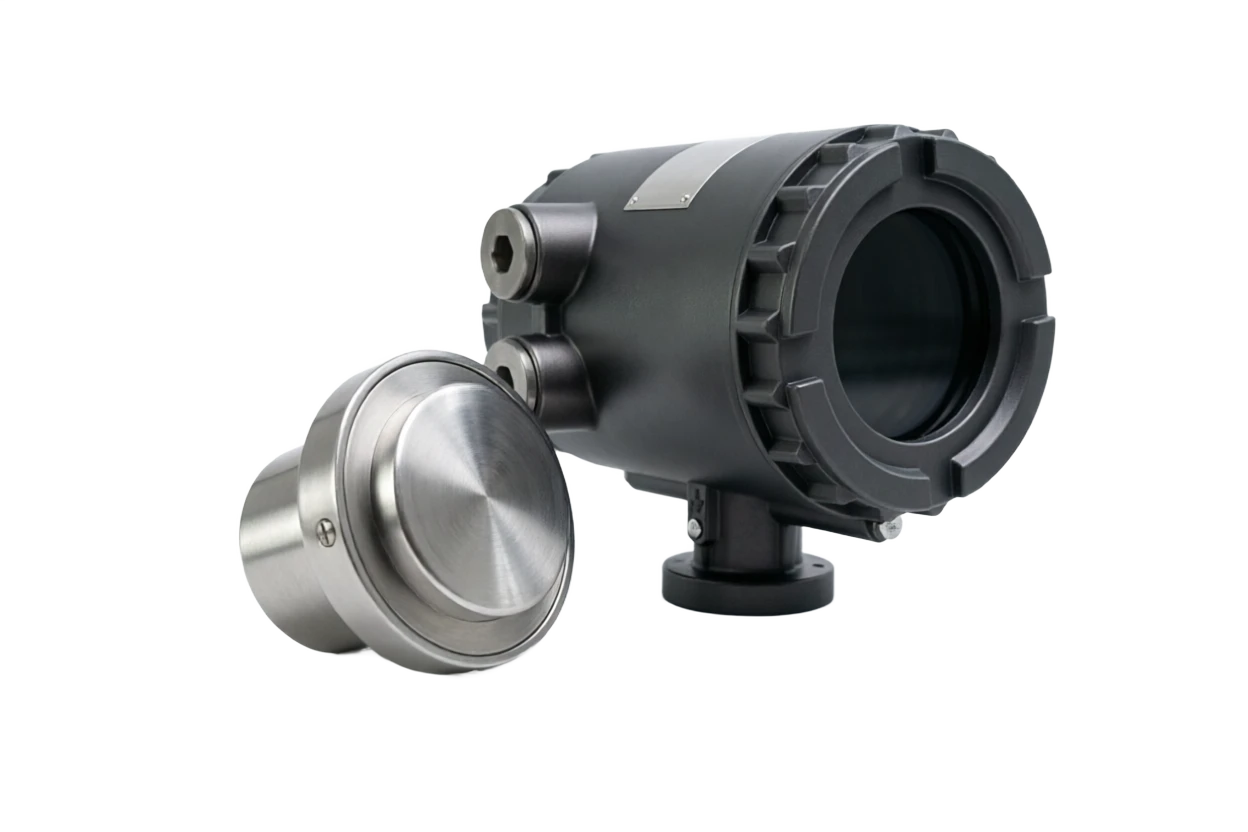
External fluid bit switches.

The principle of rebroadcast range determination, by detecting the rebroadcast range to distinguish between "liquid/insolvency" states, output switch signal: probe traverse coupling agent close to the jar wall - > discharge ultrasound pulse - > ultrasound through the jar wall into the inner air - > no liquid: sound waves reflect at the bottom of the tank, very weak/no echo (rebroadward echo) when liquid: liquid reflect strength, sharp rise in rebs in the perbate (insisting of missing PFVs) - detection path recognition margin difference - > trigger relay/crystal output. In order to prevent frequent switching due to surface fluctuations, the instrument contains demurrage (late bands): the "no-> fluid " exchange threshold differs from the "no-no-liquid" transition threshold, typically the difference being the difference between the 5 ~ 30 mm fluid position

  1. 01

    1 . Incentive pulse . CPU triggers voltage ceramics, exerts high pressure sharp pulses.

  2. 02

    2 • Pressure reverse effect • ceramic chip vibrations, launching 1 ~ 5 MHz HF ultrasound

  3. 03

    3 . Convergence wall . Convergence ..for the air inside the tank .

  4. 04

    4 • Interface Reflection • Air/liquid resistance is extremely low and liquid reflectivity is close to 100%

Externally-plug-in support for liquid bit switches

Provide survey missions, media and installation conditions and obtain product configuration advice.

Contact us
Externally-posted liquid bit switches Technical Note

TECHNOLOGY & APPLICATION

Understand the principles, the exact selection.

From measurement principles to field applications, the technical features and selection elements of the external drop-off switch are understood.

01

TECHNICAL GUIDE

Overview

(External-mounted Lever Switch, ELS) is a point-level liquid alert/control instrument that is completely non-contact tanks. Its sensor (ultrasound) is installed on the outer wall of the tank, and it sends pulses into the tank through ultrasound through the ejection wall. When the liquid surface rises/depositions to the fixed level, the instrument output switch signal (dry point/transistor/relay) is used for high-low-Line position alerts, pump start control, and lock protection.

Status of the industry

The external fluid bit switches represent the "non-contact" route in the liquid spot supplement table and together constitute the liquid spot alert instrument system with the external sticker fluid meter (continuous measurement), the magnetic float fluid switch (contact mode), and the acoustic fork (contact type). It has incorruptibility in the context of corrosive, flammable and explosive, sanitary levels, and in-service tank modification.

Document Purpose

The sensoring mechanism, mechanical and electrical structure, technological advantages and limitations, typical application scenarios, key parameter tables and spectrometers for the external fluid switch for system combo, provide instrument engineers with a ready-to-ground quick-check information.

02

MEASUREMENT PRINCIPLE

Operating principle

Based on voltage effects + ultrasound penetrators +

The principle of rebuff range determination, by detecting a "liquid/innovenous" state of the echo range, is to output switch signal: probe traverse coupling agent close to the jar wall - > launch ultrasound pulse - > ultrasound through the jar wall into the inner air - > liquid when no: sound echoes at the bottom of the jar, very weak/no echo (considered as a remote echo)

When is liquid

The liquid reflector is strong, the echo range is sharper at the probe (defaulting the disassembly vs deep end tank bottom) -> to detect the difference in circuit recognition -> triggers relay/transistor output.

2.1 Signal transmission 7-step path

2.2 Thresholds and demurrage characteristics

In order to prevent frequent switching caused by surface fluctuations, the instrument contained demurrage (late bands): the "no liquid -" has a liquid "toggle threshold is different from the "no liquid -" toggle threshold, typically the difference is the difference between the 5 ~ 30 mm fluid position.

External-

2.4 canned wall-based table

The ultrasound penetrating wall capacity is significantly affected by the mass and thickness of the canister, as shown below.

External-

The working principles . Steps / linksCross-reference
StepsLinkAnnotations
1Incentive pulse.CPU triggers voltage ceramics, exerts high pressure pulsation
2Voltage reverse effectsCeramic chip vibration, launch 1 ~ 5 MHz HF ultrasound
3Convergence through wallsCombination carries the air through the canister wall.
4Interface ReflectionAir/liquid resistance is extremely low, with a surface reflection of almost 100%
5RebroadcastThe ceramic chip receives the echo with a positive voltage effect.
6RangeCompared with liquid and insolent return range threshold
7Switch OutputDry point/transistor/relay action, alarm or pump control
Motion of work . Status / Reverse rangeCross-reference
StatusRebroadcast rangeContact Status
Normal, no fluid.Long end tank bottom weak echo, low range.- I'm in a lockdown.
Liquefied position to thresholdThe surface is back up. The range is up.Switch to frequent open.
The fluid drops back to the drop zone.Back to weak echo again.Restore to NC/C.
ModeOutputTypical applications
High-level, low-level alert.Close the dry link.Fire water tanks/chemical tanks High/low alarm
Pump out control.Relay SwitchPumps are out, spills are out, smoke is out.
Lock protectionSolid state switchesResponse plume/ boiler dry burn chain
The working principles . The canned wall mass / the thickness of the jarCross-reference
CannerysFitnessConcordantRemarks
Carbon steel/ stainless steel3 ~ 30 mmSilicon resin/epoxyMost common. Good shot.
Aluminium3 ~ 25 mmSiliconA slight decline, additional gain required
Titanium/Hallium alloys3 ~ 15 mmSpecially designed coupling agentHigh-value field, protected.
Glass steel (FRP)5 ~ 30 mmSiliconAvailable, thickness required
Plastics (PE/PP/PVC)≤ 50 mmSiliconIt's a lot worse. It's a high frequency.
Glass/Porcelain5 ~ 30 mmSiliconVisible light is visible, and needs to be evenly applied
Scratch.5 ~ 20 mmSiliconNeed special blast-proof type
Liner (rubber/PTFE)Base + liner ≤ 8 mmSiliconThe liner must be between the canal wall and the probe.
03

PRODUCT STRUCTURE

Product structure

From acoustic probes, electronic modules, switch output, human interface, shell5

Most of the composition, structured as follows (top-down)

External-

Shell/wire cavity

Material/forms: Aluminium alloy/ stainless steel/plastics. Primary function: Protection level IP65~IP68, carrying internal components

Status indicator

Material/form: LED Red/Green Double Main function: Show liquid/non-liquid state on site

Main circuit board

Material/form: MPU + signal reconciliations Main function: Generating incentives, echo detection, threshold determination, switch output

Porcelain chips.

Material/forms: PZT-5 HF main function: electrical and acoustic conversion, core sensitive elements

Match Layer

Material/form: epoxy + tungsten powder. Primary function: Acoustic resistance to matching and improved penetration

Spectrum front

Material/form: PVDF/PP/PTFE/Stainless steel. Primary function: Corrosion resistant, sealed, acoustic matching windows

Compositants/coupling layers

Material/forms: Silicon resin/epoxy/diverse glue. Primary function: Exclude the air between the probe and the canister and ensure ultrasound

Mounting bracket

Material/forms: Magnetic insulation/calories/ glue/claves Primary function: Tighten the probe to the jar wall (pressure ≥ 1 kg)

Switch Output

Material/form: Dry point/transistor/relay key function: output warning or control signal

Cable entrance.

Material/form: M20/1/2 "NPT/M12 interface main function: Power + Signal cable introduction, IP68 seal

Code

Component: Output type Materials/forms: contact parameters Main function: Typical application

OUT-R1

Component: Relay dry points (SPDT) Materials/forms: 250 VAC / 5A Main function: Direct drive pump, valve, sound light alert

OUT-R2

Component: Double-Slash Relay (DPDT) Materials/form: 250 VAC / 3A Primary function: Two-way independent control

OUT-T1

Component: NPN Tronogram Materials/Forms: DC 30V / 100 MAJOR : CHEC/DCS Number

OUT-T2

Component: PNP transistor material/form: DC 30V / 100 MA Primary function: PLC/DCS numeric volume

OUT-IO

Component: IO-Link Communications Materials/forms: Digital two-way communications Main function: Industry 4.0, Smart Sensors

OUT-W

Component: LoRa/NB-IOT Materials/Forms: Battery Power Supply Primary function: Remote monitoring without wiring

Code

Component: Fixed mode Materials/forms: Pressure requirement Main function: Application of tank type

FIX-M

Component: Magnetic insulation (in permagnetic) Materials/forms: Suction ≥ 30 kg Primary function: Iron Magnet tank top/side wall, temporary monitoring

FIX-C

Component: Cardium (metal belt) Materials/forms: tension ≥ 100 N Main function: Pipeline, side wall of a can

FIX-B

Component: bolt fixation Materials/forms: Twisted ≥ 5 N.m. Primary function: permanent installation, vibration

FIX-A

Component: epoxy glue bonding Materials/forms: solidification ≥ 24 h Primary function: plastic/glass/irregular surface

FIX-T

Component: Track/Stander Materials/Form: Welding/Kicking Primary function: Outdoor, River, Deep well

04

TECHNICAL GUIDE

Analysis of strengths and weaknesses

4.1 Main advantages

External-

4.1 Main advantages

The tank is completely unopened.

Note: Sensors are placed outside the cans without fire/ opening/cut-off modifications

Total non-exposure medium

Note: Non-corrosive, distilled, clogged, sanitary concerns, usable in strong acid alkali tanks

Install Easy

Note: Magnetic adhesive/glue/calcade can be fixed, debugging time ≤ 5 min

Price economy

Note: 1.5 ~3 times the acoustic fork/floating level, but saves open/cut-off costs

Wide application

Note: Water, acid, oil, slurry, liquefied gas are applicable, metal cans and plastic cans are available

No active widget

Note: Non-activated mechanical parts, MTBF usually > 100000 hours

But the threshold can be fixed on site

Note: Set a liquid-level alert point by key/infrared, without re-opening

Multi-output type

Note: Support dry points/NPN/PNAP/IO-Link/wireless

Battery Power Options

Note: Wireless battery power 5-10 years without requiring cable

On-site instructions.

Note: LED Red/Green Double Indicator Liquidity Status, clearly visible

#

Advantages: shortcomings

Cannery wall sensitivity

Note: Metal tank preference/plastic tank gain/verified thickness ≤ 30 mm

There's a barrier in the coating/blaze.

Note: Use of special couplings + increase gain/replacement of radar fluids on the switch

Strong foam/strength

Note: Change to a pitchfork/conductor radar/floating switch

Blind zone restrictions

Note: Distance between the location of the probe and the liquid position ≥ 5 cm

Multiple cans of installation interference

Note: Cant spacing 30 times/encumber

Ice/clubber effects

Note: Use of heat-pants/heating probes/increase

Effects of liquid density changes

Note: Adaptation algorithms/re-marking using thresholds

Vacuum/negative tank inappropriate

Note: Internal and external pressure differential > 50 kPa may lose wavelength, switch to floating/floating ball

05

APPLICATIONS

Application area

For situations where HLLI/Pump Start Control/Lock Protection is required, with particular emphasis on the inability/resatisfaction of tanks to open holes

The following are typical applications.

5.1 Applications not recommended

Not recommended 1

A large number of foam +-strung constant pressure tanks (e.g. beer fermenters, sugared pans) with severe loss of wave, should be replaced by a pitchfork/conductor radar/floating table switch.

Not recommended 2

For high vapour/high dust (e.g. steam boilers, coal powdered bunkers), the radio frequency conductor/single forklock switch should be used instead.

Not recommended 3

Vacuum/high-negative pressure tanks, acoustic vectors having a dispersion of the sound medium and possibly a dissipation of the inner and external pressure of the tank, should be replaced by differential pressure/floating/magnetic stretch switches.

Not recommended 4

Cannery walls are thick (>30mm) or mixed liners, with severe ultrasound decay and should be replaced by external radar-level fluid switches (applying metals, plastics, glass multiple walls)

Not recommended 5

At a high accuracy requirement (±1 mm level), the external drop-off switch is a switch volume rather than a continuous measurement and should be replaced by a radar bitometer/magnetic stretching fluid bitometer.

External-

Municipal water supply

Typical application: Fire wells/second water tank High LSD alert Reason for recommendation: in-service tank modification/waterproofing IP68

Water treatment

Typical application: sewage/regulating pool Spill/screeching space Recommended rationale: Price economy, cleanliness

Petroleum chemicals

Typical application: acid alkali tank/chemical tank HLSG Recommended rationale: PVDF/PTFE probe resistant to strong corrosiveness

Food and drink

Typical application: Juice/milk cans. Feed control. Recommended rationale: sanitary level, non-polluting medium.

Pharmaceuticals/biofermentation

Typical application: culture-based tank, high-low liquid ligation, recommended rationale: Sanitary + non-contaminated + CIP implosible

Agricultural irrigation

Typical application: reservoir/channel High LLD control Reason for recommendation: Solar+ Wireless Program mature

River level

Typical application: river/ reservoir/water drain alert recommended rationale: IP68 dive + mine protection

LPG/Liquefied Gases

Typical application: LPG/gas storage tanks HLAT alerts Recommended rationale: Ex d blast protection + total non-contact

Response

Typical application: Reaction plum/coiler Dry burn chain Recommended rationale: non-contact + remote diagnosis

Rehabilitation in service

Typical application: Adding fluid to the old tank alert. Recommended rationale: no need to stop the fire/most rapid installation

06

TECHNICAL SPECIFICATIONS

Technical Parameter Table

The following table summarizes the typical technical parameters of the industrial-grade external drop-off switch, for reference

Standard specifications for IFM, Siemens, Pepperl+Fuchs, Vega, Schneider, Jaming, etc.: External-

Technical Parameter Table # / Parameter ItemCross-reference
#Parameter ItemTypical specification
1Operating principleUltrasound through walls and back-up range
2Working frequency~ 5 MHz, high frequency segment is 1 measure higher than continuous measurement
3Compatible tank wall materialsCarbon steel/stainless steel/aluminium/ titanium/glass steel/plastic/glass
4Apply cannery thicknessMetal 3 ~ 30 mm / Plastic ≤ 50 mm
5The probes are temperature-resistant.40 ~+80 ℃ standard, -40 ~ +200 ℃ high temperature
6Electronic ambient temperature20 ~ +70 ℃
7Response time≤ 1 s Typical/modifiable 0.1 ~ 10 s
8Back to the compartment.5 ~ 30 mm liquid bit differential, adjustable
9Alarm Point SetupKeys/Infrared/IO-Link/HaRT by manufacturer
10Repeatability±1 mm wet / ±3 mm dry
11Media viscosity limit≤ 5000 cP High-frequency reimbursement for viscous media
12Media density limit≥ 0.7 g/ cm3 , the density of adaptation can be relaxed to 0.5
13Media temperature limit≤ +200 ℃ The probe is within the temperature range.
14Output MethodRelays SPDT/DPDT/NPN/PNAP/IO-Link/wireless
15Contact rating250 VAC / 5A Relay / DC 30V / 100 MA transistor
16Electricity voltage24 VDC Standard / 220 VAC with power type / battery 3.6 V wireless
17Work≤ 1 W Wireless / ≤ 0.05 W Wireless Static
18SignalsLED Red/Green Double, LSD+Fault Indicator
19Ingress protectionIP65/IP67/IP68 dive scenario
20Explosion protection markingEx iIC T6 / Ex d IIB T4 blast
21Body materialAluminium alloy cast/restainless steel 316L/plastic PBT
22Probe materialPVDF/PTFE/PP/Stainless steel 316L
23Cable entrance.M20x1.5 / 1/2 "NPT/M12 Waterproof interfaces
24AuthenticationCE/CCC/Blast/SIL 2/Measure Device Type Approval
07

SELECTION GUIDE

Select Table

The selection should be "canner mass-" output-"explosive-" installation-"

"Communication Protocol" five steps down, five subdivided spectrometers.

7.1 Select by wall mass and thickness of the tank

7.3 Select by application scene

External-

7.4 By blast and protective type

External-

Selective Table . Code / Cannery WallsCross-reference
CodeCannerysThickness RangeProbe typeTypical applications
WM-SCarbon steel/ stainless steel3 ~ 30 mmStandard DetectiveCommon metal tanks, general-purpose
WM-ALAluminium3 ~ 25 mmHigh frequency probeAluminium alloy tank tank vehicle
WM-TITitanium/Hallium alloys3 ~ 15 mmHF+deservationCoercion, high value field
WM-FRPGlass steel (FRP)5 ~ 30 mmMedium frequency probeChemical storage tanks/containers
WM-PLPlastics (PE/PP/PVC)≤ 50 mmLow frequency high penetrationPlastic water tank/barrel
WM-GLGlass/Porcelain5 ~ 30 mmHigh frequency probeGlass Reaction Blank/Pipe
WM-ENScratch.5 ~ 20 mmExplosive-proofCorrosive Reaction Blank
CodeOutputLoad capacityTypical applications
OUT-R1Relay SPDT single-slash250 VAC / 5 ADirectly drive pumps, valves, sound light alerts
OUT-R2Relay DPDT Double-Slash250 VAC / 3 ATwo-way independent control.
OUT-T1NPN Leak TransistorDC 30V / 100 mAPLC/DCS numeric volume
OUT-T2PNP Source TransistorDC 30V / 100 mAPLC/DCS numeric volume
OUT-IOIO-LinkDigital Double-DirectIndustry 4.0, Smart Sensors
OUT-WWireless LoRa/NB-IotBattery power supply 5-10 yearsRemote surveillance, no wires.
Selective Table . scene / Recommended SpectrumCross-reference
sceneRecommended probe.Recommended OutputRecommended installation
Fire water tank to alert the police.PVDF/StandardOUT-R1 RelayMagnetic inhalation/sicking
Watersheds to protect against spillsPP/Self-cleaningOUT-R1- Cut the crap.
The acid tank H.E.P.D.PTFE/HassleOUT-R1 + Ex dThe bolt.
LPG HLPstainless steel + Ex dOUT-T2 PNPbolt/Franc
Milk/juice input control316L HealthOUT-IO IO-Link- Cut the crap.
Reaction clear against dry burningHigh temperature + remoteOUT-T1 NPNDivision/Stand
Selective Table . scene / Recommended SpectrumCross-reference
sceneRecommended probe.Recommended OutputRecommended installation
River water level tele-alert.PVDF/IP68OUT-W WirelessStands/guides
Old cans.PVDF/magnetic suckingOUT-R1Magnetic inhalation/calories
I'm on a continuous basis.Not recommended, change to place-count--
Selective Table . Code / Explosive ModelCross-reference
CodeExplosion protection typeIngress protectionTypical applications
EX-NNo blast-proof (normal)IP65Airroom, outdoors, non-hazardous areas
EX-DEx d IIB T4IP67Chemical storage tanks (explosive gas environment)
EX-IEx iIC T6IP67/IP68Above the embers, flammable, explosive medium
WP-ANo blast + IP65IP65Installations indoors
WP-BNo blast + IP67IP67Outdoor, wet environment
WP-CNo blast + IP68IP68Dive installation, wells, long-term water inundation
WP-DNo blast + IP69KIP69KFood, pharmaceuticals, CIP flushing
CodeElectricityMountingApply scene
PWR-24D24 VDC wiredbolts/caloriesStandard industrial sites
PWR-220A220 VAC Powerdbolt/FrancOutside, no 24V
PWR-BATBattery 3.6 V power supplyMagnetic inhalation/caloriesRemote/temporary/wireless programmes
PWR-POEPower supply on bus (PoE)The rack.Remote control centre
FIX-MAG-Magnetic inhalation (never-magnetic)Iron Magnetic Can, Temporary Monitoring
FIX-CLAMP-Carcass (metal belt)Pipes, canisters, side walls.
FIX-BOLT-Snatch fixed.Permanent installation, vibrations
FIX-ADH-epoxy glue.Plastics/glass/unruly surfaces
08

SELECTION GUIDE

Selective guidance and trouble-checking

8.1 Nine-step selection process

External -- Summary

The external liquid slot switch is the preferred liquid spot alert in a tank that cannot/do not want to open holes, with a significant advantage in being completely uncontacted/equipment/combat friendly. The selection shall focus on four elements of the mass and thickness of the tank, its media compatibility, the mode of output, the manner of installation and require that the high vapour/high dust/high viscosity/vacuity tank/precision be upgraded to a pitchfork, float or radar fluid switch programme.

Selective guidance and troubleshooting . Step / TaskCross-reference
StepsTasksKey issues
1Clearly measure objectsLiquid/slurry/oil/alphate? Media density, viscosity, corrosivity?
2Determine tank parametersCanton wall mass, thickness, liner/painted? Can the tank open?
3Selecting the probe material7.1 WM-S/AL/TI/FRP/PL/GL/EN
4Select OutputPLC/DCS/Pumps/valves/tele-monitoring? Select OUT-R1 / T1 / T2 /IO/W by 7.2
5- Take the blast.Explosive gas/dust environment? Ex d / Ex ia
6Select protection.Indoor/outdoor/dive/high pressure flush? Press 7.4 Select WP-A/B/C/D
7Select InstallationMagnetic insulation/calories/ bolts/ glue? Press 7.5. Select FIX-MAG/CLAMP/BOLT/ADH
8Power selection24 VDC/220 VAC/Battery? Press 7.5 PWR-24D/220A/BAT/POE
9Order.Checking power supply, displaying language (Chinese), authentication (CE/CC/SIL), matching agent
#Attention
1Plugging: Silicon resin/epoxy glue between the probe and the can wall, excluding air
2Probe close: Installation pressure ≥ 1 kg, magnetic insorption ≥ 30 kg
3Avoid welding/strength strengthening: ultrasound interference with metal structure, suggested distance ≥ 50 mm
4Avoid liquid import/export: Flow zone is unstable, recommended distance ≥ 200 mm
5Avoiding sunlight: Sunshine heats the wall of the cans, causing a drift of the probe temperature, and suggests a shade mask
6Avoid decomposition: cans of condensed water will deflate signals and will increase temperature/heating
7Avoid multiple cans of interference: adjacent cans of space ⁇ probe diameter 30 times, or shielded
8First shift: one study in actual fluids, one study in empty cans, one study in liquids.
9Power stability: voltage fluctuations ≤ 5%, pressurers or barriers, if necessary
10Preserve maintenance space: ≥ 200 mm space around tanks to facilitate maintenance/replacement
Fault phenomenaPossible causeMeasures to address
Keep calling the police.Cannery content mismatch/coupled insufficientValidation of jar walls/coupling/re-college thresholds
I never called the police.Cannery wall too thick/probes dropped/power abnormalCheck the wall thickness/tight probe/screen the power source
Selective guidance and trouble-shooting • Fault phenomena / Possible causesCross-reference
Fault phenomenaPossible causeMeasures to address
Output Frequent SwitchesLiquid surface fluctuations/delays are too smallIncrease demurrage/filtration/reposition of liquids
High temperature environment lossSpectrum temperature drift/canner wall deformationHeat shield/cool/reform radar switches
The temperature is lost.Condensant condensation/canner wall iceTemperature couplings/heat/heat-up
Plastic cans lost.Cannery wall too thick/dryReduce frequency/gain/reform radar switches
Misreporting after fluid density changesThe echo range is affected by density.Adaptation/re-de-specify using thresholds
The fluid's lost its viscousness.Sticky medium absorbs ultrasoundInterpret fork/floating fluid switch
LED Light/No OutputPower failure/wire error/component damagePower/wire inspection/repatriation maintenance