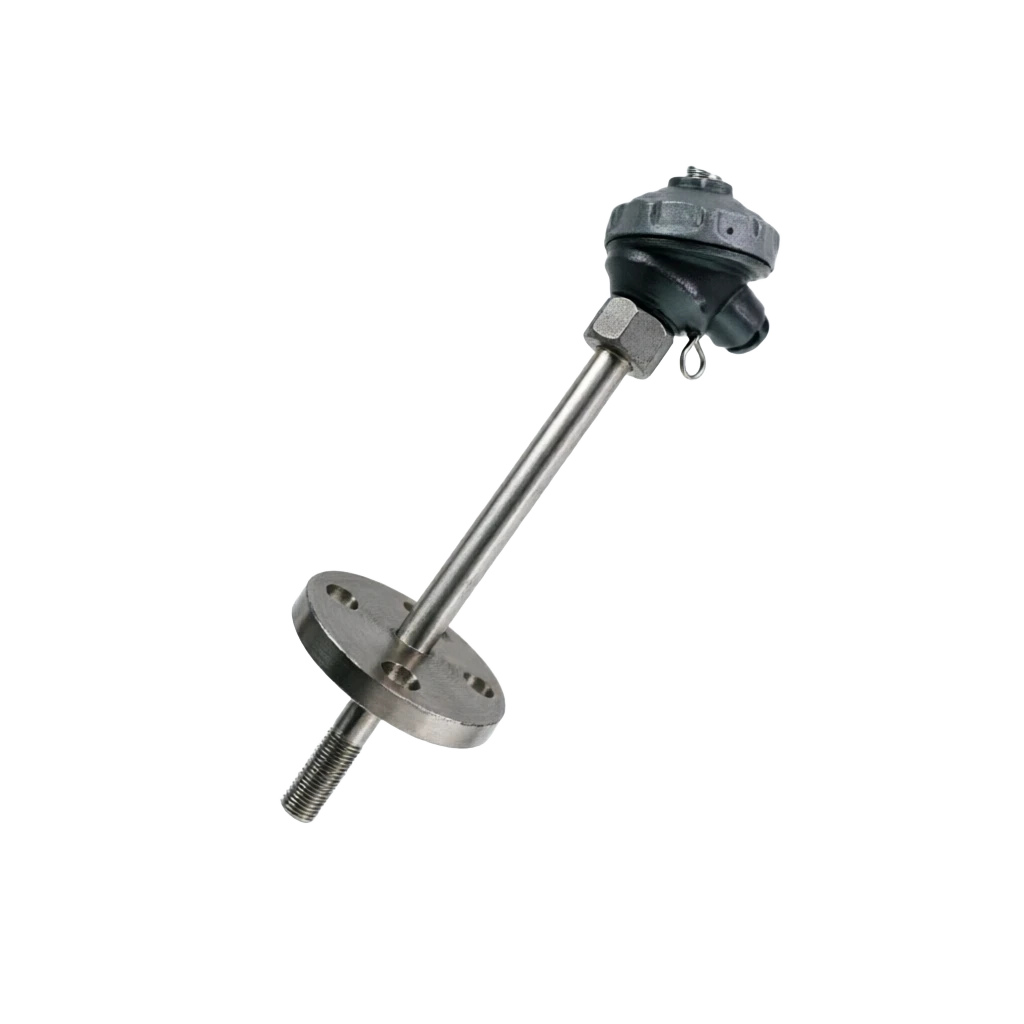
PRODUCT TECHNOLOGY

Heat resistance.

Operating principle

- The principle of the work.

The core temperature element is platinum electrical resistance (Pt100 or Pt1000). Platinum is a precious metal with very high stability, good corrosive and near linear temperature-resistance properties. Yes. 0 ~ 850℃ Within range, the resistance value of platinum resists follows the IEC. 60751 Standard: When t ≥ 0℃ Time: Rt = R0 × ( 1 + At + Bt² +Ct + Sq) of which R0 Yes. 0℃ The time is labelled as electrical resistance ( PT100 Time 100 A, B, C are constant coefficients, and A = the key is the protective structure and surface hardening. The typical grinding shield consists of the following components: (1) outer grinding layer: hard alloy (tungsten cobalt alloy YG6/YG8)

  1. 01

    9083×10³/℃,B = -5.775×10⁷/℃²。 The instrument converts temperature by measuring changes in end-to-end resistance values in conjunction with the above formula.

  2. 02

    Two-lined two-wire, one-on-one R, the other-on-the-not-reimbursed, all the wire-intrusion charges are included in the measurement error, short distance, low accuracy.

  3. 03

    Three-lined, one-on-one R1, one-on-one R2 (public end), three-quarter compensations for the faulty electrical resistance of the wire.

  4. 04

    Four-lined, two for currents, two for measuring voltage.

Hear resistant electrical resistance support

Provide survey missions, media and installation conditions and obtain product configuration advice.

Contact us
· Technical Note

TECHNOLOGY & APPLICATION

Understand the principles, the exact selection.

The technical characteristics and selection elements of the resistance to grinding thermal resistance are understood from measurement principles to field applications.

01

TECHNICAL GUIDE

Overview

(Abrasion-Reistant RTD) is an industrial temperature sensor designed for high wear and tear. It works on the principle of temperature-temperature linear properties of platinum thermal resistance, by using special alloys (Hasmine, Tungsten Alloy, Nickel Alloy, etc.)

Technical means such as surface hardening (carbon seepage, nitrogenification, laser melting), grinding coating (tungsten carbonation, ceramics, chromium oxide, titanium nitrogen oxide, etc.) are, while maintaining temperature accuracy, significantly increasing the useful life of the probes under harsh conditions such as particle brushing, wear and wear, and high temperature corrosion.

High-speed fluid temperature measurements containing high concentrations of solid particles, such as coal powder pipes, cement kiln chambers, waste incinerators, circulatory fluid boilers, coal-chemicals, metallurgy furnaces, sinterers, ore-powder pipelines, etc., are widely used. The hardness of the grinding shield can be up to HRC60-70 and the service life increased by more than 5-10 times compared to the normal assembly heat and electrical resistance, which is a key instrument for the response to wear and tear in the field of industrial temperature measurement.

Main features

Developmental progress

Thermal resistance to grinding is a specialized temperature gauge developed in industrial areas such as coal-fired power plants, fluidized bed boilers, cement kilns, etc. In the 80 era, domestic fire plants began to introduce grinding heat resistance from Europe and the United States and Japan; Since the 90 era, domestic producers have been conducting autonomous R & D and introducing a variety of specifications for grinding thermal resistance products, which are now fully domesticized and exported in large quantities to countries along the " one way " route.

Abrasion-ResistantRTDSummary

General description · Serial number / Main featuresCross-reference
Serial numberMain featuresBrief description
1Very high grinding.Hard alloy / ceramic coating, hard HRC60 ~ 70, longer 5 ~ 10 times longer
2High accuracy of measurementsBased on platinum resistance properties, class A ± (0.15 + 0.002 ⁇ t) °C, class B ± (0.3 + 0.005 ⁇ t) °C
3Broad range of measurementsTypical -200 ~ +850 ℃, usually ≤ 600 ℃
4- It's a mechanical shock.Multilayer complex protective condom structure, capable of particle flushing, instantaneous heat shocks
5Long-term stability is good.Platinum-retarded silk is very stable. Annual drift rate. ≤ 0.05 ℃.
6The options are rich.Multiple lengths, protective material, process connections optional, adapted to different installation requirements
7Smart integration optionsInline temperature adapter module, output 4-20 MA or Hart signal
02

MEASUREMENT PRINCIPLE

Operating principle

2.1 Pyramid electrical resistance to temperature

The core temperature element is platinum resistance (Pt100 or Pt1000). Pelican is a precious metal with high stability, good corrosive resistance and near linear temperature-resistance properties.

Measurement formulaClick to see the big picture
When t≥ 0°C: Rt = R0 x (1 + At + Bt2 + Ct + Sq)

0 ~ 850℃ Within range, the resistance value of platinum resistance follows the temperature of IEC. 60751 Standard: When t ≥ 0℃ Time: Rt = R0 × ( 1 + At + Bt² + Ct + Sq)

where R0 is nominally called 0℃ (100 times at PT100), A, B, C is constant, A =

  1. 01

    9083×10³/℃,B = -5.775×10⁷/℃²。 The instrument converts temperature by measuring changes in end-to-end resistance values in conjunction with the above formula.

2.2 Litigation and compensation for errors

2.3. Groundproofing principles

The key is to protect the structure and to harden the surface. The typical grinding shield consists of the following components: 1 ) outer grinding layer: use of rigid alloy (tungsten cobalt alloy) YG6 / YG8 high hardness materials such as chrome carbide, titanium carbide or aluminium ceramics, which can be as hard as possible HRA90 above, capable of absorbing high-speed particle wash-down;

(2) Middle Transitional Layer

(b) Thermal stress between the grinding layer and the inner metal shield is mitigated by nickel-based alloy (Halleign C276 / Inconel 600 / Monel 400) or titanium alloy;

(3) Inner metal protection

(b) A platinum-resisting temperature element made of 316 L SS or Inconel 600, which forms a gas-inciled structure;

(4) Wire segment

The waterproofing box (IP65/IP66/IP68) + shield cable is used to ensure the stability of signal transmission.

2.4 Workflow mapping

Abrasion-ResistantRTDSummaryAbrasion-ResistantRTDSummary

The working principles · The routing approach / StructureCross-reference
QuoteStructureCompensation for errorsTypical applications
Double-lineTwo strings, one to R, the other to public.No compensation, all wire blockages are included in the measurement error.Short distance, low precision
TrilinearThree strings, one to R1, one to R2 (public) and the third to compensate.Compensatory for the circuit blocker. Precision.Mainstream industrial site
Four-wireFour strings, two to provide currents, two to measure voltage.Complete elimination of wire resistance error, maximum accuracyLaboratory, high-precision
Motion of work . Step / ActionCross-reference
StepsActionsAnnotations
1Electrical resistance samplingMeasure the resistance value of platinum by wiring
2Signal reconciliationLinearization, filtering, wire-based electrical resistance compensation
3Temperature ConversionConversion of temperature using IEC 60751 formula
4OutputResisting signal / 4-20 MA / Hart / bus output
Motion of work . Step / ActionCross-reference
StepsActionsAnnotations
5Temperature DisplaySecondary / DCS / PLC Display / Alert
6Protection mechanisms(e) Overtook protection, fracturing self-diagnosis, Quantification)
03

PRODUCT STRUCTURE

Product structure

3.1 Complete structure

Composed of temperature elements (paralypium electrical resistance), grinding complex protective kits, wire boxes, lead lines, process connections, installation of accessories, etc. Typical structures are shown in the figure: from the temperature end to the end of the line, in descending order, the grinding cap (in contact with fluids), the intermediate transition layer, the inner metal shield, thermal element, insulation material, the wire box, cable head, the threading/Franc.

3.2 Hat types with grind tolerance

3.3 wiring and output

Abrasion-ResistantRTDSummaryAbrasion-ResistantRTDSummary

Temperature component (plyptunium resistance)

Main function: The temperature-to-temperature conversion core Typical material: Pt100 / Pt1000 pesium

Insulation material

Main function: Electrical insulation, support

Inner metal protective kit

Main function: Air-container protection, support structure Typical mass: 316L SS / Inconel 600

Transition level

Main function: Heat stress mitigation, corrosive resistance

A grinding hat.

Main function: Anti-particle flush core component Typical material: tungsten cobalt alloy / Chrome carbide / Aluminium oxide ceramics

Grid proof coating (optional)

Main function: Further increase in grindability Typical material: Cyclops / Chromium oxide / titanium nitrogen

Process connection

Main function: Connection to pipe / device installation Typical mass: screw / Frank / Weld / Cassette

Junction box

Main function: Connecting to compensatory conduits / shielding cables Typical material: aluminium alloy / engineering plastic / SS

Cable Header

Main function: Waterproof and dustproof material: M20 / 1 / 2 " NPT / M12 interface

Block cable

Main function: Signal transmission, resistance to interference

Temperature Transmitrator Module

Main function: Internal signal reconciliation module Typical material: 4-20 mA / Hart module

Blastproof shell

Main function: Detonation / This Ann is blastproof

Hat Type

Structure module: Structural characteristics Main function: hardness Typical material: typical application

Tungsten cobalt alloys

Structure module: Total hard alloy YG6/YG8, End cap 10-30 mm Main function: HRA 88 ~90 Typical materials: coal powder pipes, fluidized beds

Chromium carbide

Structure module: whole hard alloy, high strength, durable, good grinding. Main function: HRA 89~92 Typical material: power plant coal powder, high wear and tear

Aluminium oxide ceramics

Structure module: high pure aluminium oxide ceramics, insulated to high temperature, main function: HV 1500

Zincinnium oxide ceramics

Structure module: high-resilience ceramics, heat-resistant shocks. Main function: HV 1300

Silicon carbide ceramics

Structure module: high hard, resistant to corrosion: HV 2000 Typical material: strong erosion medium

Welding / Spraying

Structure module: Welding/ spray-resistant grinding on metal matrix. Main function: HRC 60~70 Typical material: generic grinding site, cost-sensitive

Direct electrically resistant output

Type of signal: Pt100 Resisting signal Characteristics: raw signal, with secondary instrument Application scenario: short distance, low cost location

A second-line system 4 - 20 mA

Type of signal: 4 - 20 mA Flowring Characteristics: Integrated Temperature Transducer, Anti-disturbation Strong Application scene: Industrial field mainstream, remote 1 km

Four-wire

Type of signal: Pt100 Resisting signal Characteristics: highest accuracy, no-thin error Application scenario: laboratory / measurement level

Hart Output

Signal type: 4-20 maA + Hart numeric characteristics: compatible simulation + digital communications application scenario: smart instrument, DCS integration

Field bus

Signal type: Profibus-PA / Foundation Fieldbus feature: full digital communication, remote diagnostic application scenario: large DCS / industrial 4.0 system

Wireless output

Signal type: Wireless Hart / LoRa feature: free-wire, suitable for retrofitting

04

TECHNICAL GUIDE

Analysis of strengths and weaknesses

4.2 Main shortcomings

Abrasion-ResistantRTDSummary

4.1 Main advantages

Very high grinding.

Note: Hard alloy / ceramic caps, hard HRC 60 ~ 70, life expectancy 5-10 times the normal heat resistance

High accuracy of measurements

Note: Based on platinum resistance properties, class A ± 0.15°C, class B ± 0.3°C; excellent long-term stability

Broad range of measurements

Note: 200 ~ + 850 °C full scale, covering most industrial temperature measurements

- It's a mechanical shock.

Note: Multilayer complex protective condom structure capable of high-speed particle flushing and instantaneous heat shocks

It's a high temperature corrosive.

Note: Haq alloy / Inconel protective rods for strong corrosive media such as sulphate, hydrochloric acid, hydroflonic acid

De-marked long-term stability

Note: Annual rate of platinum resistance drift ≤ 0.05 ℃, no site marking

Smart integration high

Note: Inline temperature adapters supporting 4-20 MA / Hart / bus output

Installation maintenance simple

Note: Secure structure, standard process connectivity, ease of installation and replacement

Explosive option

Note: Detonation / This Ant model can be used for FLA/ Dust scene

Disadvantages and use restrictions

Longer response time

Note: Multilayer complex protective condom structures make heat response time longer, and 0.5 is usually 30~120 s

Higher prices

Note: Hard-quality alloy / ceramic caps are expensive, 3-10 times the normal heat and electrical resistance

It's a lot of weight.

Note: Whole structure compact but metal-heavy, total weight 1~5 kg

Curved is restricted.

Note: The hardness of the grinding shield is high and cannot be bent on site; position and angle of installation is limited

Renovation difficulties

Note: Once the cap is worn or disabled, the overall replacement is required and maintenance costs are higher

Not applicable to ultra-subtractive medium

Note: Very fine particles (mime level) may still be exposed to the breach of the protective shield

Ceramic brittle risk

Note: Ceramic caps are resistant to mechanical shocks, need to avoid collisions in installation/transport

05

APPLICATIONS

Application area

It is widely used in industrial sites for high concentrations of solid particles washed or high-speed currents because of its very high grinding properties and measured accuracy

The common application areas are shown in the table below:

Typical application cases

(1) Temperature monitoring of coal powder pipes in power plants: installation of grinding thermal resistance on the walls of the powder, monitoring of the transport temperature of the powder (80 ~120 °C), use in coal powder concentration regulation and containment warning.

(2) Cement kiln smoke room temperature monitoring

Installation of rigid alloy caps on the side wall of the smoke room to resist thermal resistance, long-term monitoring of the temperature of combustion in the kiln (≤ 1100℃) and participation in the temperature control of the kiln.

(3) Fireplace Monitoring of Waste Incendiary Flow

Installation of ceramic caps in the pyrotechnics of the residual boiler to resist heat and electrical resistance, monitoring of the temperature of the smoke (150 ~250°C) and participation in the reconciliation of the efficiency of residual heat recovery.

(4) Circulation fluidized boiler bed temperature monitoring

Installation of grinding-resistant thermal resistance in the boiler ' s closed phase, monitoring of fluid bed temperature (850 ~ 950 °C), participation in combustion control and desulphurization of nitrous.

(5) Temperature monitoring of gas furnaces in coal-chemical plants

Installation of Haq alloys on the gas-created furnace wall to withstand thermal resistance, monitoring of the temperature of the gas-creature furnace, and participation in response control and load regulation.

Abrasion-ResistantRTDSummary

Electricity / Fire

Application scenario: coal powder pipe, wind pipe, flue temperature Typical media: coal powder, flue gas, wind powder mixture

Cement / Building Materials

Application scenario: rotary kiln smoke room, slurry cooler, coal powder pipe

Metal / Steel

Application scenario: furnace, sinterer, coal powder blowout

Chemical / Coal

Application scenario: Circulation fluidized bed, gasification furnaces Typical media: coal powder, catalyst, synthetic gas

Mines / Mining

Application scenario: mine powder pipelines, mill exports

Waste incineration

Application scene: fireplace, residual heat boiler Typical medium: smoke, fly ash, waste burning products

Biomass generation

Application scenario: biomass boiler, flue gas pipe Typical medium: biomass particles, flue gas, fly ash

Glass / ceramic

Application scenario: kiln flueque, refractory furnace Typical media: high temperature smoke, glass smelt

Paper / Pulp

Application scenario: Black liquid recovery boiler, power boiler Typical media: black liquid, flue gas, fly ash

Oil / Gas

Application scenario: Catalysing, Coal Powder Transmission Typical media: Catalyst particles, flue gas, gas

06

TECHNICAL SPECIFICATIONS

Technical Parameter Table

6.1 General parameters for the whole machine

Abrasion-ResistantRTDSummary

6.2 Accuracy and reliability parameters

6.3. Groundproof performance parameters

Abrasion-ResistantRTDSummary

Table of technical parameters · Parameters / Technical indicatorsCross-reference
ParametersTechnical indicatorsRemarks
Sensor typePt100(α=0.00385)/ Pt1000(α=0.00385)/ Cu50 / Cu100Based on field requirements
Temperature range200 ~ +850 ℃Rin-resistant specifications - 200 + 600 °C
Accuracy classLevel A ± (0.15+0.002 ⁇ ) °C; Level B ± (0.3+0.005 ⁇ ) °CIEC 60751 Standard
Sheath materialHAB Alloy C276 / Inconel 600 / 316L SS / titaniumSelect by Media
Hat materialtungsten cobalt alloy YG6/YG8 / Chrome Carbonized / titanium Carbonized / Aluminium Oxide CeramicBy the strength of wear
Hardness of the grinding layerHRC 60~70 / HRA 88~92Hard-quality alloy caps
Process connectionG1/2 / G1 / M27x2 / Frank DN25 ~ DAN100/ Welding / CarcassBased on installation requirements
Insertion depth100 ~ 3000 mmAs per live request
QuoteDouble-lined / Three-lined / Four-linedBy Precision
And the response time.30 ~ 120 sMulti-layer protective gear
Insulation resistance≥ 100 MΩ(500 VDC)Temperature measurements
Pressure resistance2500 VAC / 1 minTemperature measurements
Conservator diameterΦ16 / Φ20 / Φ22 / Φ25 / Φ30 mmMatch on a needs basis
Ingress protectionIP65 / IP66 / IP68By Model
Explosion protection markingEx d IIB T4 / Ex d IIC T6 / Ex iIC T6 (by model)—
Connect box materialAluminium alloy/ engineering plastics / SS / cast ironBased on field requirements
Cable seal.M20 / 1/2 "NPT/M12 / Waterproof interfacesPress the order.
Weight1 ~ 5 kgBy Specification
Output signalResisting signal / 4-20 maA / Hart / Profibus-PA / WirelessBy Configuration
Technical parameter table · Parameter / IndicatorCross-reference
ParametersIndicatorsTest Conditions
A-level precision±(0.15+0.002|t|)℃IEC 60751 Standard
B-Accuracy±(0.3+0.005|t|)℃IEC 60751 Standard
And the response time.30~120 sWater flow measurement
And the response time.90~300 sWater flow measurement
Insulation resistance≥ 100 MΩ500 VDC Temperature
Pressure resistance2500 VAC / 1 minTemperature and stress tests
Year stability≤ 0.05 ℃/year100°C timescale
Thermal circulation error≤ 0.1 ℃100 heat cycles
Vibration resistance5 g / 10~500 HzGB/T 2423
- It's a shock.30 g / 11 msGB/T 2423
EMC CompatibilityGB/T 17626Industrial-level electromagnetic compatibility
Grid-resistant levelHat materialHardnessTypical lifetimeSuitable operating conditions
Light wearWelding / SprayingHRC 55~606-12 monthsSmall particles
Medium wearChromium carbide / cobalt alloysHRA 85~8812-24 monthsCoal powder, low concentration particles
Heavy wearWhole hard alloy YG6/YG8HRA 88~9024~36 monthsHigh concentration of coal powder, ore powder
Extreme wearSilicon carbide / Silicon nitrocid ceramicsHV 1500+≥ 36 MonthsExtreme erosion.
High temperature and corruption.Aluminium oxide ceramics + Hax alloyHV 1500 / HRC 6024~36 monthsHigh temperature corrosive + wear
07

SELECTION GUIDE

Select Table

7.1 Naming rules

Selected examples

WR-P-A-YG8-0500-G1-T3-6-D-I indicates grinding thermal resistance, PT100 components, A-grade precision, YG8 cobalt caps, insertion depth 500 mm, G1 screw connection, temperature limit 600°C, IP66 protection, blastproof type, 4-20 MA output.

7.2 Summary of commonly used models

Abrasion-ResistantRTDSummary

Selective Table . Code Section / Code ExampleCross-reference
Code segmentExample:What's code for?
WR-WRRare-resistant RTD
- ShapeP/P1/CP PT100 / P1 PT1000 / C Cu50
- PrecisionA/BAA / BB
- Hat.YG6/YG8/Cr/TC/AL/ZRYG6/YG8 Cobalt / Cr Chr Carbide / TC titanium / AL Aluminium / ZR oxidation
- Insert depth0500Four digits, in mm = 500 mm
- ConnectionG1/G2/FG1/G2 screw / F Frank
- TemperatureT1/T3/T4T1 300℃ / T3 600℃ / T4 850℃
- Protection5/6/85 IP65 / 6 IP66 / 8 IP68
- Bomb protection.N/D/IN / D barlast / I Benan
- OutputR/I/HR / I 4-20mA / Hart
Selective Table . Model / HatCross-reference
ModelHatInsertion depthTemperature rangePressure rangeApplications
WR-P-YG6-0500YG6 Cobalt500 mm≤ 600℃≤ 10 MPaTemperature of coal powders in power plants
WR-P-YG8-1000YG8 Cobalt1000 mm≤ 600℃≤ 10 MPaCoal powder / Bottom of the fluidized bed
WR-P-Cr-0800Chromium carbide800 mm≤ 600℃≤ 10 MPaCement kiln smoke room temperature
WR-P-TC-0500titanium carbonated500 mm≤ 850℃≤ 10 MPaTemperature of the hot wind of the metal-heavy furnace
WR-P-AL-0500Aluminium oxide ceramics500 mm≤ 1100℃≤ 10 MPaTemperature of the smoke pipe in the waste incinerator
WR-P-ZR-0800Zincinnium oxide ceramics800 mm≤ 1100℃≤ 10 MPaIt's a heat-shock.
WR-P-SIC-0800Silicon carbide ceramics800 mm≤ 1300℃≤ 10 MPaIt's a hot spot.
WR-P1-Hart-0500Cobalt + Hart Output500 mm≤ 600℃≤ 10 MPaSmart DCS / Industrial 4.0 Integration
08

SELECTION GUIDE

Selection Guide

8.1 Basic steps for selection

8.2 Model job recommendations

8.3 Selective care

Abrasion-Restent RSummary (1) end-caps are key to the resistance to heat resistance and must be selected according to the mass particle hardness, flow speed, concentration combination: the particle hardness is high, the hard alloy or ceramics are hard; the particles are low, the welding coating is sufficient.

(2) In high-speed situations where the flow rate of the medium is greater than 10 m/s, it is recommended to install the "preset" (dependant towards fluids) and to increase the thickness of the cap (≥ 30 mm).

(3) When the temperature of the medium exceeds 850°C, the high temperature-resistant (corture cap) + dispersive structure is recommended; when the temperature exceeds 1100°C, the ceramic cap + Inconel 600 protective condom is required.

(4) In the event of strong corrosive (sulphates, hydrochloric acid, hydroflonic acid), the haze alloy C276 is required; common 316L stainless steel is less corrosive.

(5) The blast-proofing scene must confirm the blast-proofing certificate number and grade provided by the manufacturer, and the power supply / output parameters are strictly wired in accordance with blast-proof specifications.

(6) The ceramic caps are resistant to mechanical shocks and should be fitted in such a way as to avoid collisions; special protective condoms are recommended for purchase of spare parts.

(7) The depth of the insertion should be left in excess

Insert depth = the wall thickness of the container + the depth of penetration in the flow (recommended to reach 1/4 ~1/3 pipe diameter) to avoid the false temperature caused by piping ash.

(8) Cables shall be fitted with zinc plating steel or metal hoses to avoid co-opting with power cables; the use of shielding to compensate cables is recommended.

(9) Periodic inspection of the wear and tear of the caps is recommended for periodic verification every 6-12 months, with the replacement of the entire probe if necessary.

(10) Smart model (Hart / bus) suggests that liquid crystal display module space be set aside for daily viewing of temperature values and diagnostic information.

8.4 Summary

It is a key temperature instrument for industrial field response to high-mortar conditions and has been widely applied to key temperature measurement points in the fire-electric, cement, metallurgical, chemical, waste incineration and so forth, using such technical tools as hard-quality alloy/pormic caps, multilayer composite protective gear, platinum electrical resistance high-precision temperature measurements. The selection of the type requires a combination of the end cap and protective material, combining the particle hardness, flow speed, temperature, corrosive factors, and giving priority to the dominant brand model with a solid maturity and a rich application case to ensure long-term stability.

Selective guidance · Steps / ConcernsCross-reference
StepsElements of concernCommon Options
1Multipoint SelectionPT100 / PT1000 / Cu50 / Cu100 (system-based)
2Accuracy classA (±0.15℃) / B (±0.3℃)
3Temperature range200 ~ +850℃ (Scorted Specification ≤600℃)
4Hat materialCobalt alloy / Chrome Carbonized / Aluminium Oxygen / Silicon Carbonized
5Sheath material316L SS / Inconel 600 / Hapsy Alloy C276 / titanium
6Insertion depth100~3000 mm (by location on site)
7Process connectionscrew / Frank / Weld / Cassette
8QuoteDouble/ Trilinear / Four Lines (Accuracy Demand)
9Output signalBlock / 4-20 MA / Hart / bus
10Detonation/protectionDetonation / Bennan / IP65 / IP66 / IP68
Typical Work StatusRecommended ModelRationale
Temperature of coal powders in power plantsWR-P-YG6-0500Tungsten cobalt alloy caps for sprinting, A-grade precision, main system for the power distribution plant
Fluid boiler bed temperatureWR-P-YG8-1000Deep insert YG8 cap, A-grade precision, tolerance 600°C high temperature
Cement kiln smoke room temperatureWR-P-Cr-0800Carbonized chrome caps are resistant to high temperature, B-precision meets requirements
Frozen temperature of the waste incineratorWR-P-AL-0500Aluminium oxide ceramics are high temperature resistant, corrosive, 1100°C used for long periods
Temperature of the hot wind of the metal-heavy furnaceWR-P-TC-0500Tittium carbonated caps 850°C, anti-temperature particles flushed
Temperature of gas furnaces for coal-chemicalsWR-P1-Hart-0500 + Inconel 600Hawt alloys resistant to corrosion, Hart output intelligence integration
The boiler gives the temperature.WR-P-YG6-0300In light wear and tear, the value of the tungsten cap is high.
Boiler flue temperatureWR-P-AL-0800Ceramic caps are high-temperature smoke, A-grade precision.
Circulation fluid bed refruit temperatureWR-P-ZR-0800Xenon oxide ceramics resistant to heat shocks and resistance to frequent temperature fluctuations
High temperature corrosive and corrosive.WR-P-SIC-0800Extreme grinding of carbide silt, HV 2000 hard