PRODUCT TECHNOLOGY

Thermal detonating electrocution.

Operating principle

- Thermal bombproofing. - The work.

The core working principle of thermoelectric dolls is SeebeckEffect: connect the two different components of conductor A (or semiconductor) and B to a closed circuit, which produces heat power EAB when the temperature of the two points is different. Thermal power is proportional to the temperature difference at both ends and the direction is determined by the nature of the material. In industrial temperature measurements, one end (cold end/reference end) is usually kept at the known constant temperature (frequently 0°C ice water mixture, or compensated with electronic cool end) and the other (hot end/measurement end) is inserted into the detected medium. When temperature changes at the end are measured, thermal power changes and can be converted to measured temperature according to the national scale (IEC60584). 0°C, when changes in ambient temperature introduce measurement errors, cold end compensation is required. Common compensation

  1. 01

    1 . Measuring End Temperature . Thermal exposure is detected in the medium, and the Sebek effect produces a mV-grade heat voltage.

  2. 02

    2 Compensatory Guides Compensatory Guides extend thermal power to the cold end far from the hot zone

  3. 03

    3 • Cold-end compensation · Smart Transmitter Inline PN closed to measure cold-end temperature, automatic compensation

  4. 04

    4 . Linearization. Convert MV to temperature based on IEC 60584 scale

Support for the blast thermal voltage

Provide survey missions, media and installation conditions and obtain product configuration advice.

Contact us
- Technical note

TECHNOLOGY & APPLICATION

Understand the principles, the exact selection.

From measurement principles to field applications, the technical characteristics and selection features of the implosion thermome voltage are understood.

01

TECHNICAL GUIDE

Overview

(Explosion-Proof Thermocouple) is an industrial temperature sensor designed specifically for explosive hazard sites.

It works on the principles of thermal power of Sebek, and achieves temperature detection by measuring thermal power changes; The outer casings are "Explosive-proof" (Flameproof / Ex d) structures capable of withstand the explosive pressure of an internal explosive gas mixture and preventing internal explosive flames from spreading to the outer body of the shell, thus ensuring safe use in the flammable, explosive gas environment.

It started in the last century. 60 The demand for blast protection in the petrochemical industry in the past, with the IEC 60079 The series of international blast standards has been progressively developed. Currently, the widespread application of explosive thermal electro-mechanical (ESP) devices to industrial sites containing explosive gases or steam, such as oil, chemical, oil, gas, pharmaceuticals, coal mines, paints, solvents, fertilizers, is one of the preferred instruments for temperature monitoring at hazardous sites.

Main features

Developmental progress

Flameproof thermocouples evolved alongside flameproof electrical equipment. Europe and the United States began establishing industrial explosion-protection standards in the 1960s. IEC 60079 was issued in the 1970s. China introduced and adapted these standards in the 1980s and published the GB 3836 series in the 1990s. Chinese manufacturers now cover design, production, inspection and explosion-protection certification, and export these products.

Explosion-

General description · Serial number / Main featuresCross-reference
Serial numberMain featuresBrief description
1High securityThe blast casings withstand internal blast pressure, deter the discharge of the flames and ensure the safety of personnel on the ground
2High blast-proof.Ex d IIC T6 / T4, covering the highest-level gases of hydrogen, acetylene, carbon dioxide, etc.
3Temperature range wide200 ~+1800 ℃, optional for multiple fraction numbers such as K/E/J/T/S/B/N
4Respond fast.Thermal electromechanicals directly exposed to the medium, and 0.5, typical 0.5-10 s
5Strong structure.Metals shield + blastproof wire box, resistant to shock vibration, resistant to mechanical damage
6Multi-degree signK/E/J/T/S/B/N, etc., cover industries mostly at temperature measurement sites
7Remote TransmissionRemotely transmitted (reduced MV signal in 100 m)
02

MEASUREMENT PRINCIPLE

Operating principle

2.1 Thermal electrical effects of Sebek

The core working principle of thermoelectric dolls is SeebeckEffect: connect the two different components of conductor A (or semiconductor) and B to a closed circuit, which produces heat power EAB when the temperature of the two points is different. Thermal power is proportional to the temperature difference at both ends and the direction is determined by the nature of the material.

In industrial temperature measurements, one end (cold end/reference end) is usually kept at the known constant temperature (frequently 0°C ice water mixture, or compensated with electronic cool end) and the other (hot end/measurement end) is inserted into the detected medium. When temperature changes at the end are measured, thermal power changes and can be converted to measured temperature according to the national scale (IEC60584).

2.2 The cold-end compensation rationale

Thermal Pedestal Scale is based on a cold end of 0°C. The cold end cannot be maintained for long periods of time when actually used.

0℃ The following are common forms of compensation: 1 Ice bathing: immersion of cold end 0℃ (b) The highest accuracy but cumbersome maintenance in ice water mixtures;

(2) Compensation for Bridges Act

(b) The temperature of the cold end is measured by the PN condensing temperature sensor, which is built into the secondary instrument, and the heat power is automatically compensated;

(3) Compensatory Lines Method

(b) Use of a compensatory guide matching the thermoelectric pyrometrics to extend the cold end to a distance from the heat source, the environmental stabilization unit (e.g., the control room) and then to use electronic compensation;

The vast majority of the insulated thermoelectric dolls currently have intelligent temperature transporters (internal cold end compensation, A/D, linearization) to output 4-20 MA standard signals.

2.3. Detonation of blasts

The core idea for blast protection is "Enable internal explosions but prevent explosion transmission": (1) Dispersion shell: with high-strength aluminium alloy or casting steel, wall thickness meets the GB 3836.2 / IEC 60079-1 standard requirements, and can withstand

1.5 times the internal explosive pressure;

(2) Interruptible gap

The co-ordinated gap between the outer layers (sniffles, flanks, end covers, etc.) is strictly controlled below mm to ensure that the internal blast flames cannot be transmitted to the outer parts of the shell through the gap;

(3) Detonated face processing

All blast surfaces need to be refined to a hardness of up to 1.6 m below Ra and above HB 30;

(4) Cable introduction

(b) Use of implosive cable seals or filling letters to ensure that external explosive gases cannot enter through the cable entrance;

(5) Declaring and Warnings

The outer shell is clearly marked with "Ex d IIC T6" blast marks and "caps after power out" warning signs.

2.4 Workflow mapping

Explosion-Explosion-

Motion of work . Step / ActionCross-reference
StepsActionsAnnotations
1Measuring End TemperatureThermal exposure is detected in media, and the Sebek effect produces a mV-grade heat voltage.
2Compensatory guideCompensatory conduits extend heat power to cold end far from hot zone
Motion of work . Step / ActionCross-reference
StepsActionsAnnotations
3Cold junction compensationSmart Transmitters Internal PN closed to measure cold end temperature, automatic compensation
4LinearizationConvert mV to temperature values based on the IEC 60584 fraction table
5Signal output4-20 ma/ Hart/ bus output to DCS/ PLC
6Explosive-proof protection.The blast casing prevents internal blast spreading and ensures safety on site
7Temperature DisplayDCS / Secondary instrument displays temperature, alarm, record
03

PRODUCT STRUCTURE

Product structure

3.1 Complete structure

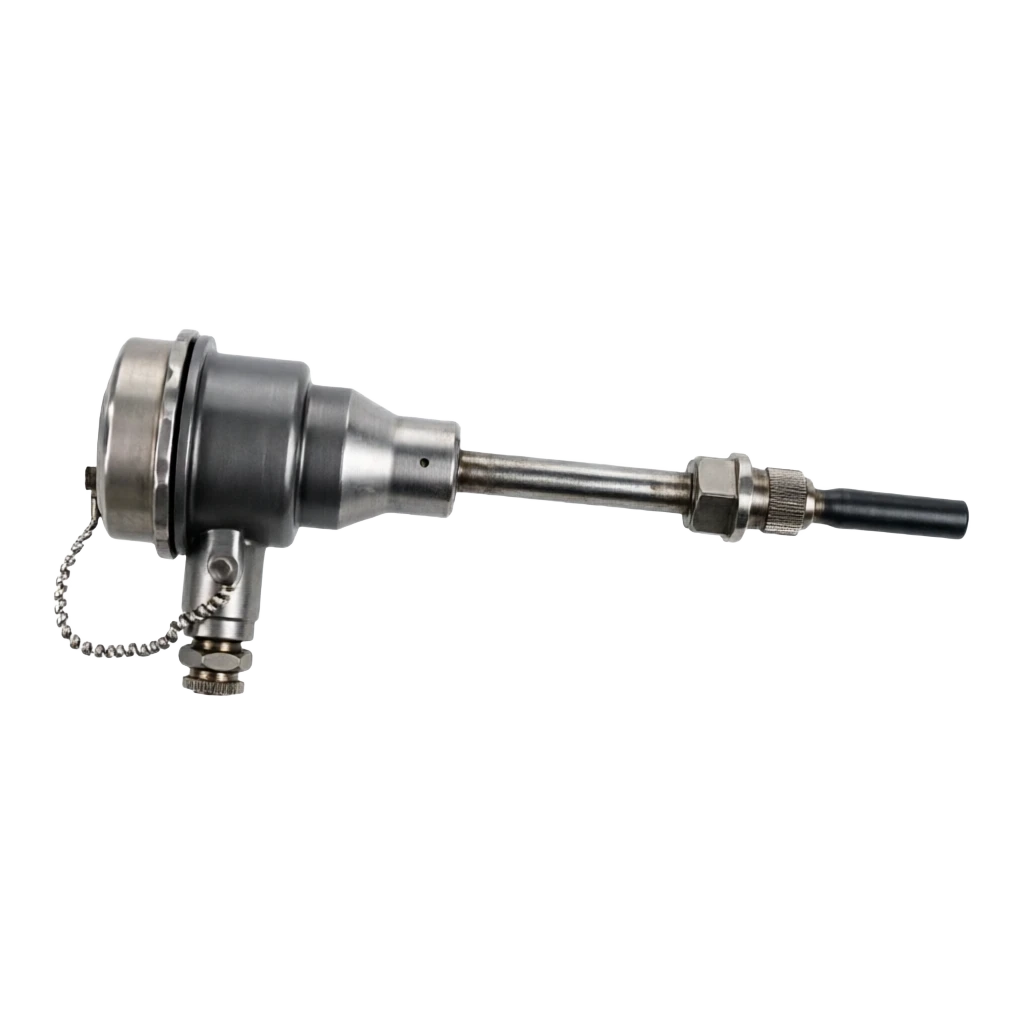
Composed of thermal electrodes (temperature detection), insulation materials, metal protections, blastproof wire boxes, blastproof cable seals, process connections, etc. From the measurement end to the end of the line, in descending order: the measurement end (hot)+ the insulation tube+ the metal shield+ the blastproof wire box+ the electrical interface+ the process connection.

3.2 Irregularity Contrast

3.3 wiring and output

Explosion-Explosion-

Thermal electrodes (even wires)

Main function: The Seckbeck effect produces thermal power

Measurement end (hot)

Main function: Direct exposure to detected media Typical material: Welding point, geometry / insulation type

Insulation material

Main function: Bipolar electrical insulation

Metals.

Main function: Air-container protection, support structure Typical mass: 316L SS / Inconel 600 / Hapsy Alloy

Junction box

Main function: Connecting compensatory conduits / Transmitters Typical material: Casting aluminium alloy / stainless steel / Engineering plastic

- The blast seal.

Main function: Cable introduces blastproof seals Typical material: implosion type fillings / Sealed interfaces

Connector End

Main function: Linking to the wire and external compensation guide

Temperature Transmitters (optional)

Main function: Cold end compensation + signal reconciliation Typical material: 4-20 MA / Hart module

Process connection

Main function: Connection to device / pipe installation

Deck / Warning

Main function: blast-proof signs, security alerts Typical material: stainless steel / aluminium alloy

Sensor type

Structure module: Ophthalmic material. Primary function: Temperature range. Typical material: precision.

Type K

Structure module: NiCr-NiSi Main function: 200~+1260°C Typical material: ±1.5°C or ±0.4%t Industrial most common, oxidizing atmosphere

Type E

Structure module: NiCr-CuNi Main function: 200 ~ +900℃ Typical mass: ±1.5℃ or ±0.4% t Medium low temperature, highest heat power

Type J

Structure module: Fe-CuNi Primary function: 40~+750°C Typical material: ±2.5°C or ±0.75%t Reverts the atmosphere to a favourable and inexpensive atmosphere

Type T

Structure module: Cu-CuNi Primary function: 200~+350°C Typical material: ±1°C or ±0.75%t High temperature accuracy

Type S

Structure module: Pt10Rh-Pt Primary function: 0~+1,600°C Typical material: ±1°C or ±0.4%t High temperature precision, precious metals

Type B

Structure module: Pt30Rh-Pt6Rh Primary function: +200~ + 1800°C Typical mass: ±1.5°C or ±0.5%t super-heat conditions

Type N

Structure module: NiCrSi-NiSi Primary function: 200~+1300°C Typical material: ±1.5°C or ±0.4%t Resisting from oxidation and high temperature corrosion

Type R

Structure module: Pt13Rh-Pt Primary function: 0~+1,600°C Typical material: ±1°C or ±0.4%t High temperature precision, precious metals

Direct MV Output

Type of signal: Thermal power MV signal Characteristics: original signal, with a special secondary instrument

A second-line system 4 - 20 mA

Type of signal: 4-20 MA Current loops Characteristics: Integrated Temperature Transmitters, Anti-Interruption Strong Application scene: Industrial site mainstream, remote 1 km

Hart Output

Signal type: 4-20 ma + Hart numeric characteristics: compatible simulation + digital communications application scenario: smart DCS integration, remote diagnosis

Field bus

Type of signal: Profibus-PA/ FF feature: full digital communication, two-way diagnosis Application scenario: large DCS / industry 4.0 system

Wireless output

Signal type: Wireless Hart / LoRa feature: free-wire, suitable for retrofitting

MODBUS RTU

Signal type: RS485 + MODBUS feature: Groupable network, multi-format and associated

04

TECHNICAL GUIDE

Analysis of strengths and weaknesses

4.2 Main shortcomings

Explosion-

4.1 Main advantages

High security

Description: The blast casing withstands internal blast pressure, deters the discharge of the flame and ensures the safety of personnel and equipment at the site

High blast-proof.

Note: Ex d IIC T6, covering the highest levels of explosive gases such as hydrogen, acetylene, carbon dioxide, etc.

The temperature is extremely wide.

Note: 200 ~ + 1800 °C fully overwrite, optional multiple fraction numbers such as K/E/J/T/S/B/N

Respond fast.

Note: Thermal direct contact medium, 0.5 typical 0.5-10 s

High accuracy of measurements

Note: K ± 1.5°C, S ± 1°C, precision B ± 1°C to reach

Strong structural sustainability.

Note: Metal protection + blastproof wire box, resistant to shock vibration, resistant to mechanical damage

Remote Transmission

Note: mV signal decay, with long-range transmissions above 100 m

Price spread

Note: General K price medium, S/B high accuracy of precious metal

Smart Integration

Note: Internal temperature adapter, output 4-20 MA / Hart / bus

Disadvantages and use restrictions

Need cold end compensation.

Note: Cool temperature changes introduce errors that must be compensated by compensating the bridge or the compensater guide

Needing a dedicated compensation lead

Note: Different degrees require a corresponding compensation guide, not mixed

High temperature drift

Note: Material changes in the metrolines used for chronic high temperatures require periodic validation/ replacement

Bigger.

Note: The blast-proofing box occupies space and is larger than the normal thermoelectric doll

Heavy

Note: found aluminium alloy wire box + metal shield, overall weight 1~5 kg

High installation requirements

Note: Strict requirements for blastproof surface installation and the need for specialized blast-proof electrical installation personnel

The opening is restricted.

Note: The lid is strictly off in electrical mode; maintenance must be maintained after power cuts and re-engineering

Higher prices

Note: Higher than the price of a normal thermoelectric doll 50% ~ 200%

Not for dust environment

Note: Dust protection requires an ex tD/ Ex t model

05

APPLICATIONS

Application area

Because of its high explosive safety, it is widely used in industrial sites where explosive gases or steam are dangerous.

Areas of use are shown in the table below.

Typical application cases

(1) Refinery Heat Monitoring: Installation of the K-type Insulation Thermal Puppet (Ex d IICT4) in the furnaces of the constant pressure-reducing device, monitoring of the chamber temperature (≤ 800℃), participation in combustion control and protection of the cavity of the furnace tubes.

(2) Chemical Response Pure Temperature Control

Installation of an E or K-type insulation thermoelectric doll, monitoring of reaction temperature (≤500℃), accompanying temperature transmitter output 4 - 20 mA to DCS, participating in automatic control of reaction temperature.

(3) Temperature monitoring of LNG storage tanks

Installation of the T-type cryo-detonated thermal voltage voltage (-200 ~ +350℃) at the top/floor of the LNG storage tank to monitor the temperature inside the tank and ensure safe operation of the tank at low temperatures.

(4) Temperature monitoring of wellheads in oil and gas fields

Installation of J-type or K-type insulation thermoelectric dolls in wellheads, monitoring of extraction fluid temperature (≤200℃) and participation in yield measurement.

(5) Response temperature control at pharmaceutical workshops

Installation of sanitary K-type insulation thermoelectric dolls (Ex d IICT6) on the material plant response sheet to monitor the response temperature to ensure accurate response control and GMP safety requirements.

Explosion-

Oil / petrochemical

Application scenario: Reaction plume, heater, distillation tower temperature Typical media: crude oil, gasoline, diesel, liquefied gas

Chemical / Coal

Application scenario: reactor, catalytic fission, gasification furnace Typical media: organic solvent, acid alkaline, synthetic gas

Gas / LNG

Application scenario: gas pipelines, LNG tanks Typical media: natural gas, LNG, LPG, CNG

Hydrocarbon exploration

Application scene: wellheads, separators, oil and gas treatment units Typical media: crude oil, accompanying anger, oil and water mixture

Pharmaceuticals/ Fine Chemicals

Application scenario: Reaction sheet, drying equipment Typical media: ethanol, acetone, organic solvent, feedstock

Painting / Painting

Application scenario: Reaction plume, storage tanks, paint jars, typical media: paint, organic solvent, diluent

Fertilizer / Pesticides

Application scenario: synthetic ammonia, urea, pesticide production Typical media: ammonia, urea, ammonium nitrate, organophosphorus

Gas / Focus

Application scenario: gas cabinets, coke stoves, electro-coated media: coke stoves, trans-fired gas, high-fired gas

Gas station / Gas tank

Application scenario: storage tanks, pipelines, gas tankers Typical media: gasoline, diesel, kerosene, oil

Coal/ Mine

Application scenario: gas extraction, blast-proof electrical equipment

06

TECHNICAL SPECIFICATIONS

Technical Parameter Table

6.1 General parameters for the whole machine

Explosion-

6.2 Accuracy and reliability parameters

6.3 Application of the working conditions parameters

Explosion-

Table of technical parameters · Parameters / Technical indicatorsCross-reference
ParametersTechnical indicatorsRemarks
Sensor typeK/ E/ J / T / S / B / N / R (selected according to field needs)—
Temperature range200 ~ + 1800 °C (in fractional)K:-200~+1260℃;S:0~ +1600℃;B:+200~+18 00℃
Accuracy classI ± 1.5°C or ± 0.4%t; II ± 2.5°C or ± 0.75%tIEC 60584 Standard
Thermal power.Microvolt MV signal, converted to temperature by fraction table—
And the response time.0.5 ~ 10 s (Flow speed by protective diameter/ medium)—
Insulation resistance≥ 100 MΩ(500 VDC)Temperature measurements
Pressure resistance2500 VAC / 1 min (at constant temperature)—
Sheath material316L SS / Inconel 600 / Hapsy Alloy C / titaniumPress Media
Protect the diameter of the shieldΦ3 / Φ4.5 / Φ6 / Φ8 / Φ10 / Φ12 / Φ16 mmAs per live request
Insertion depth100 ~ 3000 mmAs per live request
Process connectionG1/2 / G1 / M27x2 / Frank NN25 / DN50 / calcium / WeldingPress the scene.
Connect box materialArgument alloy (standard)/ stainless steel (optional)/ engineering plasticsBy blast-proof level.
Explosion protection markingEx d IIB T4 / Ex d IIC T6 / Ex d IIC Gb (by model)—
Explosive protection standardGB 3836.1 / GB 3836.2 / IEC 60079-0 / IEC 60079-1—
Blast clearanceIssued by State-accredited blast inspection bodiesAs ordered
Ingress protectionIP54 / IP65 / IP66By Model
Ambient temperature40 ~ + 70 °C (working temperature of the carrier)—
Compensatory guideReimbursable guide matching the fraction number must be used—
Cable seal.Detonation type filler / blastproof sealed interfacePress the scene.
Weight1 ~ 5 kg (by specification)—
Technical parameter table · Parameter / IndicatorCross-reference
ParametersIndicatorsTest Conditions
I-Specific± 1.5°C or ± 0.4%tIEC 60584 Standard
Level II precision± 2.5°C or ± 0.75%tIEC 60584 Standard
And the response time.0.5~10 sWater flow measurement
And the response time.2~30 sWater flow measurement
Insulation resistance≥ 100 MΩ500 VDC Temperature
Pressure resistance2500 VAC / 1 minTemperature and stress tests
Cold end compensation error≤ ±0.5℃Temperature of the environment 0~50°C
Long-term stability≤ ±0.1% t/ monthFull-range drift rate
Vibration resistance5 g / 10~500 HzGB/T 2423
- It's a shock.30 g / 11 msGB/T 2423
EMC CompatibilityGB/T 17626Industrial-level electromagnetic compatibility
MTBF≥ 50000 hoursAverage no-facilities time
Technical parameter table · Worktype / Typical temperatureCross-reference
Status TypeTypical temperatureExplosive gasThe bomb-proof recommendation.
Refinery units≤ 800℃Petrol, diesel vapourEx d IIC T4 / T6
Chemical reactor≤ 500℃ethanol, acetoneEx d IIC T4 / T6
LNG storage tank200~+50℃Methane (IIC)Ex d IIC T6
Gas pipelines≤ 200℃Methane (IIC)Ex d IIC T4 / T6
Gas/ Gas tank≤ 200℃Gasoline steamEx d IIB T4
Pharmaceutical response≤ 300℃ethanol, organic solventsEx d IIC T4 / T6
Gas cabinet≤ 200℃Coal-fired gas (IIB)Ex d IIB T4
Fertilizers≤ 500℃Ammonium (IIA)Ex d IIA T4
07

SELECTION GUIDE

Select Table

7.1 Naming rules

Selected examples

EX-TC-K-I-0500-G1-L-D6-6-I-A indicates the explosive thermoelectric doll, K-type fraction, I-level precision, penetration depth 500 mm, G1 screwdriver connection, 316L protective condom, Ex d IIC T6 blast protection, IP66 protection, 4-20 MA output, aluminium alloy wire box.

7.2 Summary of commonly used models

Explosion-

Selective Table . Code Section / Code ExampleCross-reference
Code segmentExample:What's code for?
EX-TC-EX-TCExplosion-proof Thermocouple
- The fractional.K/E/J/T/S/B/NK Nickel Chromium-Silon/ E Nickel Chromium-Cronic Nickel / S ⁇ 10-Platinum
- PrecisionI/III I I/ II II
- Insert depth0500Four digits, in mm = 500 mm
- ConnectionG1/G2/FG1/G2 screw / F Frank
- A protective kit.L/H/TL 316L / H Haps Alloy / T titanium
- Bomb protection.D4/D6D4 Ex d IIB T4 / D6 Ex d IIC T6
- Protection5/65 IP65 / 6 IP66
- OutputR/I/HR mV / I 4-20mA / H Hart
- The switchboard.A/SA aluminium alloy / S stainless steel
Selecting Table . Model / SemimetryCross-reference
ModelSensor typeInsertion depthExplosion protection markingOutputApplications
EX-TC-K-0500K500 mmEx d IIC T64-20mARefinery response, chemical plants
EX-TC-K-1000K1000 mmEx d IIC T4HartHeating stoves, heating chamberes.
EX-TC-E-0500E500 mmEx d IIC T64-20mAMedium-temperature, pharmaceutical response
EX-TC-J-0500J500 mmEx d IIB T44-20mARevert atmosphere, gas refueller / gas tank
EX-TC-T-0800T800 mmEx d IIC T6HartLNG / LPG Low Temperature Tank
EX-TC-S-1000S1000 mmEx d IIC T6HartHigh temperature precision measurements
EX-TC-B-1000B1000 mmEx d IIC T4HartSuper-heat precision measurements
EX-TC-N-0500N500 mmEx d IIC T64-20mAIt's a high temperature corrosive event.
EX-TC-K-IP66K500 mmEx d IIC T6HartOutside, wet, corruption-proof
08

SELECTION GUIDE

Selection Guide

8.1 Basic steps for selection

8.2 Model job recommendations

8.3 Selective care

Explosion-(1) explosive gas group shall be strictly selected according to the standard GB 3836 / IEC 60079: Hydrogen / acetylene / Disulphide Carbon as IIC group, and Ex d IIC T6.

(2) Temperature group T1 ~T6 determined by the temperature of self-burning of the medium

T6 highest (≤ 85℃); T4 medium (≤ 135℃); T1 ~ T3 lower.

(3) Compensation guides must be used that are strictly corresponding to the fractional numbers, otherwise greater measurement errors (K-type KX compensation guides) will be introduced.

(4) Thermal implosion electrocution must be installed in units with the pay for blast-proofing and must be constructed at the GB 50058/IEC 60079-14 standard.

(5) Adequate installation space should be reserved for the site

The length of the direct tube segment ≥ 10 x pipe diameter; insert depth = packaging diameter 1 / 3 ~ 1 / 2.

(6) When the medium temperature is higher than 1000°C, the preferred type of S/R/B precious metals is recommended; and the Inconel 600 protective shield is used to withstand high temperatures.

(7) Periodically check whether the blast shield has been damaged or corrosively damaged, and the damage must immediately be replaced with the entire surface and the blast shield cannot be repaired on site.

(8) The opening of the wiring box covers in electrically available conditions is strictly forbidden; maintenance must be without electricity and wait 10 minutes before the opening of the lid.

(9) Cables shall be fitted with zinc plating steel or blast-resistant taps to avoid co-opting with power cables; the use of shielding is recommended to compensate cables.

(10) Ex tD / Ex t Pyrotechnic implosion thermoelectrics of dust, not replaced by gas-resistant explosive models.

8.4 Summary

It is a key blast-proof instrument in the field of temperature measurement in industrial hazardous sites and has been widely applied to the explosive gas environment in the petroleum, chemical, gas, pharmaceutical and other industries, using technical means such as the containment shell, thermal power effect of Sébéké, multi-dimensional dimensions, and the integration of intelligent transmitters. The selection needs to be combined with the explosive grouping of the medium, temperature grouping, temperature range, precision demand, protective material, etc., and to strictly adhere to the GB 3836/IEC 60079 series of blast protection standards to ensure long-term safety.

Selective guidance · Steps / ConcernsCross-reference
StepsElements of concernCommon Options
1Multipoint SelectionK/ E/ J/ T/ S/ B/ N (Category/ Atmospheric)
2Accuracy classI (±1.5℃)/ II (±2.5℃)
3Temperature range200 ~ + 1800°C (selected by fraction)
4Explosion protection markingEx d IIB T4 / Ex d IIC T6 (grouped by gas)
5Sheath material316 L SS / Inconel 600 / Haps alloy / titanium
6Insertion depth100~3000 mm (by container/ pipe)
7Process connectionscrew / Frank / Weld / Cassette
8Output FormmV / 4-20 maA / Hart / bus
9Ingress protectionIP65 / IP66 (by field environment)
10Connect box materialAluminium alloy / stainless steel (by environmental corrosivity)
Typical Work StatusRecommended ModelRationale
Refining oil heating furnace chamber temperatureEX-TC-K-1000-HartK-type temperature range over 800°C, Hart output intelligence integration
Chemical Reaction Pure TemperatureEX-TC-K-0500-4-20mAK Generic, 4-20mA Remote DCS System
LNG Storage Tank Temperature MonitoringEX-TC-T-0800-HartT-type for low temperature - 200 + 350°C, Hart output intelligence diagnosis
Control of pharmaceutical reaction temperatureEX-TC-E-0500-4-20mAE. High heat power, high accuracy, sanitary polishing
High temperature precision measurementsEX-TC-S-1000-HartS-precious metal, precision ± 1°C for calibration and precision temperature measurement
Gas/ Gas tankEX-TC-J-0500-4-20mAJ-type cheap, medium-low temperature precision, IB.
Fertilizers synthetic ammonia unitsEX-TC-K-0800-4-20mAammonia is a IIA group, which is met by normal Ex d IIB T4
Gas pipelinesEX-TC-K-0500-HartMethane belongs to IIC Group, which must Ex d IIC T6
High temperature corrosive eventEX-TC-N-0500-Inconel 600N-type antioxidation resistant to corrosion, Inconel 600 protective shield resistant to high temperature
It's a wet outdoors.EX-TC-K-IP66 - stainless steel wire boxIP66 Protection + stainless steel wire box resistant to corrosion