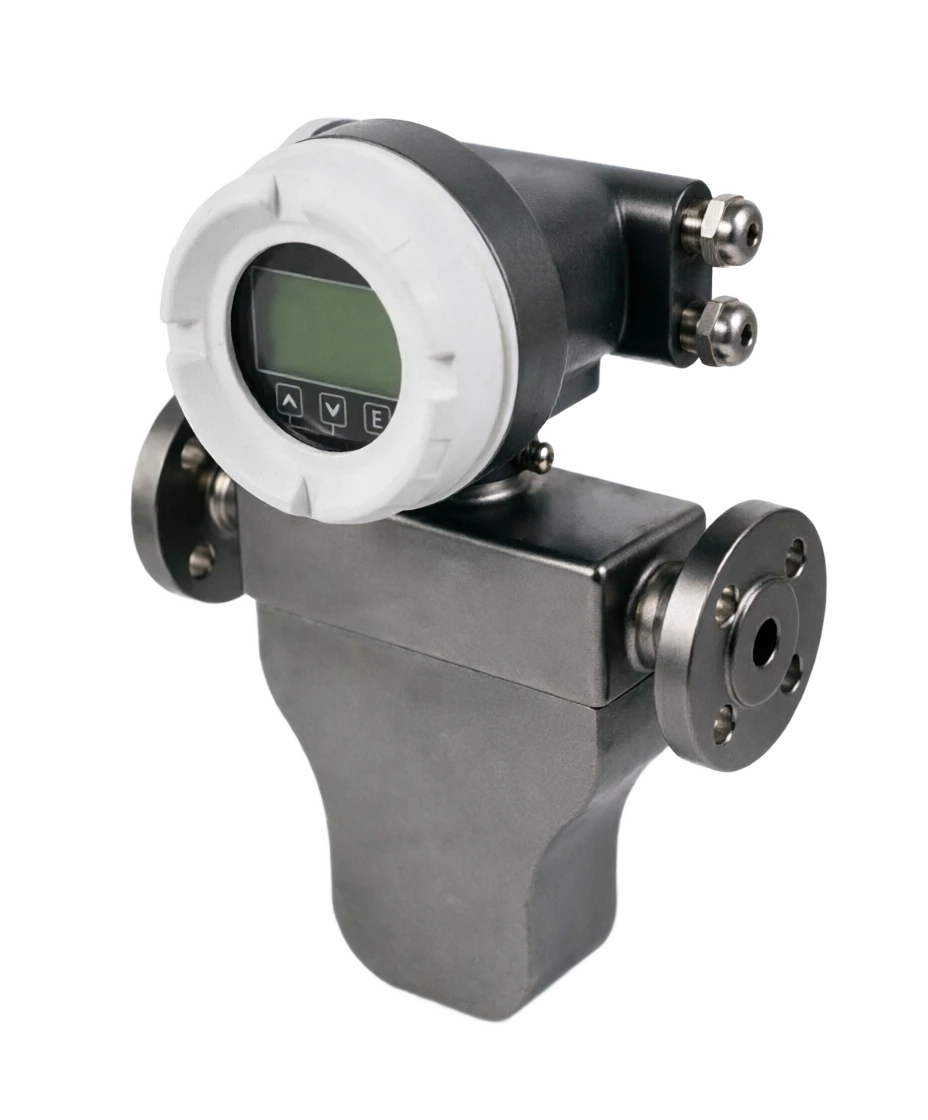
PRODUCT TECHNOLOGY

Mass flowmeter

Operating principle

Quality flow meters .

In industrial contexts, it is commonly referred to as the Coriolis Mass Flowmeter, CMF, a CPV, a instrument for directly measuring fluid mass flows using the Corioli effect. It does not require temperature, pressure compensation, and the measurements are not influenced by variations in the medium properties, representing the highest level of accuracy (trade settlement level) for flow measurements. Note: Thermal gas mass flow meter is also a "direct" mass flow meter, but only for the medium and medium-precision gases, which is presented separately in this series of " Thermal gas mass flow meter " ; This paper focuses on the corioli formula common to liquids/gases. When the fluid is in a rotating reference system while it moves in a straight line, it produces a corioli that is proportional to mass flow: F = 2 m.

  1. 01

    Fluids flow in vibrating tubes and interact with the direction of the tube wall;

  2. 02

    The side fluids of the entrance are accelerated by the vibrating tube, the side of the exit is slowed and the opposite direction produces the corioli;

  3. 03

    (a) The interaction of forces distorts (reversible) the measurement tube;

  4. 04

    (a) The distortion (i.e. the phase difference of the two end detection coil signals, or the time difference, ⁇ t) is proportional to the mass flow;

Quality flow metering support

Provide survey missions, media and installation conditions and obtain product configuration advice.

Contact us
Quality flow meters . Technical notes

TECHNOLOGY & APPLICATION

Understand the principles, the exact selection.

From measurement principles to field applications, the technical characteristics and selection elements of the mass flow meter are understood.

01

MEASUREMENT PRINCIPLE

Measurement principle

In industrial contexts, it is commonly referred to as the Coriolis Mass Flowmeter, CMF, a CPV, a instrument for directly measuring fluid mass flows using the Corioli effect. It does not require temperature, pressure compensation, and the measurements are not influenced by variations in the medium properties, representing the highest level of accuracy (trade settlement level) for flow measurements.

Notes

Thermal gas mass flow meter is also a "direct" mass flowometer, but only for the medium and medium gases, which is presented separately in this series of Thermomatic Gas mass flow meters; the Corioli formula is used in this paper for focus liquids/gas.

1.1 Corioli doctrine

Measurement formulaClick to see the big picture
F = 2·m′·(v × ω)
c

When the fluid is in a rotating reference system while moving in a straight line, it produces a corioli that is proportional to mass flow: F = 2 m' (v x ⁇ )

c of which m'is mass flow, v is fluid flow vector, and ⁇ is rotation angle speed vector.

The actual instrument is not really spinning, but instead of vibrating.

The measuring tube keeps vibrations at the inherent frequency of the drive-circle.

The cyclical "rotational system" is equivalent to micrometres.

  1. 01

    Fluids flow in vibrating tubes and interact with the direction of the tube wall;

  2. 02

    The side fluids of the entrance are accelerated by the vibrating tube, the side of the exit is slowed and the opposite direction produces the corioli;

  3. 03

    (a) The interaction of forces distorts (reversible) the measurement tube;

  4. 04

    (a) The distortion (i.e. the phase difference of the two end detection coil signals, or the time difference, ⁇ t) is proportional to the mass flow;

  5. 05

    Transmitr detects phase differentials and converts them to mass flow output

    q = K. ⁇ t (K-marked coefficients, related to measuring tube structure and materials)m

1.2 The rationale for density measurements (source of the first table multi-parameter)

Measurement of the mass of the tube medium participating in the vibration system and changing its equivalent vibration frequency

(b) The greater the medium density, the lower the vibration frequency;

Vibration frequency to reverse fluid density (precision to be achieved) ±0.002 g/cm³);

Q = q / old;

(b) Temperature compensation in vm combined with temperature sensors (Pt100);

The solution can also be measured by concentrations (solve content) derived from density.

1.3 Summary of key characteristics

Measurement principles . Characteristics / DescriptionCross-reference
FeatureAnnotations
Direct mass measurementNot affected by temperature, pressure, density, viscosity, composition change
No direct liner requirementInsensitive to current flow speed distribution, easy to install
Multiparameter SynchronizationMass flow, volume flow, density, temperature, concentration
No obstacleUnruptible flow in the measuring tube, inactive parts (with a small vibration)
02

PRODUCT STRUCTURE

Structure

2.1 Two core components

Transmitters and sensors can be integrated (in situ direct reading) or in a split (distant installation, high temperature/dangerous setting).

2.2 Measurement tube form (core design with decisive trade-offs)

Single Vs Double

The dual-barrel structure is more self-balancing for external vibrations; single-barrel no-switchers, no-pent angles, and better suited to sanitary and high-coagination settings.

2.3 Materials and connectivity

Measurement tube material

304, 316 L (general), Hapsy Alloy C, titanium (corrosive condition) can be customised in consultation;

Shell

stainless steel, protection against IP67;

Connection

(a) Francs (GB/T series, DIN/ANSI custom), screws, card-shythms;

Fireproof.

Ex iIC T4, Ex d IIC T4.

2.4 Example of model spectrometry

Take the example of QTTF.

Series F (DN6 ~ 80, ~200 ~ 350°C), Series V (DN15 ~ 200, large calibre), Series D (DN1 ~ 10, microflow), Series K (DN6 ~ 50). Main international brands (Eiman Micro Motion, E+H, Cologne, etc.) are divided by sensor shapes (e.g. Delta tube, Promass series). Common domestic codes SLD, CMF, LZM, QTCMF, etc.

Applicable standards

GB/T 20728 (Measuring fluid mass flow by corioli flow); control protocol JJG 1038 (Corioli mass flow count).

Sensors

Composition: Shunter (shunting), Measurement tube (sensitive tube), Driven wire, Detection of the coil (one by one), Temperature Sensor (Pt100), Crust function: Perception flow, density and conversion to telecommunications

Transmitters

Composition: Power, Driver, Test, Quantification, DSP Operations, Showing, etc. Circuit Module Functions: Signal Conversion, Operation, Display and Output

U shape (brush)

Structure: Single/Biple U-shaped tubes Characteristics: strong signal (high reversal volume), classic; slightly more pressured, easily stoked

Double U-shaped/ Double-barrel

Structure: Two tubes symmetrical vibrations. Characteristics: each offsets the external vibration interference, the mainstream structure

Straight (single-direction)

Structure: A direct tube Characteristics: smallest pressure, easy to clear, healthy; weak signal, sensitive to external vibration

Sub-form / S / Triangle

Structure: Various types of bending variant Characteristics: balancing signal strength with structure

Micro-wow/Choose

Structure: Small curvature bends. Characteristics: Small caliber high accuracy

03

TECHNICAL GUIDE

Advantages and disadvantages

3.1 Advantages

Direct measurement of mass flow - no temperature compensation

(a) Not affected by changes in the medium properties (temperature/pressure/density/ stickyness/assembly) and is a real direct mass flow instrument;

The highest accuracy in the family - plant-standarded precision of 0.05% ~ 0.1%

On-site 0.15% ~0.2% (liquid); gas 0.5% ~1.0%; repeatability ±0.05%, trade settlement level;

Multi-parameter Synchronization - A table simultaneously output mass flow, volume flow, density, temperature

(b) The availability of derivative concentrations and the savings of several instrument investments;

A very wide range - General 20

1 and partial models as high as 100:1 or 500:1;

No direct-dip requirements - insensitive to flow speed distribution

No flow and straight-pipe segments are required and the location of the installation is flexible;

Product features

(b) Medium adaptive wide-scale - high viscosity liquids, solid slurry liquids, trace gases liquids, medium pressure gases; measured values are not sensitive to viscosity;

No moving parts, no hindrances - uncommitted flow in measuring tubes

Low pressure (over-the-pipe) and low wear risk, with longer-term stability better than turbine/volume;

Rapid response — sensitive to fluid flow and suitable for bulk control and ratio;

Health level capabilities - 316 L/Haps Alloy + No Dead Point Design to meet GMP;

Smart function - Self-inspection, multiple alarms, HART/RS485 bus

Digital signal processing (DSP) reduces the amount of drifting during temperature.

3.2 Disadvantages and limitations

Use limits

(a) High prices - initial investments are much higher than electromagnetic, vortex, differential (about 3-5 times the heat, 5-10 times the normal turtex) and the cost of large calibres rises sharply;

Use limits

(a) The length of the main tube is limited - more than DN200~DN300, which is usually replaced by alternative principles + compensation schemes due to the difficulties of promoting volume, weight and cost;

Use limits

(b) Sensitivity to external vibration - a strong vibration environment (by the repump, compressor) can interfere with measuring tube vibration, requiring good installation of the base, tremor cushions, or even abandonment of the selection;

Zero drift - long run zero drift

Zero changes are required periodically; additional errors are caused by the piping stress (strewn, heat swelling);

Use limits

(b) Two-stream measurement of gaseous fluids is limited - measurement errors for liquids with higher gas content (buffs above a certain percentage) are significantly increased and the type of slurry containing solids is carefully selected;

Non-negligible (brush) - U-shaped, etc., bend structure is more damaged than the direct tube

(b) High viscosity media are more visible;

(a) Need for full tube measurements - the measuring tube must be filled with media and not be used for disgruntled tube/portal pipe;

Use limits

(b) The low/high temperature end depends on materials - extreme temperatures (−200°C deep cold, 350°C high temperature) require special materials and structures, which are costly;

Use limits

Pressure effect - the pressure of the high pressure measure tube will cause the movement of the calibration factor (part of the high end model is compensated for by static pressure);

Maintenance requires specialized — specialized knowledge in the setting and marking of the carrier parameters; high costs of damage maintenance.

04

APPLICATIONS

Application area

4.1 Typical application scenarios

4.2 Selective positioning judgement

By accuracy and medium needs

Only volume flow, clean liquids, low cost electromagnetic/turbo/turb street;

Conventional gas monitoring, compensation-free, value-for-money heat gas mass flow metrics;

(b) Large diameter (>DN300) master measurement differential pressure + temperature pressure compensation;

Applications

Direct mass flow, trade settlement/high accuracy ratio/multiparameter (density/concentration) Côte d ' Ivoire mass flow meter is required;

Strong vibrating environment and cannot be isolated

Petroleum chemicals

Typical uses: Trade in crude oil/finished oil measurability, precise measurement of high-value media such as ethylene acetene DN15 ~ 150 French, 0.15% Level

Chemical Matching

Typical use: Multi-assembly feeder ratio by mass, reaction feed control (volume control) Recommended configuration: double-barrel U + HART bus

Food medicine

Typical uses: high viscosity formulations such as syrup/egg fluids, sterile fillings, concentration monitoring 316 L Health card straight tube type

Energy gas

Typical uses: natural gas/liquete gas trade settlement, energy measurement, recommended configuration: high pressure (≤40MPa) + 0.5% class

Painting/ink

Typical use: high viscosity fluid measurement

Environmentally sound water treatment

Typical uses: sludge input control, pharmaceutical concentration + flow synchronized monitoring, recommended configuration: plasma liquid type + concentration derived

Semiconductor/special

Typical use: high purity argon/helium precision measurements Recommended configuration: D series microflow type

Liquid gases

Typical uses: LPG, LUM, REM (Gassable media) Recommended configuration: high pressure anti-gasification structure

05

TECHNICAL SPECIFICATIONS

Technical Parameter Table

5.1 Table of general parameters

Notes

The accuracy of the series is 0.1%/0.2% liquid, 0.5% gas, 1:20 scale scale.

5.3 Precision scale

Technical parameter table · Parameter / SpecificationCross-reference
ParametersSpecifications
Media testedLiquids (containing high viscosity, plasma, trace gas), medium-pressure gases
Calvary rangeDN1~DN200 (mainstream DN3~DN150; selected brand to DN250/300)
Measuring itemsMass flow, volume flow, density, temperature (associable concentration)
Mass flow accuracyLiquid: 0.05% ~0.2% R; Gas: 0.5% ~1.0% R
Repeatability±0.05%
Turndown ratio1:20 (General) ~1:100 (Way-Stand) ~1:500 (Part of)
Density measure range0.2~2.5 g/cm³
Density measurement error±0.002 g/cm³
Temperature measurement error≤1℃
Process medium temperature−196 ~+250℃ (General); Special Model −200 ~ +350℃
Operating pressure0~10MPa (general); high pressure type to 40MPa (PN42)
Measurement tube material304, 316L (General); Haq Alloy C, titanium (or customised)
Output signal4~20mA, pulse 0~2000Hz, RS485, HART (optional)
Power supply24VDC (outside)
Explosion protection markingEx iIC T4 / Ex d IIC T4
Ingress protectionIP67
ConnectionFrancs (GB/T, DIN/ANSI custom), screws, sanitary cards
Installation requirementsNo direct-pipe requirement; full-pipe requirements; avoiding piping stress and strong vibration
Implementation/approval criteriaGB/T 20728; Checkout Protocol JJG 1038
SeriescaliberTemperature rangePressurePositioning
F SeriesDN6~DN80−200~350℃0~10MPaGeneric
V SeriesDN15~DN200−200~300℃0~10MPaLarge caliber type
Series DDN1~DN10−40~350℃0~10MPaMicro-flow type
K SeriesDN6~DN50−200~350℃0~10MPaTight
Technical parameter table · Level / Liquid precisionCross-reference
LevelLiquid precisionGas accuracyTypical applications
Trade settlement level0.05%~0.15%R0.5%RCrude oil/gas interface measurement
Industrial precision0.2%R0.5%~1.0%RMatch control, reaction material
General monitoring level0.5%R1.0%RGeneral process monitoring
06

SELECTION GUIDE

Select Table

6.1 List of parameters required for ordering

  1. 01

    (a) The name, density, viscosity, gas content/condensation of the detected medium (decision tube type and material);

  2. 02

    (a) The mass flow range (minimal/normal/maximum) versus the volume-scale demand;

  3. 03

    Work pressure, medium temperature, ambient temperature;

  4. 04

    (a) Pipeline caliber and connection standards (Franc/snack/carp);

  5. 05

    Precision requirements (trade settlement 0.15%/ control 0.2%/ monitoring 0.5%);

  6. 06

    Need for density, concentration measurement function;

  7. 07

    (a) Output signal form (4~20mA / pulse / bus) and display demand (one/bunch);

  8. 08

    (a) blast-proofing, protection-level;

  9. 09

    Installation of environmental vibrations (requirement of shock mitigation measures);

  10. 10

    Health requirements (GMP, electric polishing, no dead corner).

6.2 Table of the selection of the measurement tube form

6.4 Output and Functional Configuration Table

6.5 ELEMENTS FOR USE OF EQUIPMENT

  1. 01

    (b) Pyrometric measurements - measuring the tube down (liquid) or up (gas/mulp fluids to be empty) at the time of horizontal installation to ensure full tube filling;

  2. 02

    Avoid pipe stress - no force-matching, flanc bolts are secured and soft connections are provided when necessary;

  3. 03

    (a) A distance from a powerful vibration source - to repump, to apply support and tremors near compressors;

  4. 04

    Zero - Zero points are marked when the shipment is in full pipe, stop (valves broken); zero points are regularly repeated;

  5. 05

    (b) Diverse dichotomy of the gaseous fluid - the gaseous media (LPG, liquid ammonia) are maintained with sufficient back pressure to prevent flashing;

  6. 06

    (b) Control of flow speeds in the plasma fluids and protection against erosion of measuring tubes;

  7. 07

    (b) High viscosity media for pressure loss accounting;

  8. 08

    (a) Be determined by the rigorous catalogue cycle (JJG 1038, mandatory in trade settlements);

  9. 09

    Long-term decommissioning before deployment, with zero points and insulation checked;

  10. 10

    The carrier parameters (quantitative range, small signal removal, blockage) are adjusted to the condition of the work to avoid trade settlement errors.

Selective Table . Work / Recommended TubeCross-reference
WorkRecommended tube type
Conventional liquid/gas, anti-disruption priorityDouble U (main)
High viscosity, hygiene, need to be empty.Direct tube (unilateral/bi-director)
Slurry, trace gas.Micro-wow/ Double-barrel symmetry
Microflow (additional, laboratory)Series D Microflow Type
Vibration environment (unable to avoid)Double-barrel self-balancing structure + seismic mitigation installation
MediaRecommended measuring tube material
Conventional water solution, oil316L
Corrosive acidHawthorne Alloy C.
Chlorine-containing ion/waterTitanium
Health level (food/pharmaceutical)316L EMPLE
Select Table . Needs / ConfigurationCross-reference
RequirementsConfigure
Regular Remote4~20mA+pulse
Digital TransportHART / RS485(Modbus-RTU)
Bulk control/quantity loadPorter built-in batch control function
Density/concentration monitoringEnable density channel + concentration algorithm
Remote displayPart-former (walled/disk-mounted)
07

TECHNICAL GUIDE

Horizontal contrast

Select the mode.

Quality straightness is kosher, with a precision of point one trading level; density concentration is measured in a way that is more suitable than loading; and a strong high calibre is soft and is re-elected with sufficient budget.

The latest plant sample is based on that.

Horizontal comparison · Contrast / Corolis mass flow indexCross-reference
ComparativeCorioli Quality Flow CountThermal gas mass flow meterElectromagnetic flowmetersVortex flowmeter
Measure ObjectLiquid + GasesDry and clean gas onlyPower-transmitting liquidsLiquid/gas/vapour
Output VolumeDirect mass flowDirect mass flowVolume flowVolume flow (compensated)
Precision±0.1%~0.5%R±1.0%~2.0%R±0.5%R±1.0%~1.5%R
Turndown ratio20:1~500:1100:1~1000:110:1~100:110:1~30:1
Temperature and pressure compensationNo need.No need.Not required (quality required)Yes.
Density/concentration measurementsYeah.No way.No way.No way.
Straight pipe length requirementsNone5D/3D5D/3DFormer 20D after 10D
Temperature and pressure.−200~350℃/40MPa−40~200℃/6.4MPa−40~180℃/4MPa−40~400℃/15MPa+
Solid/slurry(Strategic)No way.YuBad
Vibration resistanceBadMediumYuBad
Large-calibre economicsDifference (>DN300 restricted)Okay.Okay.Okay.
PriceHighestMediumMediumLow