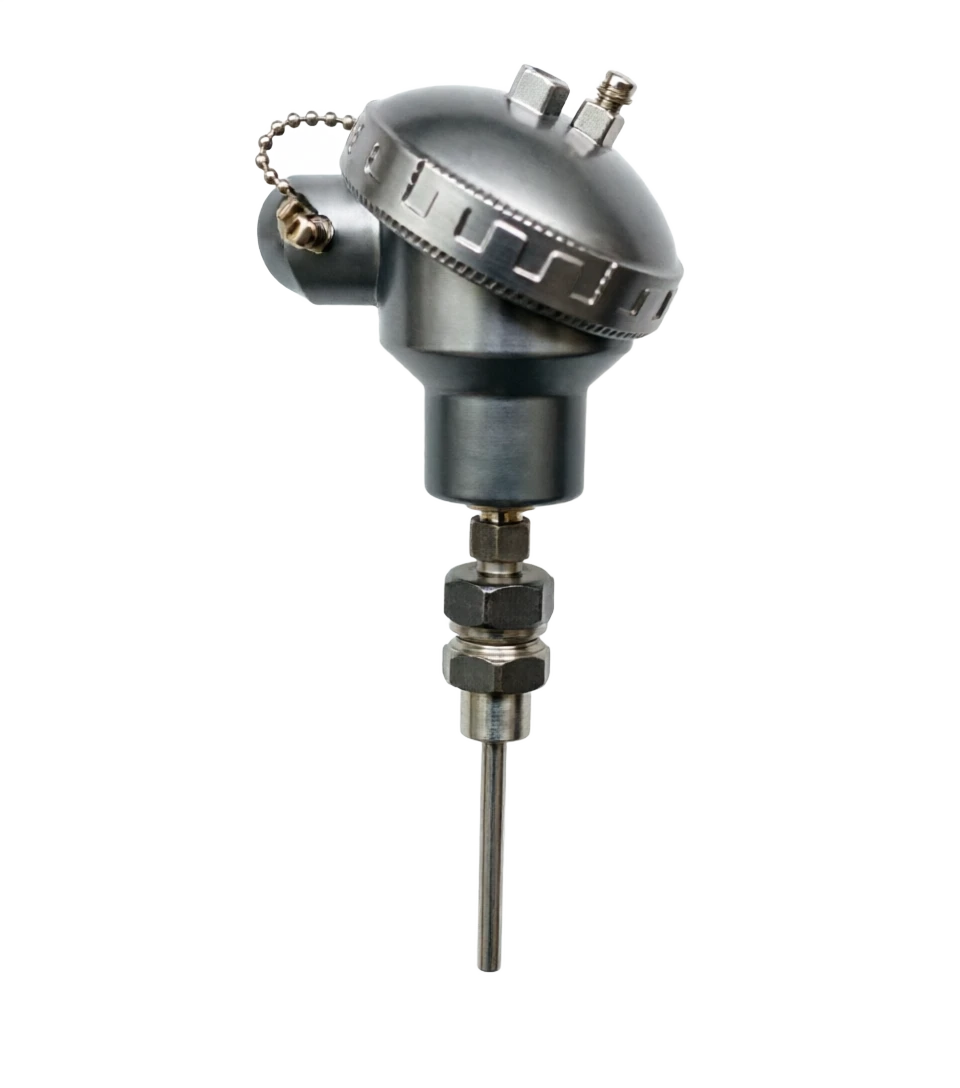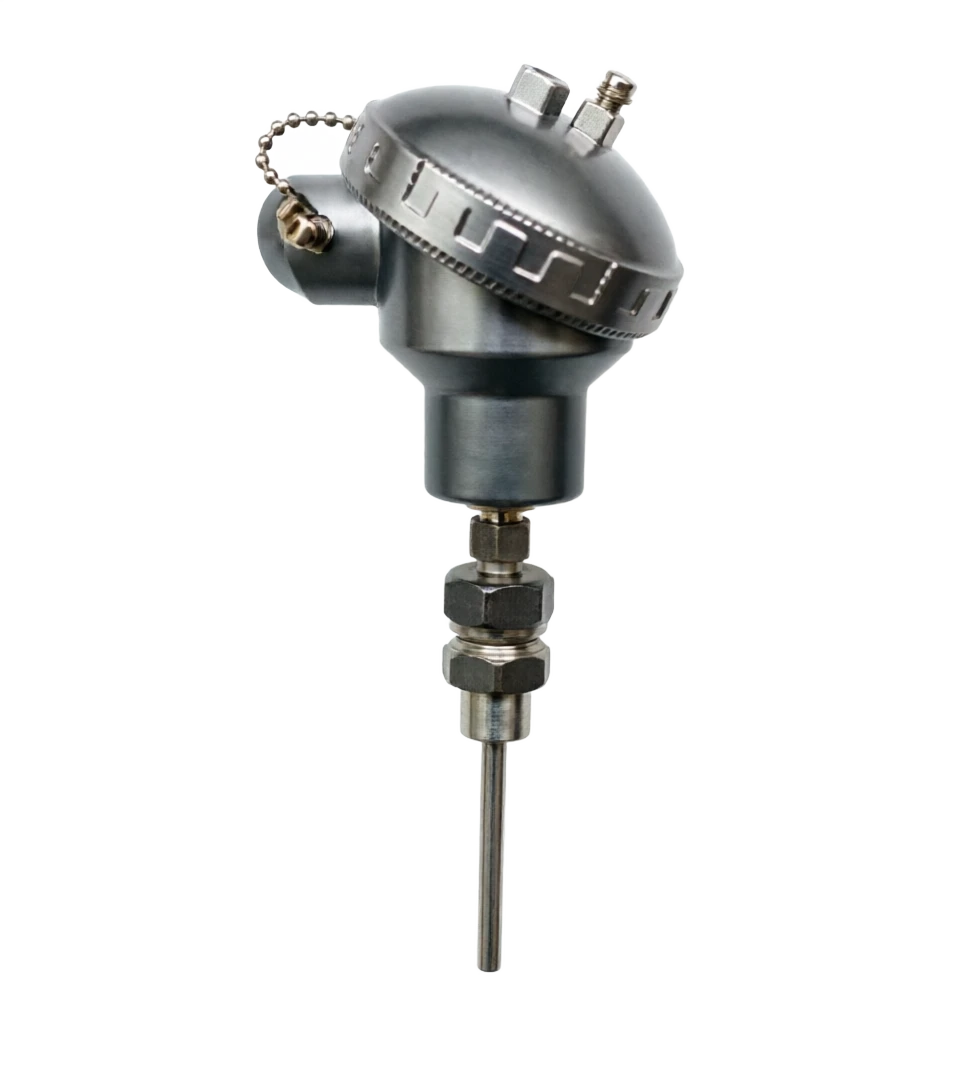
PRODUCT TECHNOLOGY

- Thermal dolls.

Operating principle

- Thermal dolls. - The work theory.

When two different stages of conductors (thermal electrodes A and B) are interconnected to form closed circuits, if the temperature of the two points is different, the heat power EAB (T, T0) is generated in the circuits, the size of which depends only on the two electrode materials and the temperature of the two ends and is not related to the length of the electrode, the thickness. This phenomenon was discovered in 1821 by the German physicist Seebeck Effects, which is the physical basis for thermoelectrical thermometry. Thermal power is associated with temperature through IEC. 60584 Standard fraction table determined, expression multiple: E(t) = c0 + c1 ·t + c2 · t² + c3 · t³ +... + cn t ⁇ n Core Process is Mineral Insular

  1. 01

    The same type of wiring is used for the ti-ni-si, N-s.

  2. 02

    IEC type (NiCrSi-NiSi), E

  3. 03

    60584 (Nicr-CuNi), J

  4. 04

    Standardized Standardized Material pair (Specific Number), K type (Fe-CuNi), T

Support for the assembly thermo-puppet selection

Provide survey missions, media and installation conditions and obtain product configuration advice.

Contact us
· Technical note

TECHNOLOGY & APPLICATION

Understand the principles, the exact selection.

From measurement principles to field applications, the technical features and selection features of the gill thermoelectric dolls are understood.

01

TECHNICAL GUIDE

Overview

(Mineral Insulated Thermocouple, WRKK Series / MI TC) is an industrial thermoelectric doll made using the integrated "metal protection + inorganic mineral insulation + inner heat electrodes" extraction process. It's typically only got a radium. 0.5 ~Φ 8mm The best I can do. 0.25mm , the curved radius is only its outer diameter 5 Multiply, core temperature measurement elements for narrow space, curved paths, high pressure containers and high vibration conditions.

The first was developed by the United Kingdom and Germany in the 1950s for the nuclear industry and aerospace temperature measurement needs. The BS4937 and IEC 60584 standards in the 1960s gradually moved towards standardization with their fractional numbers (K/N/E/J/T/S/R/B). With the Mgo insulation metallurgical process and stainless steel shield lifting technology mature, the gradual replacement of traditional assembly-forming dolls by twigs became the standard selection for industrial temperature measurement.

Main technical characteristics

General description · Serial number / CharacteristicsCross-reference
Serial numberCharacteristics
1Integrated lifting: integrated and tectonically dense, Mgo powder, hysteres
2Flexy to round: bend radius ≥ 5D, adapted to complex installation paths
3Fine diameter: ⁇ 0.5~8 mm, least ⁇ 0.25 mm, micro-integralization of the spot
4Response fast: ⁇ 1.0 Ichic. t0.5 ≤ 0.3 s (air)
5Stress resistant oscillation: withstands pressure above 50 MPa, resists mechanical shocks
6Long life: full containment of protective stock, chemical inertity of magnesium oxide, life span 5-10 years
7Temperature range: -200 ~ +1300 ℃ (K/N/E/J/T), highest S/R 1600 ℃
8The site is cut off: Ichigo is out of the plant for redundancy, and the site is short and sealed as required
9Optional variant delivery: direct-to-place integrated temperature adapter
02

MEASUREMENT PRINCIPLE

Operating principle

2.1 Thermal electrical effects of Sebek

When two different stages of conductor (thermal electrodes A and B) are interconnected to form closed circuits, the heat-power EAB (T, T0) is generated in the circuits at different points of temperature, the size of which depends only on the bipolar material and the temperature of the two ends, not related to the length of the electrode, the size of the condensed circuit. This phenomenon was discovered by the German physicist Sebeck in 1821 and is known as Seebeck Effects, which is the physical basis for thermoelectrical thermometry.

The Cu-CuNi and S (PtRh10-Pt) types are well developed.

Measurement formulaClick to see the big picture
E(t) = c0 + c1·t + c2·t2 + c3·t3 + ... + cn·t^n

Thermal power is associated with temperature through IEC. 60584 Standard scale is established, expression is multiple: E(t)= c0 + c1 ·t + c2 ·t² + c3 ·t³ + … + cn·t^n

2.2 MI Integrated lifting process principles

The most central process is integrated lifting of Mineral Insulated: the metal-coated two thermoelectric poles (even silk) are co-contained with the high-purity magnesium oxide powder, which is metalized by multi-channelal pull, roller and fire-release treatment.

(b) Gold-grade incisor. Specific steps: assembly: the penetration of a bipod wire into aluminum oxide or magnesium oxide locator, coating metal protection tube;

Powdering

Fill in high-purity Mgo powder (in the tube) ≥99.5% ) , strong to density ≥ 2.5 g/cm³;

Pull

Gradually pull the mould to target diameter ( ⁇ 0.5~8 mm), during which Mgo powder is crushed to more than 95% theoretical density;

Repulse the fire.

(b) Elimination of pull-out stress and restoration of the microclinic structure;

Welds

(b) The measuring end melts the top of the wire into a spherical node by arc welding or laser welding;

Cold End

Enriched epoxy or welded long-wire guidance at the end, connected to the connector box or integrated transmitter.

2.3 Cold end compensation for tweezers

Like a packaged thermoelectric doll, temperature compensation is required for the cold end of a cyborg. The cyborg is particularly suited to integrated temperature transmitters: the carrier has a cold end compensation sensor (Pt100 or PN knot) and directly completes mV ⁇ 4-20 MA

Convert. Common means of compensation:

2.4 Workflow

  1. 01

    The same type of wiring is used for the ti-ni-si, N-s.

  2. 02

    IEC type (NiCrSi-NiSi), E

  3. 03

    60584 (Nicr-CuNi), J

  4. 04

    Standardized Standardized Material pair (Specific Number), K type (Fe-CuNi), T

Motion of work · Serial number / Compensatory methodCross-reference
Serial numberMethod of compensationRationalePrecision
1Infra-replacement reimbursement for transmitterIntegrated Transmitrator Internal Pt100 / Pt1000 Autocompensation±0.1 ~ ±0.5 ℃, mainstream
2Compensatory route methodExtend the cold end to the temperature stabilizer with a same-point guide.±1.0~±2.5 ℃
3Ice bathing.Cold end in 0 °C ice water mixtureExtremely high, laboratory / marked
4Software Compensation MethodPLC/DCS Second indemnity± 0.3 °C, system level
Motion of work . Step / ActionCross-reference
StepsActions
①Process temperature → heat conduction through the metal sheath → MgO insulation → welded thermocouple hot junction
②Weld point temperature differentials E (T, T0)
③Thermal power follows the dots, the cold end, the long lines, the integrated transmitters.
④Transmitr cold end compensation + linear 4-20 ma/ Hart output
⑤Signal to DCS / PLC display, alarm, record, control
⑥Excess / Breaks / Trigger a malfunction signal, instrumentation to safety
⑦♪ The whole thing's gonna be a new dress ♪
03

PRODUCT STRUCTURE

Product structure

3.1 Fashion fabric level

The hyphene is a typical multi-axis conjunction structure, consisting of three layers of hyphenation (thermal electrodes), insulation and metal protection:

3.2 Measurement end-end structure forms (4 classes)

3.3 Common protective material and applicable conditions

Twisted (+)

Functional description: acoustic power pair with negative poles, assuming positive roles

Negative dope (-)

Functional description: Negative role vis-à-vis positive heat and power formation in the polar region Common materials/specifications: K/NiSi, N/NiSi, E/CuNi, J/F e Copper plating, T/CuNi, etc.

Insulation (Mgo)

Functional description: electrical insulation between positive and negative polar, heat transfer medium Common material/specifiers: magnesium oxide high purity ≥99.5% theoretical density 3.58 g/cm³

Metals.

Functional description: Air-classified protection, mechanical strength, corrosion resistance, antioxidation commonly used materials/specifications: 304 / 316 L / 321 / 310 S / Inconel 600 / GH3030

Measurement end (hot)

Functional description: Welding nodes at the top of the doppelganger, sealed Usage/Specific: Arc Welding/ Laser Welding/ Head-Down/ Insulation

Cold-end seal

Functional description: End-sealed tide protection, and extension line transposition Usual material/specifier: epoxy resin / ceramic glue / welding head

Extend the guide

Functional description: Cold end extension to connector boxes or transmitters Usual material/specifiers: Consensual guide with a = equal dimension / shield cable

Connect Box (optional)

Functional description: Seal protection, easy to maintain Usual materials/specifies: Aluminium alloy / stainless steel / IP65 ~ IP68

Process Connection (optional)

Functional description: Pipe / Container / Device Installation Common Materials/Specification: screw G1/2, Frank DN25, Carp, Activity Frank

Integrated Transmitters (optional)

Functional description: mV ⁇ 4-20 MA signal conversion Usual material/specifier: Hart / MODBUS / PROFIBUS-PA

Form

Level: Structural characteristics Functional description: Typical application Usual material/specification:

Headbrow (insulation)

Level: Welding measurement without protection, response speediest but mechanical weakness Functional description: Laboratory / Short-term measurement / High-response scene Common mass/speculation:

Shell type

Level: Measurement end and protective stock direct welding (hells), response speed, resistance, good interference functional description: Industrial process mainstream / 90% Industrial scene Common material/specification:

Insulation

Level: Measurement end and protective insulation, resistance to electrical interference, but response is slightly slow Functional description: Electromagnetic interference scene / Multipoint Measurement Common Materials/Specifics:

flat / cone

Level: Cover end crushing or car cone formation for narrow space Function description: Axisymetric temperature/pipe surface / Embedded temperature measurement Common material/specifiers:

Serial number

Level: protective material Functional description: maximum temperature Usage material/specify: applicable condition

304 Stainless steel

Functional description: +870 °C Continuous Usual material/specify: general corrosive / food / pharmaceutical

316L Stainless steel

Functional description: +870 °C Continuous Usage/Specific: General Corrosion / Chemical / Seawater / Food Level

321 stainless steel (Ti stable)

Function description: +870 °C Continuous Usage Materials/Specifics: Presistence of Corrosion between Crystals / High Temperature Mechanical Performance

310S stainless steel (25-20)

Function description: +1100 °C continuous Usage/Specific: HT/ Bulk / Fung

Inconel 600 Nickel Base Alloy

Maximum temperature: +1150 °C continuous application: high temperature corrosive / chemical / nuclear power

GH3030 Nickel-based high temperature alloys

Maximum temperature: +1200 °C Continuous Work: Aviation / Gas Wheel / High temperature heat treatment

Haq Alloy C-276

Maximum temperature: +1100 °C Applicable condition: strong acid / strong alkali / strong oxidation

titanium alloy TC4

Maximum temperature: +400 °C Applicable condition: strong alkali / seawater / chemical equipment

04

TECHNICAL GUIDE

Advantages and disadvantages

Product advantages

♪ And soft and bendy ♪

Specific: can be circled or installed along complex paths, with a minimum curve radius of only 5D (5 times the outer diameter) and a assembly fabric not possible

It's a fine field.

Specific: ⁇ 0.5~8 mm optional, with access to narrow positions such as small pipes, axle bearings, electric circuits, etc.

Respond Quick

Specific: Mgo Insulation Insulation Heat coefficient 30 W/(m K), 1.0 Ophthalmic t0.5 ≤ 0.3 s, times faster than assembly 5 ~ 10

Pressure resistant to corrosion

Specific: Full seal of the protective shield, chemical inertity of magnesium oxide, capable of withstand pressure above 50 MPa, and irreplaceable in high pressure response, bathymetric temperature

Squawk-resistant.

Specific: Mgo powders form a buffer against mybs, suitable for vibration, shock, and twisting conditions such as engines, compressors, pumps, temperature measurement

Long life expectancy

Specific: Structured, insulated, inert, 5-10 years of service life, 2-3 times the assembly

The scene is short.

Specific: The wiring out of the plant usually leaves a redundant length, which can be shortened on-site as required and then connected to the extension line by cold-end sealing

It's integrated with the transvestites.

Specific: Fit for direct integrated temperature transporter (Hart/MODBUS), simplify wiring and improve resistance to interference

Disadvantages and use restrictions

Higher cost

Response: Integrated lifting is complex, protective/mgo/polythene requirements are high and unit prices are higher than assembly formats; spare parts categories can be reduced by standardized selection

Length limited

Response: Maximum 50-100 m in single, indirect line box for ultra-long temperature measurement; depth measurement needs to be planned in advance

It's not a maintenance facility.

Response: Measurement of end-use welding is undissolved, on-site maintenance costs are low but damage requires replacement; spare parts storage is recommended

Cold-end sealing is high.

Response: The end of the end must be strictly sealed to protect against tides, otherwise the insulation of MGO powder is sharply reduced; while installed, watch for the connector box IP level

Long-term stability of high temperatures

Response: K-style tweezers at 800 ~1000 °C, with long-term use of "green erosion" (Cr migration), N-type replacement recommended in high-temperature long-term situations

No secondary processing

Response: Welded tatters can no longer process the twilight diameter; specifications need to be specified during the design phase

05

APPLICATIONS

Application area

The advantages of flexibility, sophistication, stress resistance and longevity are widely applied to the following industrial scenarios:

Petroleum chemicals

Typical application scenarios: Reaction plume, high pressure pipe, catalytic cracking, hydrogen cracking, steam cracking furnaces 600 / 316 L-pants, K/N type, t-shirts 3.0 ~Φ 6.0

Electricity / Fire

Typical application scenario: boiler overheater, reheater, gas turbine bearing, wind bearing selected elements: K/ E type, 3.0 ~ 4.5, 310 S / Inconel

Nuclear power

Typical application scenario: reactor coolant circuits, steam generator, pressurer, pump valve temperature measurement point: N / K Inconel 600 protective kit, earthquake resistance, radiation certification

Metal / Steel

Typical application scenario: furnace hot stove, oven, rotor, furnace, casting crystallizer Selector: K/N/S/B, 310S / GH3030 protective kit, high temperature resistance

Aviation / Space

Typical application scenario: engine burner, turbine blade, tail nozzle, test platform. Selected elements: K/N/S/R, GH3030 / GH4145, protective kit, ⁇ 1.0 ~ ⁇ 3.0

Ships

Typical application scenarios: diesel cylinders, pressurizers, boilers, hydraulic systems for wheelers 316 L / Inconel protection, earthquake resistance

Mechanical / Axisymmetric Temperature

Typical application scenario: electric bearings, pump bearings, compressors, wind bearings, gearboxes Selected elements: J/K, ⁇ 1.0 ⁇ 3.0, flat / cone end

Medicine/ Food

Typical application scenarios: fermentation cans, pap, CIP cleaning, fungic tank, cold chain transport Selected elements: 316L protective kit, T/E type, 1.6 ~ ⁇ 3.0, sanitary level

Thermal/ stove industry

Typical application scenario: heat processor, time-use, carbon-drinking, welding furnaces Selected elements: K/N/S/B, ⁇ 4.5 ⁇ 8.0, 310S / GH3030

Construction / Building

Typical application scenarios: AC, hot water supply, solar heating, ground source heat pump. 1.0 ~Φ 3.0 , 304 - A protective condom.

06

TECHNICAL SPECIFICATIONS

Technical Parameter Table

6.1 Overall technical indicators

6.2 Temperature ranges and accuracy of fractional numbers

6.3 Response Time (reference)

6.4 Comparison of main parameters of the tattered wires of different outer diameters

  1. 01

    Select Table

Model naming rules (reference IEC 61515/JB/T 9238): W (temperature instrumentation) R (thermal voltage) K (holstery) □ (spect)-□-□ (regulating material)-□ (insert depth)-□-□ (process connection)-□ (output)

7.1 Type by fraction + temperature

7.2 Select by media / industry

7.3 Type by Output

  1. 01

    Selection Guide

8.1 Selection Processes

the selection shall be determined in the following order:

8.2 Selecting with assembly thermoelectric dolls

8.3 Recommended wiring-speculation type for a tweed

K (NiCr-NiSi)

Most commonly -200 ~ + 1260 °C, is highly oxidizing, but 800 ~ 1000 °C has a "greening" risk (Cr priority oxidation leads to negative polar contamination);

N (NiCrSi-NiSi)

An upgraded K version that is resistant to green erosion and more stable in heat, is recommended for use in long-term high temperatures above 800 °C and preferred for a high-level mainstream dress-up wiring;

E type (NiCr-CuNi)

Thermal power is highest (68 μV/°C) and is highly sensitive and commonly used in industrial processes < 600 °C;

Type J (Fe-CuNi)

Cheap, but Fe is highly oxidized at 0~760 °C and only suitable for short and medium temperatures;

T (Cu-CuNi)

-200 ~ +400 ℃, which is stable at low temperatures and is often used in cold chains, food, pharmaceuticals;

S / R / B

Precious metals, 0-1600°C, for use in high temperature precisions such as metallurgical, glass, research, etc.

8.4 Recommendations for the selection of the outer wiring path for a dress

8.5 Attention to the installation of velvet

1 Curve Radius ≥ 5 D, avoiding hard folds (which can damage the MGO insulation layer), which can be rendered impervious by convulsing the same position several times;

② Immerse the sensing end to a depth of at least 10 times the thermowell diameter to avoid heat-conduction error.

The measurement end should be protected from direct exposure to flame or heat impact areas;

4 The cold end must be strictly sealed to protect against tide. IP65 above, wet environment selection IP67/IP68 ;

High temperature (>800 ℃) long-time work preferences N+ Inconel 600 / GH3030

6 High Vibration Event Crust + Titium 3.0 above, avoid cold end filling loosely;

Exd II BT4 / Exia II CT6 (b) Blast-proof wire boxes with filaments;

When the tatter wire leaves the factory, Mgo powder is dry and sealed and must be immediately re-sealed after short cut, otherwise the insulation will result in a sharp reduction of electrical insulation, and an incorrect instrumentation or even a short circuit.

8.6 Maintenance elements

— End of document —

Technical Table of Parameters . Parameter Item / Parameter ValueCross-reference
Parameter ItemParameter Value
Product implementation standardsIEC 60584 / IEC 61515 / GB/T 18404 / JB/T 9238
Sensor typeK / N / E / J / T / S / R / B
Exterior SpecificationΦ0.5 / Φ1.0 / Φ1.6 / Φ2.0 / Φ3.0 / Φ4.5 / Φ6.0 / Φ8.0 mm
Temperature range200 ~ +1300 ℃(K/N/E/J);-200 ~ +400 ℃(T);0 ~ +1600 ℃(S/R/B)
Accuracy classI (±0.4% ⁇ t ⁇ or ±1.5 ℃); II (±0.75% ⁇ t ⁇ or ±2.5 ℃)
Insulation resistanceConstant Temperature ≥ 1000 M Q m; High temperature (maximum working temperature) ≥ 5 M Q m
Insulation materialMagnesium peroxide (Mgo) ≥ 99.5%
Sheath material304 / 316 L / 321 / 310S / Inconel 600 / GH3030 / Haps alloy
Minimum bend radius5 times the outer diameter (5D)
Response Time t0.5Φ 1.0 ≤ 0.3 s (air) 3.0 ≤ 1.5 s;Φ 6.0 ≤ 4 s
Pressure ratingGeneral 10 MPa; high pressure type up to 50 MPa
Vibration resistance10~500 Hz / 5 g(IEC 60068-2-6)
- It's a shock.100 g / 4 ms(IEC 60068-2-27)
Ingress protectionIP65 / IP67 / IP68 (Accompanying connection box)
Line Modend-line/ rd-line/ th-line
Cold junction compensationInline Pt100 / Soft Compensation / Ice Bathing
Output signalmV / 4-20 mA / Hart / MODBUS / PROFIBUS-PA / Foundation Fieldbus
Use temperature (wirebox)40 ~ +85 ℃
Relative Humidity5% ~ 95% RH, no condensation
Storage temperature40 ~ +85 ℃, dry and ventilated
General supply length500 / 1000 / 2000 / 5000 / 10000 mm or custom
Life expectancyTypical 5-10 years (relates to temperature, vibration, corrosive condition)
Weight (reference)Φ 1.0 About 25 g/m;Φ 3.0 About 110 g/m;Φ 6.0 About 320 g/m
Sensor typeElectro-ideomaterialsTemperature rangeI GrantII. PAYMENTS
KNiCr-NiSi200 ~ +1260 ℃± 1.5 °C or ± 0.4% ⁇ t ⁇±2.5 ℃ or ±0.75%
NNiCrSi-NiSi200 ~ +1300 ℃± 1.5 °C or ± 0.4% ⁇ t ⁇±2.5 ℃ or ±0.75%
ENiCr-CuNi200 ~ +870 ℃± 1.5 °C or ± 0.4% ⁇ t ⁇±2.5 ℃ or ±0.75%
JFe-CuNi40 ~ +760 ℃± 1.5 °C or ± 0.4% ⁇ t ⁇±2.5 ℃ or ±0.75%
Technical parameter table · Semimeter / electrode materialCross-reference
Sensor typeElectro-ideomaterialsTemperature rangeI GrantII. PAYMENTS
TCu-CuNi200 ~ +400 ℃± 0.5 °C or ± 0.4% ⁇ t ⁇±1.0 ℃ or ±0.75%
SPtRh10-Pt0 ~ +1600 ℃±1.0 ℃ or ⁇ [1 +(t-1100) x 0.003] °C±1.5 ℃ or ±0.25%
RPtRh13-Pt0 ~ +1600 ℃±1.0 ℃ or ⁇ [1 +(t-1100) x 0.003] °C±1.5 ℃ or ±0.25%
BPtRh30-PtRh6+600 ~ +1700 ℃(600 ~ 1700 °C not tested)±0.25% |t|
Outert0.5 in waterAir t0.5Application of recommendations
Φ0.50.05 s0.8 sMicroaxis / Laboratory
Φ1.00.1 s1.5 sAxes / Electric Crew
Φ1.60.2 s2.5 sPipe surface / common
Φ3.00.6 s6 sMainstream industrial processes
Φ4.51.2 s12 sHigh pressure containers / Reaction
Φ6.02.0 s20 sBoiler / High Temperature Pipe
Φ8.03.5 s35 sBoiler / Smoke
OuterI'm just a little bit more of a silk.InsulationCover the wall.WeightMinimal bend
Φ0.5Φ0.08MgO0.05 mmAbout 8 g/m2.5 mm
Φ1.0Φ0.18MgO0.10 mmAbout 25 g/m5 mm
Φ1.6Φ0.30MgO0.16 mmApproximately 50 g/m8 mm
Φ3.0Φ0.55MgO0.30 mmApproximately 110 g/m15 mm
Φ4.5Φ0.85MgO0.45 mmAbout 180 g/m22 mm
Φ6.0Φ1.30MgO0.60 mmAbout 320 g/m30 mm
Φ8.0Φ1.80MgO0.80 mmAbout 530 g/m40 mm
Technical Parameter Table . Work Temperature / Recommended ScoreCross-reference
Work temperatureRecommended fraction numberSheath materialRecommended external route
200 ~ 0 ℃T / E / K316LΦ1.6 / Φ3.0
0 ~ 400 ℃K / E / J / T304 / 316LΦ3.0 / Φ4.5
400 ~ 800 ℃K / N / J321 / 316LΦ3.0 / Φ4.5
800 ~ 1100 ℃K / N310S / Inconel 600Φ4.5 / Φ6.0
1100 ~ 1300 ℃N / KInconel 600 / GH3030Φ6.0 / Φ8.0
1300 ~ 1600 ℃S / R / BGH3030 / Ceramic protectionΦ6.0 / Φ8.0
Applied industryCharacteristics of the situationRecommended ModelCondoms/outside
Petrochemical and hydrogen reactorHigh pressure hydrogen gas, 300 ~ 600 °CWRK2-316L- ⁇ 3.0-N316L + Anti-hydrogen corrosive
Fracker stove tube800~1100°C high temperatureWRKN2-GH3030- ⁇ 6.0-NGH3030 High temperature alloy
Nuclear power reactorsRadiation, vibration, 350 °CWRKN2-Inconel 600- ⁇ 3.0-NInconel 600 + Earthquake
Aviation enginesHigh temperature, response 0.2 s, vibrationWRK2-GH3030- ⁇ 1.6-KGH3030+micro
Electric axle temperature measurementVibration 10 g, 110 ~ 150 °CWRKJ2-316L- ⁇ 3.0-J316L + shell
Pharmaceutical fermentation cansHealth, 135 °C sterile, CIPWRKT2-316L- ⁇ 1.6-T316L + Health level
Papactivism for foodHealth, 80 ~ 95 °C, CIPWRKT2-316L- ⁇ 1.6-T316L + Health level
Diesel aircraft for shipsVibration, oil fog, 500 °CWRK2-Inconel 600- ⁇ 3.0-KInconel 600 + Earthquake
Thermal processor800 ~ 1200 °C long timeWRKN2-GH3030- ⁇ 6.0-NGH3030+Oxidizing
Output MethodApply sceneConnectSupporting instrument
mV Direct OutputShort distance, temporary measurementsLine 2Numeric / DCS mV card
4-20 MA Two-line SystemMainstream industrial sitesLine 2DCS / Loger
4-20 mA + HartRemote Grouping / ParameterisationLine 2Hart Handheld / 475 Comms
MODBUS RTUMultiple instrument network / RS-485Line 4PLC / Industrial gateway
Technical Parameter Table · Output Method / Applies sceneCross-reference
Output MethodApply sceneConnectSupporting instrument
PROFIBUS-PAChemical's Essentially Safe Integration2 busDCS / Asset Management System
Technical parameter table · Step / ConsiderationsCross-reference
StepsConsiderationsDecision points
①Temperature rangeDetermine the minimum temperature and maximum temperature of the work, and select the fraction number by 80% of the residual.
②Media / EnvironmentCorrosive, oxidizing, reducing, determining protective material
③Pressure / VibrationHigh pressure, select thick walls, ⁇ 4.5/ ⁇ 6.0, strong vibrating selection suits.
④Space / BendA narrow space or complex path selection can be bent
⑤Response timeQuick response selection ⁇ 1.0 ⁇ 3.0; slow response selection ⁇ 6.0 +
⑥Measurement End FormFastest but weak head-on; shell-skinned; cone for surface
⑦Insertion depthPipe 1/3 in diameter; container inserted 200~500 mm
⑧Process connectionscrew / Frank / carat, by process and pressure level
⑨Output MethodmV / 4-20 maA / Hart / bus, press DCS interface
⑩Ingress protectionOutdoor IP67; underwater IP68; blastproof Exd II BT4
Comparative- Thermal dolls.A packaged thermoelectric doll.
ConstructionMetals + Mgo Integrated PullVegetable+Presser+CyberBox Fabrication
Outer⁇ 0.5~8 mm, fineUsually 16~25 mm, fixed
ResilientnessBut bend, bend radius 5DNo bending, rigid structure.
Response timeΦ 1.0 ≤ 0.3 s (extremely fast)⁇ 16 About 8-30 s (slower)
Pressure resistanceAffordable 50 MPa+General 10-30 MPa
Anti-shock resistanceMGO buffer, earthquake resistant 5 g+Poor. Vibration is easy to break.
Life expectancy5-10 years2 ~ 5 years (even silk can be replaced but ageing easily)
Field maintenanceWhole replacement, not to be removedChanger on site for / widgets
CostHigherLower (low initial input)
Apply sceneShrink space, bending paths, high pressure, vibrationGeneral industry, requirement of on-site repair
Technical parameter table . Outer / Typical applicationCross-reference
OuterTypical applicationsRemarks
Φ0.5 / Φ1.0Axes, electric circuits, aerodynamic hot spotsIt's very fast. It's less mechanical.
Φ1.6 / Φ2.0Pipe surface, heat stream, medical, foodGeneric mini-size, high value for money.
Φ3.0Mainstream industrial processes (90% scene)Recommended Default Specifications
Φ4.5 / Φ6.0High pressure reaction, furnace, flue.Mechanical strength high, stress-resistant.
Φ8.0Boiler, cracker, high temperature pipeBig, long life.
Technical parameter table · Periodic / Maintenance contentCross-reference
CycleMaintain ContentCriteria for judgement
Each shiftInspection: Indicator temperature, record curveA deviation from historical values ⁇ ±2%
MonthlyThe wire box is sealed, waterproof, ground-checked.No water, no no movement.
QuarterlyInsulation resistance test (500 V mega-e Table)Temperature. ≥ 1000 M once m
BiannualVerify: On-site vs./ Standard BodingI Within the grant
AnnualParatroopers, corrosive screeningNo visible corrosive, deformation.
Life expectancy by life expectancyChange whole dress-up wire as it maturesBy 5-10 years of life