PRODUCT TECHNOLOGY

Stainless steel diaphragms resistant to shock pressure table

Operating principle

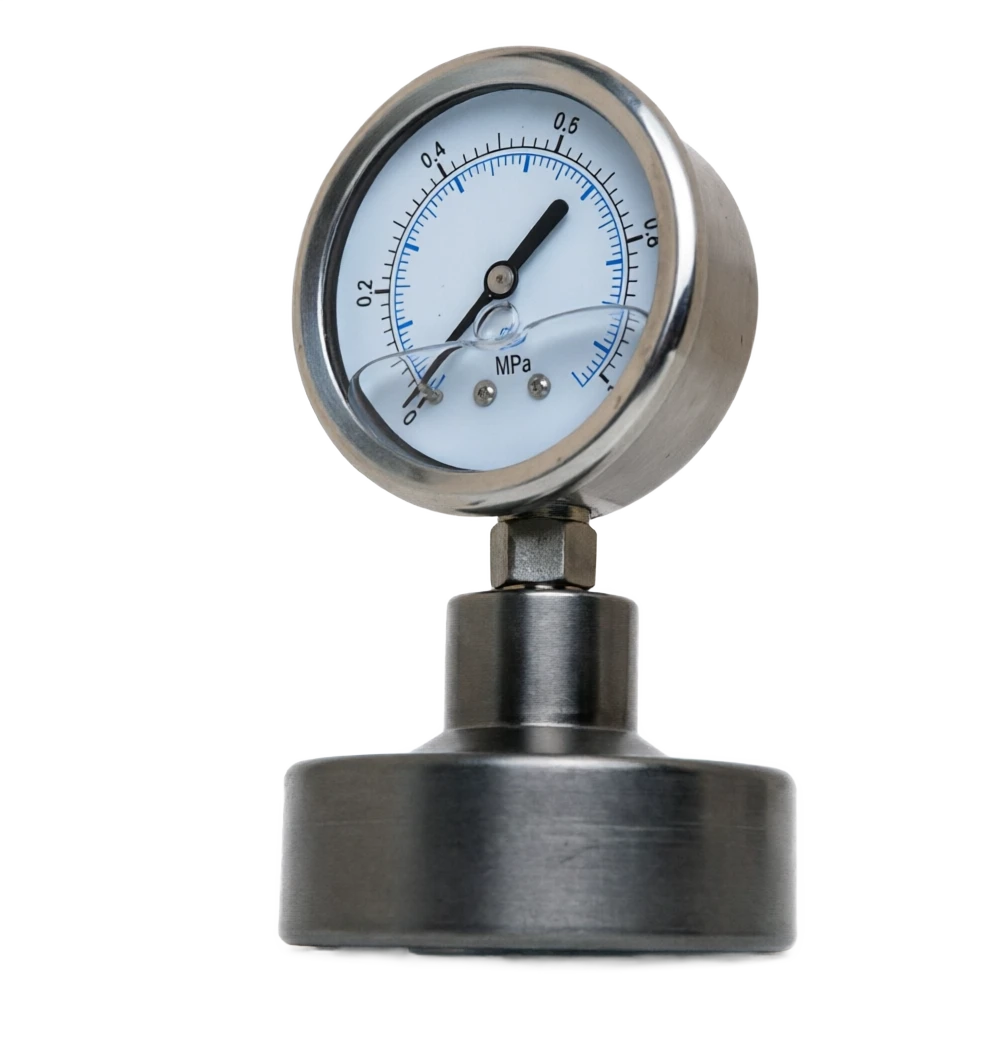
The stainless steel diaphragm resists the shock pressure table.

(YTPFN series) is a composite instrument for diaphragm separation + two technologies for seismic recharge, which can be understood as a combination of stainless steel diaphragm pressure table (YTPF) and shock resistant pressure table (N type). It addresses corrosive, crystall-friendly, high-compatibility media measurements, while adapting to a strong vibration environment, and is one of the highest protection species in the pressure table. The general diaphragm table is rapidly retorted in the vibrating environment with core gears, which are not readable by the pointer, and the gear is worn at an accelerated rate. This type is resistant to temperature effects by triple measure: the double thermal inflatation effect of sealed fluids (film system) + filling oils (shells), which is typically the result of temperature error at pressure ≤0.1% / °C, and the effect of low-range meters is more evident; Total temperature effect = general instrument temperature effect + diaphragms are subject to pressure temperature; Liquid Level

  1. 01

    The measured medium pressure P acts on diaphragms (films);

  2. 02

    (b) Diaphragm deformation, compressed diaphragm and clarinet sealed fluids (silicate oil) in closed systems between the diaphragm and the spring tube;

  3. 03

    (a) The sealing fluid forms the pressure of P- ⁇ P (the smaller the diaphragm is the less flexible the diaphragm is due to the small loss caused by the membrane rigidity);

  4. 04

    Pressure transfer to spring tube (boden tube) and free end movement through the core magnifying the pointer indicator pressure;

Stainless steel diaphragms for seismic pressure table selection support

Provide survey missions, media and installation conditions and obtain product configuration advice.

Contact us
Stainless steel diaphragms resistant to shock pressure table

TECHNOLOGY & APPLICATION

Understand the principles, the exact selection.

The technical characteristics and selection elements of the table of the stainless steel diaphragm resistance to shock are understood from measurement principles to field applications.

01

MEASUREMENT PRINCIPLE

Measurement principle

(YTPFN series) is a composite instrument for diaphragm separation + two technologies for seismic recharge, which can be understood as a combination of stainless steel diaphragm pressure table (YTPF) and shock resistant pressure table (N type). It addresses corrosive, crystall-friendly, high-compatibility media measurements, while adapting to a strong vibration environment, and is one of the highest protection species in the pressure table.

1.1 Separatismal separation transfer principles

  1. 01

    The measured medium pressure P acts on diaphragms (films);

  2. 02

    (b) Diaphragm deformation, compressed diaphragm and clarinet sealed fluids (silicate oil) in closed systems between the diaphragm and the spring tube;

  3. 03

    (a) The sealing fluid forms the pressure of P- ⁇ P (the smaller the diaphragm is the less flexible the diaphragm is due to the small loss caused by the membrane rigidity);

  4. 04

    Pressure transfer to spring tube (boden tube) and free end movement through the core magnifying the pointer indicator pressure;

  5. 05

    Eflexity repositioning of the depressive diaphragm and spring tube, and pointer back to zero.

The medium is exposed to the diaphragm only, without entering the spring tube, and avoids corrosive and clogged at all.

1.2 Seismic-resisting neon (the incremental capacity of this model)

The normal diaphragm table is rapidly retwitching the core gear in a vibrating environment, the pointer is not able to read, the gear is accelerated. This model is resistant by triple measure.

Zoom!

  1. 01

    Silicon oils in the shell - the resistance fluid absorbs vibration energy and inhibits the hand-drive while the core of the lubricator and buffer media pressure fluctuations;

  2. 02

    Core vibration reinforcement - a bearing/ gear by-products employing a grinding structure to reduce wear and deformation under vibration shocks;

  3. 03

    System-wide sealing - diaphragm sealing + double sealing of the shell to prevent spilling of filling fluid and dust intrusion.

1.3 Two main sources of error (needs to focus)

Temperature effects

Seal fluid (divestment system) + double thermal inflatation effect of oil filling (shell), ≤0.1% / °C for pressure temperature error, more pronounced for low-range instrumentation; total temperature effect = generic instrument temperature effect + diaphragm temperature effect;

Effects of liquid position differentials

If the catheter/software is transported remotely, the fluid level difference creates additional pressure. ⁇ P = the weight of the sealed fluid x the high difference, it must be corrected.

02

PRODUCT STRUCTURE

Structure

2.1 System composition (two modules + one chain of pressure)

Connection Form

Direct screw-linking (cracked) and long-distance transmission of the catheter tube (head-to-head deviation/high temperature/hazard source, hairy tube general 1-15 m).

2.2 Diveting forms

Script pairs (L), screw welding combinations (LY), open French (F), working word French (F1), tight French (F2), horned French (FJ), sanitary card type (WS), etc., French standard may choose GB/JB, HG, DIN, JIS, ANSI.

2.3 Critical Materials

2.4 Model spectrometry and positioning

YTP

Daphragm pressure table (base, cast iron/supreme shell)

YTPF

Total stainless steel diaphragm pressure table (reserve for corruption, intolerant for earthquakes)

YTPN

Seismic diaphragm pressure table (earthquake-resistant, non-stainless steel)

YTPFN

Total stainless steel diaphragm stimulator table (this model - corruption resistance + isolation + earthquake resistance three-and-one)

YTPX / YTPXC

EMP / MAB diaphragm table (with blast-proof form)

Example of typical complete model

YTPFN-100MF ( ⁇ 100, French connection, seismic oil, all stainless steel) with a snail pattern of YTPFN-100ML.

Applicable standards

JB/T 8624, Semenural Pressure Sheet; GB/T 1226, Seismic Resistance Requirements Reference JB/T 6804 (Small Resistance Pressure Sheet);

Validation of the execution of JJG 52.

Separators (pressured)

Composition: diaphragms, diaphragms, French/sniffed links, sealed gaskets: exposure to media, isolation protection

The pressurized chain.

Composition: Cystolic/direct link, sealing fluid (silicate oil) function: transfer of pressure to instruction

Earthquake-resistant indicators (instruction)

Composition: Total stainless steel watch casings, oil recharge (silican oil/glycerine), spring tube, vibrating core, pointer, palette effect: blocker defibration, magnifying instructions

Daphragms

Alternative materials: 316/316L, Haq Alloy C, Monnar Alloy (Cu30Ni70), pure tantalum, titanium, PTFE/F4

Conjunction and lower diaphragms

Alternative material: 316, 304 stainless steel

Shell

Alternative material: 304, 316 stainless steel (Phone Pyrolytan/PVC is economic)

Seal the gasket.

Alternative materials: Fluorine rubber, silicon rubber, fluorine plastics

Shell filler

Alternative materials: Silicon oil (conventional, −40 ~ 100℃), glycerine (0 ~ 80℃), high temperature silicon oil (≤150℃), fluorine oil (special)

Semension system sealing fluid

Alternative material: Silicon oil (conventional), customised as required

03

TECHNICAL GUIDE

Advantages and disadvantages

3.1 Advantages

Product features

The third type of difficulty of the first table - addressing also the three types of problem of "coloration (demonial separation) + blocking crystals (media non-table) + vibration (fuel-filled resistance)" - is the most comprehensive type of protection among pressure-table families;

Product features

The most adaptive medium - strong corrosive, high viscosity, crystallized, condensable, granular solids, high temperature liquids/gases are measurable;

Range Overwrite - 0~0.1 to 0~160MPa

(b) A general diaphragm table with vacuum and pressure vacuum specifications, far beyond the sanitary card formula;

Read steady - fueled resistance keeps the pointer open at vibrations and pulse pressure.

(b) Longer lifetime of the core;

Total stainless steel protection - surface shell 304/316

The external environment is also high-tide, mildly corrosive and protected by IP65;

(a) Remotely flexible layout - the hairy tube can be transported remotely to a safe, non-vibration-free view of the watch;

Precision Optional - General 1.5 / 1.6 Level, special custom 1.0 Level;

(a) A combination of good extension - the delivery point (alert control), hygiene, fluorine etc.;

(a) No electricity (base) is required - is essentially safe and suitable for the non-power-free site;

Non-refrequent maintenance - Seal systems are designed to have a long life and are subject to periodic review under normal conditions.

3.2 Disadvantages and limitations

Low limit accuracy - Synoptic impregnation + Filled retardation

General 1.5 less precise than diaphragm sealing transceivers;

Double temperature error - both surface oil and diaphragm sealing liquid systems are affected by temperature

(b) The condition of the work, which is subject to significant temperature changes, must be amended;

Respond slower - diaphragm transfer pressure + double delay in the hull-retarded nymph

(b) Not suitable for fast-onset stress and security lock-ups;

Dives are fragile - film thin

Fear of a complication of a hard particle impact with a breakout; if broken, the whole sheet of the sealed fluid is lost;

Non-site dismantling - Seal systems must be returned to the plant and cannot be self-sustained after filling the fluid;

Cost is high - about 5-15 times the normal pressure table

1.3~2 times the total stainless steel diaphragm table;

Weight and size - diaphragm + Frank + oily shell

The burden of installation of small-calibre pipes is evident;

Filling attitude requirements - the shell-filled oil type requires vertical installation, tilting impact readings;

Low range/micropressure is not applicable - the low resolution of micropressures by a dual liquid system;

High temperature limits - only −25 ~80°C for measured media temperature

Higher to be heated, the excess filling limit is not valid.

04

APPLICATIONS

Application area

4.1 Typical application scenario ( "Cross/Crystal + Vibration" compound)

4.2 Selective positioning judgement

By grade, avoid over-selection.

(a) A common pressure table (Y) for a medium that is clean, non-corrosive, non-vibration;

Clean, corrosive, non-vibration ⁇ stainless steel pressure table (YB);

Clean, vibrating, stainless steel shock-resistant pressure table (YBN/YTN);

Media corrosive/crystal/column, non-vibration Zero rusty steel membrane pressure table (YTPF);

Applications

(b) Media corrosive/crystal/column and environmental vibrations ⁇ stainless steel diaphragm resistance pressure table (YTPFN);

Remote transmissions, high precision diaphragm seal pressure transmitters are required.

Petroleum chemicals

Typical: Corrosive medium (vibration + corrosive) for the export of pumps/compressors YTPFN-100ML Snack + Haps Alloy C Film

Fibre/disinfection

Typical: Reactivate crystallized slurry, stir up a large vibration Recommended configuration: YTPFN-100MF French + 316 film

Bed/chlor-alkali

Typical: alkaline fluid, salt-slurry pipeline (mulcump pulse)

Pharmaceuticals/food

Typical: Corrosive CIP Cleaning Liquids in Health Settings Recommended Configuration: Health Cards (WS)+316L + Food Class Filling

Mines/metallurgy

Typical: Corrosive emulsion at hydraulic stations, mud pump export, recommended configuration: screwdriver + titanium/Hallium alloy film

Paper/septic

Typical: Pumping out of the drug (pulse + crystal)

Ship/season

Typical: cabin vibration + salt fog corrosive environment Recommended configuration: caustic tube remote transfer + 316L

05

TECHNICAL SPECIFICATIONS

Technical Parameter Table

5.1 Table of general parameters

5.3 Typical scale-precision correspondence

Technical parameter table · Parameter / SpecificationCross-reference
ParametersSpecifications
ModelYTPFN-□ML (sniff)/YTPFN-□MF (Frand)
Dial diameter⁇ 60, ⁇ 100, ⁇ 150 (common ⁇ 100/ ⁇ 150)
Accuracy class1.5 Levels, 1.6 Levels, 2.5 Levels (1.0 Levels Customizable)
Measurement range−0.1~0;0~0.1、0~0.16、0~0.25、0~0.4、0~0.6、0~1.0、0~1.6、0~2.5、0~4.0、0~6.0、0~10、 0~16、0~25、0~40、0~60、0~100、0~160 MPa
Diffusion film material316/316 L, Monnar alloy, pure tantalum, titanium, Haq alloy C, PTFE
Shells/interfaces304, 316 stainless steel (economic phenol plastics/PVC)
Shell filling fluidsSilicon oil (conventional), glycerine, high temperature silicon oil, fluorine
Ambient temperature−25~+55℃
Temperature of measured medium−25 ~ +80℃ (higher to disperse heater)
Temperature effectsTemperature error at pressure ≤0.1% / °C
Vibration resistanceFilled with oil and earthquake, adapted to strong vibration (reference to the shock tolerance table V.H.3 level)
Ingress protectionIP54~IP65
Work pressure. Rules.Still load, cap. 3 / 4 ;convert load cap 2 / 3 ;short-term cap values
Connect DimensionsSnack M20x1.5 (G1/2 " , NPT1/2 " , etc.); standards such as Frank GB/JB81, HG20592, customizable
Form of instructionDirect reading of field pointer (assignable to the YTPXN class)
Applicable standardsJB/T 8624 (separation table), GB/T 1226, JB/T 6804 (shock resistance); and validation JJG 52
ModelConnectionApply media statusCharacteristics
YTPFN-50ML / 100MLSniffed connection (M20x1.5 et al.)Corrosive but mobile mediumA tight structure, a scale of 160 MPa
YTPFN-100MF / 150MFFrench connection (GB/JB/HG etc.)Larger viscosity, crystallity, particle-containing mediaIt's not easy to accumulate, clean, block.
Technical parameter table · / General precisionCross-reference
QuantitiesGeneral precisionRemarks
-0.1~0 (vacuum)Level 2.5Micropressure resolution for a dual-liquid system
0~0.1 to 0~0.61.6~2.5 LevelThe temperature is very different.
0~1 to 0~601.5 LevelMain Scale Period
0~100 to 0~1601.5 ~2.5 LevelSnack, thicken the film.
06

SELECTION GUIDE

Select Table

6.1 List of parameters required for ordering

  1. 01

    (a) The name of the detected medium, corrosivity, viscosity, crystal/particle;

  2. 02

    (a) Work pressure (normal/maximum) determines the scale;

  3. 03

    (b) The temperature of the medium, ambient temperature to determine whether the heater is a radiator, or the type of filling fluid;

  4. 04

    Environmental vibration level

  5. 05

    Connection mode and specification (snone type / French standard and caliber DN);

  6. 06

    (a) diaphragm materials (by medium);

  7. 07

    (a) The shell mass, the pallet diameter, the accuracy level;

  8. 08

    Whether the catheter is tele- and long, whether the power is to be supplied, or whether the protection level is required;

  9. 09

    In the health field, it is indicated (calculation, food-grade filling, electric polishing).

6.2. Table of selection of diaphragm materials

6.3. Form for shell filling fluid selection

6.5 The rules for the selection of the quantum course

Still load.

Maximum working pressure ⁇ measure upper limit 3 / 4;

Handover load

• Measurement ceiling 2 / 3;

Short-time Peak

• Measurement ceiling;

The usual work point should be in range of 1/3 ~3/4;

Attention.

Some manufacturers' manuals are stable by load ≤2 / 3 Volatile pressure ≤1 / 2 Give, depending on the sample of the selected manufacturer before ordering.

6.6 Use point

  1. 01

    Vertical installation - the oily-skinned surfaces are attitude sensitive and tilted to influence readings;

  2. 02

    (b) Handling of collision-resistant diaphragms and surface filling systems;

  3. 03

    (b) The catheter tube is fitted to avoid sharp squeeze and to pay attention to the correction of the fluid level;

  4. 04

    No equipped instrument may be removed or replaced to prevent discharge from filling;

  5. 05

    (b) Media temperature exceeding (>80°C) loading of the radiator, and protection against the environmental hypertemperature;

  6. 06

    (b) Additional buffers (niscron/separation valves) when vibration is particularly severe;

  7. 07

    Periodically (JJG 52, general 1 year, severe work conditions reduced);

  8. 08

    The late increase in the pointer, the shift in the oscillation values were detected, and priority was given to the suspicion of diaphragm breakage or discharge and the return to the plant.

Table of selected types · Media category / Recommended filmCross-reference
Media CategoryRecommended filmRemarks
Weak corrosive media, steam316LEconomy
Sulphur acid, hydrochloric acid (reduced), mixed acidHawthorne Alloy C.Chemical mainstreaming
Hydroflonic acid, seawater, alkaline liquidMonnar alloy.Special
Enriched hydrochloric acid, wet chlorine gasPure tantalum.Extremely resistant, expensive.
Oxidizing/chloro-ion media (replacement of tantalum)Pure titaniumValue-for-money package
Strong acid alkalis, in health.PTFEErosion tolerance.
Table of selected types . Filling fluid / Applicable temperatureCross-reference
Filling fluidApplicable temperaturescene
Glycerine.0~80℃The warm economy
Silicon oil.−40~100℃General Preferred
High temperature silicon oil≤150℃High temperature environment
Fluorine oilHigher/SpecialTemperature and erosion, expensive.
Food levelTemperatureHealth
Work GroupRecommendations
Corrosion + Vibration + Quantities High (>25MPa)YTPFN-ML screwdriver
Glue Crystal + VibrationYTPFN-MF French
Corrosion + Vibration + High Temperature PointCough tube is passed far away + radiator
Corrosion + Vibration + Health requirementsWS Carpenter Health
Corrosion + Vibration + Call the policePumping point type (explosive structure selected in blast protection)
07

TECHNICAL GUIDE

Horizontal contrast

Select the mode.

Corrosive crystals with vibrations, YTPFN, full table; film material follows the medium and operates with two thirds of the scale; vertically, bumpproofing, and the filling system is intact.

The latest samples from the manufacturing plants are based on that.

Horizontal contrast · Contrast / stainless steel membrane resistance table YTPFNCross-reference
ComparativeStainless steel diaphragm resistance table YTPFNstainless steel diaphragm table YTPFStainless steel shock-resistant watch YBNSemenal seal pressure transmitter
PercussionYuYuMediumYu
Blocked crystals.YuYuBadYu
Vibration resistanceYuDifference (hard core loss)YuYu
Maximum of the scale160MPa60~100MPa160MPa40~100MPa
Precision1.5 Around classLevel 1.0 ~ 1.6Level 1.0 ~ 1.6±0.075%~±0.2%FS
Temperature effectsLarge (bridged systems)Bigger.SmallSmall (with compensation)
Response speedSlowest (double-dip-trained)Slow down.Slow down.Come on.
Teleport.None (assigned point switch)NoneNone4~20mA/number
PriceHigh (5-15 times the normal table)Medium HighMediumHigh
PositioningCorrosion + crystal + vibration compoundCorrosion/crystal without vibrationClean media+VibrationCorrosion medium + remote control