PRODUCT TECHNOLOGY

Non-resilted steel power point pressure table

Operating principle

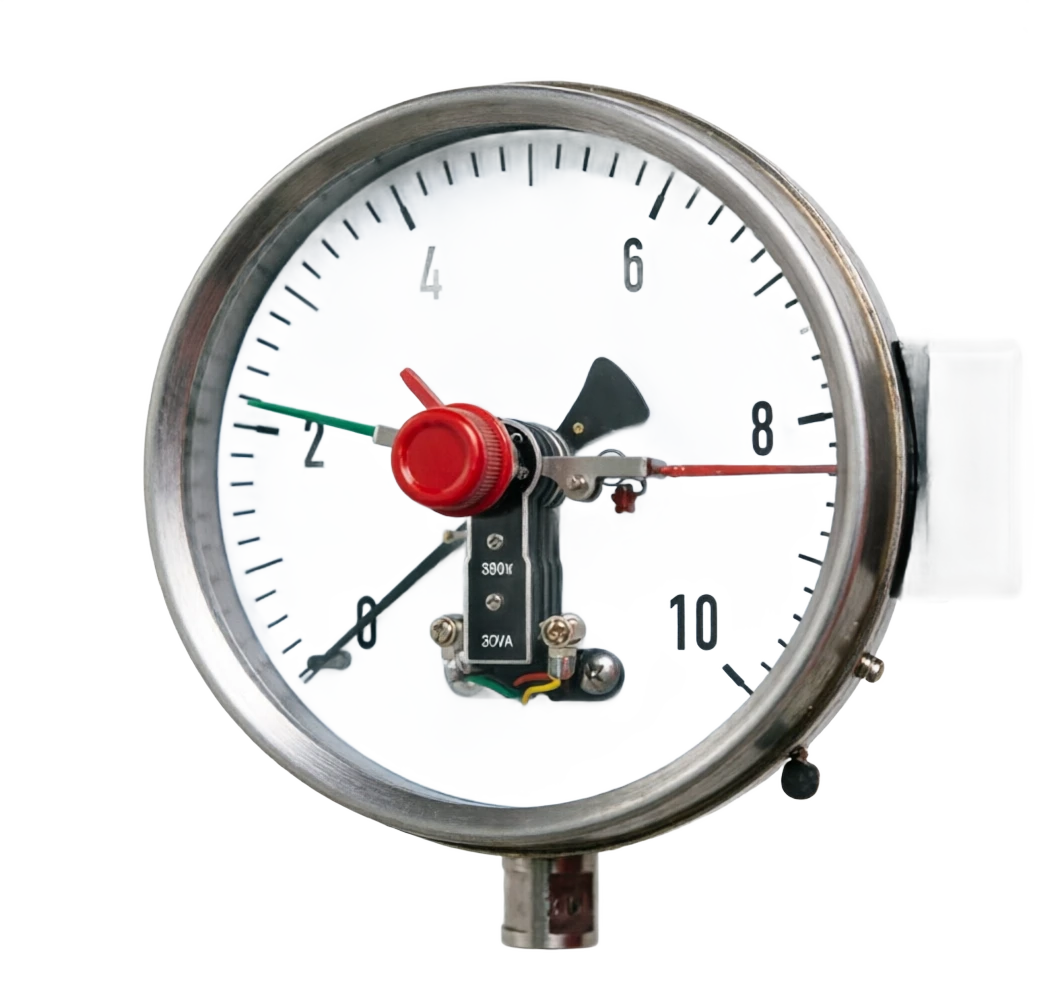
The stainless steel power point pressure sheet.

(YTX / YXC series) is an electro-integrated instrument for the installation of electrical points on the stainless steel pressure sheet - both keeping the pointer on the spot read and able to output the switch signal when the pressure reaches the specified value, achieving automatic control and alarm. It's essentially a two-fold device for "pressure table plus pressure switch". The measured medium pressure enters the spring tube (boden tube) and forces its free end to produce elasticity shifts, which are amplified by pull and gear transfer, leading to the indicator pointer (with a moving pointer) fixed to the gear axis to indicate the pressure value on the palette. Control forms: Multiple combinations of upper/lower limit (double limit), double upper limit, double lower limit, etc., with multiple control of a table if necessary. Normal electrical (YX) points are easily twitched and generate arcs, causing misaction and touch at the point of vibration or pressure pulse

  1. 01

    (a) Sets a separate 1~2 (extension to 3~4) pointer with a static pointer, which can be placed on the desired control value by the button (or key) that is adjusted on the surface glass;

  2. 02

    (a) When the measured pressure rises (or drops) to a given value, the motion of the pointer is exposed to the static pointer (or disconnected);

  3. 03

    (a) Contact action connects/disconnects the circuits of the control system, and automatically controls or sends a message alert through electrical components such as relays, contacts, etc.;

  4. 04

    Pressure drops (upping) and head-to-head separations and circuit recovery.

Support for stainless steel power point pressure table selection

Provide survey missions, media and installation conditions and obtain product configuration advice.

Contact us
Stainless steel point pressure table Technical Note

TECHNOLOGY & APPLICATION

Understand the principles, the exact selection.

From measurement principles to field applications, the technical characteristics and selection elements of stainless steel power point pressure tables are understood.

01

MEASUREMENT PRINCIPLE

Measurement principle

(YTX / YXC series) is an electro-integrated instrument for the installation of electrical points on the stainless steel pressure sheet - both keeping the pointer on the spot read and able to output the switch signal when the pressure reaches the specified value, achieving automatic control and alarm. It's essentially a two-fold device for "pressure table plus pressure switch".

1.1 Measurement principles (consistent with stainless steel pressure table)

The measured medium pressure enters the spring tube (boden tube) and forces its free end to produce elasticity shifts, which are amplified by pull and gear transfer, leading to the indicator pointer (with a moving pointer) fixed to the gear axis to indicate the pressure value on the palette.

1.2 EMP Control Principle (Incremental capacity of this model)

  1. 01

    (a) Sets a separate 1~2 (extension to 3~4) pointer with a static pointer, which can be placed on the desired control value by the button (or key) that is adjusted on the surface glass;

  2. 02

    (a) When the measured pressure rises (or drops) to a given value, the motion of the pointer is exposed to the static pointer (or disconnected);

  3. 03

    (a) Contact action connects/disconnects the circuits of the control system, and automatically controls or sends a message alert through electrical components such as relays, contacts, etc.;

  4. 04

    Pressure drops (upping) and head-to-head separations and circuit recovery.

Form of control

Multiple combinations of upper/lower limit (double limit), double upper limit, double lower limit, etc., with multiple control of a table if necessary.

1.3 Magnetic aided principles (YXC, mainstream form)

Normal electrical points (YX) are easily twitched and generate an arcs, causing misaction and tame burns. Magnetic aids (YXC)

Installation of a modifiable permanent magnet on an electrical contact signal needle

(b) Increase the magnetic field ' s pull at the point of contact, accelerate the contact movement and make contact reliable;

(b) The removal of arcs and the effective avoidance of frequent contact breaks caused by vibration or pressure pulses;

The result is increased contact switch power (30 VA vs normal 10VA), reliable movement, and long life.

The price of magnetic aids is the difference in the range.

There is an indelible gap (magnetic detour) between the connection and the disconnection value, which has a slight effect on the control accuracy.

1.4 Key control performance indicators

Control (point action) precision

±1.6% FS, Disconnected ±4% FS - less than the indicated precision, with a distinction in the selection;

Toggle Difference

(b) The typical full scale range is from several to ten percent, with a magneticly large support;

Contact rating

Normal 10VA, Magnetic Auxiliary 30VA (AC380V or DC220V, Max. 1A volume level) which cannot be directly driven by large power loads and which must be amplified by intermediate relays.

02

PRODUCT STRUCTURE

Structure

2.1 Overall composition

The instrument is made up of six parts.

Measurement systems (clarical tubes, docking), indicator devices (chips, pins, pallets), electrical pointers (set pointers, head-to-head groups, magnets), adjusters (reconciliators/keys on surface glass), casings (resert steel), wire boxes/plugs (electric interface M20x1.5, re-routing on the right side of the table, axle-to-axis installation behind the table, 6 khrom + PE end).

2.2 MATERIAL CONFLICT (Standless Steel)

Generating Group Logic

Materials (results steel) x function (magnetic aid/shock resistance/temperature resistance/ ammonia use/oxygen/explosive resistance/diffusion) x installation (repeated/axis/side)

Free combination.

Applicable standards

GB/T 1226 (general pressure table), ECTs refer in part to JB/T norms; compliance with JJG 52 is verified.

Core (measurement system)

Materials: SUS316

Shell

Materials: SUS 304(or 316)

Connect.

Materials: 304/316 stainless steel

Catalytic material

Materials: ≥110 V silver nickel alloy; ≤36 V gold (gold spots, low pressure conditions)

Watch glass

Materials: regular glass or secure double glass

Model Series

Material: Name Characteristics

YX-60/100/150

Materials: EMP pressure table Base, contact 10VA

YTX-100/150

Materials: stainless steel power point pressure table, all stainless steel, preservation

YXC-100/150

Materials: Magnetic aided Electromagnetic Point Pressure Sheet (MAMP) Magnetic Steel Insorption, 30VA

YTXC

Materials: stainless steel magnetic aided connections, embalming + magnetic aids

YNXC-100/150

Material: shock-resistant point pressure meters Filling oil, earthquake resistance, 30VA

YNXC-ZT

Materials: Stunny-resistant side of the axis

YAXC

Materials: ammonia power points, ammonia media special

YXCO

Materials: Oxygen power points Ban oil treatment

YXW

Materials: Temperature Resistance, High Temperature

diaphragm (YTPX/YTPXC etc.)

Materials: EMP diaphragm pressure table with separators to detect corrosion/crystal media

YBXX

Materials: stainless steel blast-proof points

03

TECHNICAL GUIDE

Advantages and disadvantages

3.1 Advantages

Instruction + Controls the diaphragm-- direct reading pressure on site and output of switch signals

A table replaces "pressure table + pressure switch" to save installation slots and costs;

Set visualization - Set the pointer to be displayed directly on the dashboard

Control values are clear and can be adjusted by a spin button on the ground;

Flexible forms of control - upper-ceiling, double-ceiling, double-delimitation

Up to 2-4 points, allowing multiple alarms/locks;

Magnetic aided reliability high - magnetic steel arc and dithering

Long life and high power of switches at contact points (30VA);

stainless steel preservative - 304/316 shell and core

(b) Corrosive-resistant environmental atmosphere and media;

No complex power supply -- contact is just a passive switch signal.

It's essentially a "dry point" and it's simple to access the system;

The amulex/shock resistance/explosive resistance - high yield capacity

Covers severe conditions such as corrosive, vibrating, flammable and explosive;

Price economy - far below pressure transmitter + display controller scheme

Simple control of circuits is highly expensive;

Product features

Visibility is optional - shock resistant (filled) resistance up to V.H.3 ~ V.H.4;

Maintain visualization - touch action, pointer back to zero eye, easy failure judgement.

3.2 Disadvantages and limitations

Control accuracy below indicator accuracy - Indicator 1.6

(a) ± 1.6% FS, ± 4% FS, which cannot be used for precise control;

The difference in the range is particularly evident in magnetic aids.

Connectivity/disconnection values cannot be duplicated and are short-sets for the exact event where the margin is requested;

Small contact capacity - 10-30VA, maximum 1A (less 3A)

(a) cannot be directly driven by the / EMP load and must be passed through the intermediate relay;

Not suitable for high frequency movements - frequent contact break-ups burn and wear

Life expectancy is limited; applied with caution in situations of frequent fluctuations;

Contact is mechanical - prolonged idle may have poor oxidized exposure

(b) Reduced reliability of electrical dust, wet environments;

Reconciliation with watch buttons - set value adjustments to operate on the surface

(a) Pressure adjustment and remote setting difficulties;

Output switch only - no simulation/number output

(a) The DCS recording trends cannot be entered and the distribution of alternative transmitters needs to be continuously measured;

Safety dependent connection - For flammable explosive, choice of blast-proof type and correct connection

(b) The general type is strictly prohibited for use in explosive hazard areas;

Use limits

(a) Seismic-resistant temperature ranges - Filled-up ambient temperature −20 ~ +60℃ (normal −40 ~ +70℃);

Blinker direct contact medium - Base-type medium shall be non-corrosive to stainless steel, clean and non-crystal

Otherwise, the diaphragm pattern will have to be upgraded.

04

APPLICATIONS

Application area

4.1 Typical application scenarios

4.2 Typical control circuits

(b) Acoustic light alarm. Classic application: A system of automatic pressure stabilization of air pressure/water pressure down to the lower limit contact point closed and pump closed up to the upper limit point.

4.3 Selective positioning judgement

Just look at the pressure on the spot, ⁇ the normal pressure table (Y/YB);

(b) Pressure switch signals are required for simple control/alert, and no continuous long-range transmission of stainless steel power point pressure sheets (YTX/YTXC);

Control accuracy is high (<±1% FS) or requires DCS ⁇ pressure transmitter + controllers/numeric numerometers;

Media corrosive/crystal + control demand diaphragm electrical points (YTPX/YTPXC);

Flammable explosive environment • Explosive-proof point-type or sub-Anternator programme.

Water treatment/water supply

Typical uses: Pump start control, upper- and lower-limit alerts for network pressure YTXC-100

Hydraulic/gaseous systems

Typical use: Hydraulic alarm at hydraulic stations, gas source pressure chain, recommended type: YNXC (shock resistant)

Petroleum chemicals

Typical use: Corrosion Environmental Pressure Alert (non-explosive zone) Recommended type: YTXC; blast-proof area selection YBXX

Boiler/heat

Typical use: soda system pressure protection (with relay chain) Recommended type: YTXC + temperature resistant

Refrigeration/air pressure

Typical use: Compressor high-pressure protection Recommended model: YTXC-100 double limit

Fire/gas

Typical use: self-detonation of pressure pumps, pressure surveillance

Power station support

Typical use: oil pressure, water pressure alarm, recommended type: YNXC

05

TECHNICAL SPECIFICATIONS

Technical Parameter Table

5.1 Table of general parameters

5.3 Contact electrical specification table

Technical parameter table · Parameter / SpecificationCross-reference
ParametersSpecifications
Model SeriesYTX / YTXC (stainless steel magnetism)/ YNXC (shock resistant)/ YBXX, etc.
Dial diameterΦ60、Φ100、Φ150
Indication accuracy⁇ 60:2.5 level; ⁇ 100/ ⁇ 150:1.6 level (1.0 level custom)
Set (control) precisionConnect ±1.6% FS, disconnect ±4% FS; set point deviations around ±0.5% ~±1%
Measurement range-0.1~0; -0.1~0.06~0.1~2.4 (UNP) 0~0.1 to 0~100 MPa
Contact ratingNormal type 10VA; magnetic aids 30VA (AC380V or DC220V, maximum current approximately 1A, partial 3A slot)
Catalytic material≥110 V silver nickel alloy; ≤36 V gold contacts
Form of controlUpper and Lower (Standing), Double Upper, Double Lower (extensible 3-4 points)
Maximum working voltageAC 380V or DC 220V
Machine core materialSUS316
Body materialSUS304 / 316 stainless steel
Ingress protectionGeneric IP54; earthquake resistant IP65
Ambient temperatureNormal −40 ~ +70℃; Seismic −20 ~ +60℃
Process medium temperature≤80℃ (higher heat tolerance)
Relative Humidity<85%
Vibration resistanceV.H.3; separability SWOT V.H.4
Temperature effects≤0.4% / 10℃ (from 20 ⁇ 5℃)
Electrical interfaceM20x1.5,6 core + PE local end; path to the right side of the table, axis to the back of the table
Connection ThreadM14 x 1.5 ( ⁇ 60); M20 x 1.5 ( ⁇ 100/150), G/NPT custom
Implementation/approval criteriaGB/T 1226、JJG 52
ModelTable PathIndication accuracyHead-Touching CapacityRangeCharacteristics
YTX-60Φ60Level 2.510VA0~0.1~60MPaSmall, screwdriver M14 x 1.5
YTX-100 / 150Φ100/150Level 1.610VA0~0.1~100、−0.1~0~2.4MPaBase stainless steel
YTXC-100 / 150Φ100/150Level 1.630VAIbid.Magnetic aid, mainstream recommendation
YNXC-100 / 150Φ100/150Level 1.630VA0~0.1~60MPaErosion-resistant oil, V.H.3.
YBXX (explosive)Φ100/150Level 1.6Visual StructureGeneralFlammable explosive scenes
Technical Parameters · Project / Normal Points (YX)Cross-reference
ItemNormal Points (YX)Magnetic Auxiliary Point (YXC)
Head-to-head power10VA30VA
Maximum working voltageAC380V / DC220VAC380V / DC220V
Max.Approximately 1AApproximately 1A (part 3A)
Arc DepressionNo special measuresMagnetic steel acoustic arcade
Vibration AdaptationPoor (fault-prone)Yu
Toggle DifferenceSmallerLarge (magnetic mosaic visible)
06

SELECTION GUIDE

Select Table

6.1 List of parameters required for ordering

  1. 01

    Name, corrosivity, cleanliness of the detected medium;

  2. 02

    Control requirements

    (a) Upper/lower limit set values, single or double limits (two upper/twin/up), controlled uses (alert or lock off);

  3. 03

    Work pressure range ⁇ Quantities (in accordance with the static load ≤3 / 4 cap rule);

  4. 04

    System voltage and load type Checking the contact capacity to determine whether intermediate relays are required;

  5. 05

    Environmental conditions

    Vibration (in shock resistant type), erosion of atmosphere, blast-proof zone;

  6. 06

    (b) Medium/environmental temperature ⁇ Temperature/fuel-resistant;

  7. 07

    (a) Tables, accuracy, form of installation (routing/axis/sideside);

  8. 08

    (a) The link screw specification;

  9. 09

    (c) The electrical interface direction and the mode of the connector box.

6.2 Control Form Selection Tables

6.3 Functional derived selection forms

6.4 Touch and load matching rules

  1. 01

    Accounting for load capacity

    Load VA x safety factor (≥2) ⁇ contact capacity;

  2. 02

    (b) Sensible loads (exposers' wires, electromagnetic valves) shock currents are large, safety coefficients of 3-5 or intermediate relays are required;

  3. 03

    Control of circuit voltage up to the AC380V/DC220V limit;

  4. 04

    Select the gold contact version at the low pressure small signal (≤36 V) to avoid the silver nickel contact oxidation;

  5. 05

    HF break-ups (more than several times per minute) should be replaced by pressure switches or transmitter programmes.

6.5 Quantities and rules of creation

The range is selected according to the measurement rules (silent load ≤3 / 4, transformation ≤2 / 3 cap);

Sets values to drop as far as possible between 20% ~80% areas of the range, away from the fullness and zero;

(b) The upper and lower limit must be set at a distance greater than the switch, otherwise the shock will be activated;

Whether the access/disconnect accuracy will satisfy the control requirements by ±1.6% / ±4% FS calibration.

6.6 Use point

  1. 01

    (b) Pre-connection check of power type and contact capacity and ban overloading of direct-drive loads;

  2. 02

    The explosive hazard environment must be selected for blast-proof type and wired and grounded in accordance with blast-proof requirements (PE end securely connected);

  3. 03

    (a) The setting value reconciliation is made with a dedicated knob/key, and the pressure adjustment is protected against error;

  4. 04

    Magnetic aid points are not suitable for high frequency secondary break-ups;

  5. 05

    (a) Periodically (recommendation 3-6 months) check the pointer back to zero, the contact movement is normal and the head is emptied;

  6. 06

    (a) First-time pre-screening contact guide after prolonged idle;

  7. 07

    (b) The medium shall be clean and non-corrosive to stainless steel, otherwise the diaphragm formula shall be upgraded;

  8. 08

    Checking in accordance with the check-up cycle (JJG 52, general 1 year; control of key points of return reduced).

Selecting table · Control requirements / Points configurationCross-reference
Control needsPoints ConfigurationTypical uses
Single overpressure alarm.1 Points of Contact (ceiling)Simple alarm.
Control of pressure automaticallyDouble-point upper- and lower-limit pointsPumps/compressors activated
Two-tier police.Double UpperEarly warning + lock
Multi-part Control3-4 PointsComplex circuits.
Selection table · Conditions / Recommended derivativesCross-reference
ConditionsRecommended derivatives
Conventional corrosive environmentYTX/YTXC base
Vibration/pulse pressureYNXC Resisting Oil
Media corrosive, crystallizedDaphragms Electron Points (YTPX/YTPXC)
High temperature mediumYXW temperature resistant (heaters, if necessary)
Ammino mediaYAXC ammonia
Oxygen.YXCO Ban
Flammable explosive sitesYBXX blast-proof type (subject to blast-proofing clearance and the regulation of wires)
DiskAxe-Leave Front (ZT) type
07

TECHNICAL GUIDE

Horizontal contrast

Select the mode.

The control is required, and the electrical points are used for the double-purpose; magnetic-anti-impressive points are stable, with both upper and lower limits being applied to the heart; the contact belt is not moving on a large load and the intermediate relay is not missing; and blast-proofing is recognized on the ground, with precision requiring a high-up transducer.

The new sample is the same.

Horizontal comparison · Contrast / stainless steel point pressure tableCross-reference
ComparativeNon-resilted steel power point pressure tablestainless steel pressure table (YB)Pressure switchPressure transmitter
On-site instructions.Yes.Yes.NoneNone (numbers visible)
Control the signal.Switches (tangles)NoneSwitches4~20mA/number
Control precision±1.6%~4%FS—±1%~2%FS±0.075%~0.5%FS
Set VisualTab sets the needle visualization—Blind.Numeric Settings
Output Capacity10-30VA dry point—15~30VAExternal relay required
Simulations are a long way from here.NoneNoneNoneYes.
Resist.It's a shock-resistant type.It's a shock-resistant type.YuYu
PriceMediumLowMediumHigh
PositioningInstructions + simple control alarmsPurely indicationsPure controlContinuous measurements + precise controls