PRODUCT TECHNOLOGY

Ultrasound fluids

Operating principle

Hypersonic fluids.

Based on voltage + time (time of flight, ToF) ranging. Core formula is: D = c t / 2D - Spectrum to liquid surface distance (m) ⁇ c - acoustic rate of transmission in air ( ⁇ 340 m/s) ⁇ t - launch to return time (s) c/ with significant temperature effect (about 6 m/s per increase of 10 °C, relative error ⁇ blind area (Dead Zone / Blocking Distance): accelerator must wait for crystal bells to decay (typically 100 ~ 500 mm) so that a minimum distance (blind area) between the liquid surface and the probe must be kept to the blind level

  1. 01

    8%) and real time compensation for industrial-scale ultrasound liquids average integrated temperature sensors, with the formula amended to: c = 331.45 × ⁇ (1 + T/273.15) (m/s) T - ambient temperature (°C)

  2. 02

    1 . Incentive pulse . CPU triggers voltage ceramics, exerts high-frequency voltage

  3. 03

    2 • Oppressive reverse effect • vibrating ceramic chip, launching 20 ~ 200 kHz ultrasound

  4. 04

    3 . Air transport .. sound waves spread to the liquid surface in the air inside the can.

Hypersonic fluids selection support

Provide survey missions, media and installation conditions and obtain product configuration advice.

Contact us
Hypersonic fluids . Technical note

TECHNOLOGY & APPLICATION

Understand the principles, the exact selection.

The technical characteristics and selection elements of the ultrasound fluid meter are understood from measurement principles to field applications.

01

TECHNICAL GUIDE

Overview

(Ultrasonic Level Meter, ULM) is a typical non-contact physical position gauge that is used to counter-position the flight time difference by launching an ultrasound pulse and receiving a echo to the liquid surface. Since the rate of acoustic transmission (≈340 m/s) in air is much lower than that of electromagnetic waves, the ultrasound fluids are structurally simple, price-efficient, easy to install, and are the preferred of small and medium Quantities (≤ 15 m), constant temperature pressure, and relatively clean environments.

Status of the industry

The hypersonic fluids are the most widely used entry-type non-exposure meters used in the table of the geometry instrument, which together with the radar grader and the conductor radar form the three main forces of "non-exposure fluid measurements", with market occupancy rates exceeding 50% in the municipal water, chemical storage tanks, water treatment, food beverages, etc.

Document Purpose

The sensory mechanisms, mechanical and electrical structures, technological advantages and limitations, typical application scenarios, key parameter and selection forms for the system to combo ultrasound fluid meters provide instrument engineers with a ready-to-ground quick-check information.

02

MEASUREMENT PRINCIPLE

Operating principle

Based on voltage + time (time of flight, ToF) ranging. Core formula is: D = c t / 2D - Spectrum to liquid surface distance (m) ⁇ c - Acoustic rate of transmission ( ⁇ 340 m/s) ⁇ t - launch to return time (s)

Due to the significant temperature effect (10 ℃ per increase, acoustic speed increases approximately 6 m/s, relative error ⁇

  1. 01

    8%) and real time compensation for industrial-scale ultrasound liquids average integrated temperature sensors, with the formula amended to: c = 331.45 × ⁇ (1 + T/273.15) (m/s) T - ambient temperature (°C)

2.1 Ultrasound signal 8-step transmission path

2.2 Three measurement models

Based on the high relationship between the surface and the probe, the ultrasound fluids measure three measurement models:

2.3 Blindness and return to Porterism

Blind zone (Dead Zone / Blocing Distance): The probe is subject to a chip-beeping (typically 100-500 mm), so a minimum distance (blind zone) must be kept between the liquid surface and the probe, and the instrument will be produced in full quantities or alarms when the liquid enters the blind zone.

Revert intensity

Surface reflectivity, ultrasound liquid > solid particles, calm liquid > volatile surface, high-media constant, low vapour, greater light foam return.

Fake echo

The inside barriers (the ladder, the mixer, the heating tube, the French takeover) are capable of reflexive interference, and modern instrumentation is identified and suppressed through false echo learning (False Echo Supplement, FES).

Measurement formulaClick to see the big picture
D = c · t / 2
Measurement formulaClick to see the big picture
c = 331.45 × √(1 + T/273.15) (m/s)
The working principles . Steps / linksCross-reference
StepsLinkAnnotations
1Incentive pulse.CPU trigger voltage electro-porcelain and apply high-frequency voltage
2Voltage reverse effectsCeramic chip vibration, launch 20~200 kHz ultrasound
3Air transportThe sound waves are spreading to the liquid surface in the air inside the can.
4Interface ReflectionThe sound waves are exposed to liquid, and some energy reflect back to the probe.
5RebroadcastThe ceramic chip turns the echo into a telecommunications signal with a positive voltage effect.
6Signal reconciliationZoom in, plasticize, filter, and fight.
7Temperature compensationAdjust sound speed at real time temperaturec
8Liquid Level OutputCalculate liquid bits by H = L - D, output 4~20 ma / HART
Modular / FormulaCross-reference
ModeFormulaAnnotations
Measuring distance patternsD = c·t/2Directly display the probe to the liquid surface distance D (used when the manufacturer debugs or users set empty tank height)
Liquid-level height modeL = H − DMost commonly used: H for full mass range (canner height), D for spot to surface, output L
Air height/residual spaceE = D − dOutput of the remaining space from the probe to the liquid surface E, often used for residual monitoring before the high-level alert
03

PRODUCT STRUCTURE

Product structure

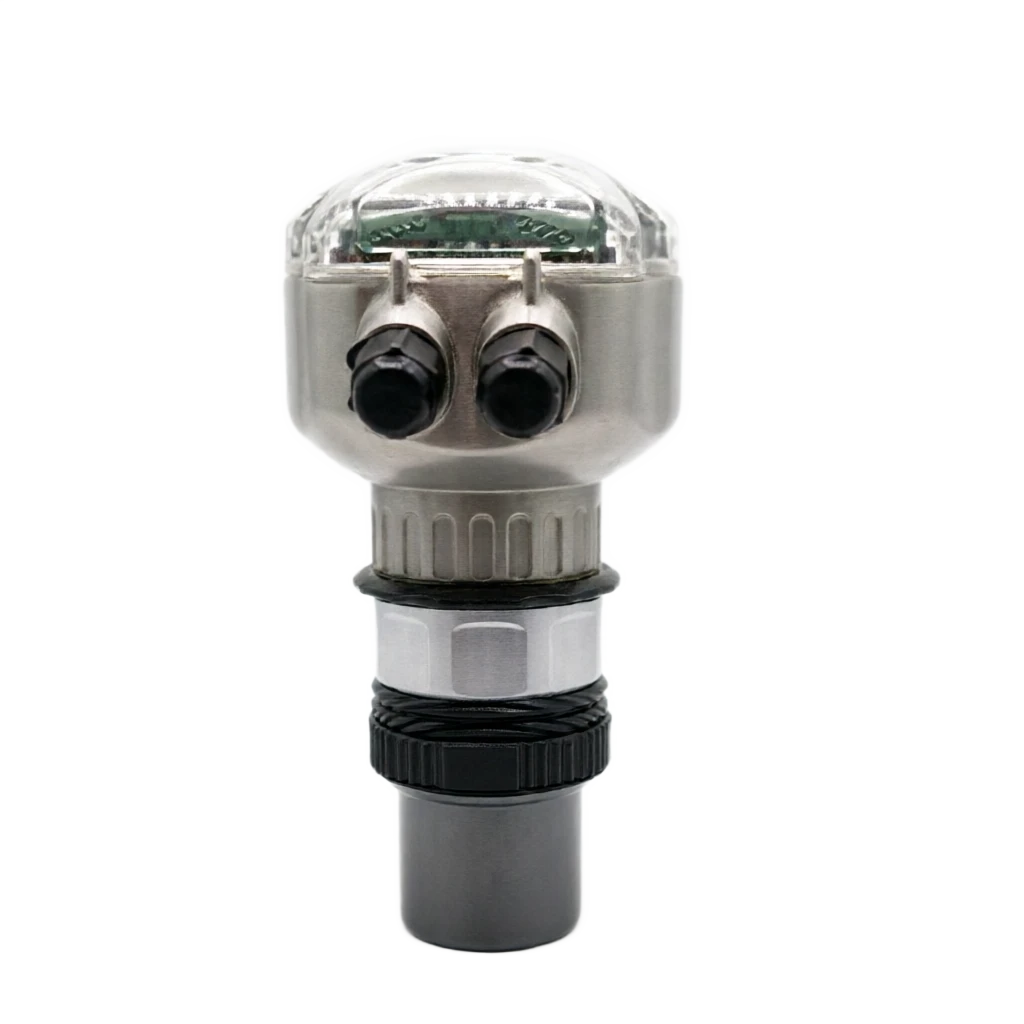
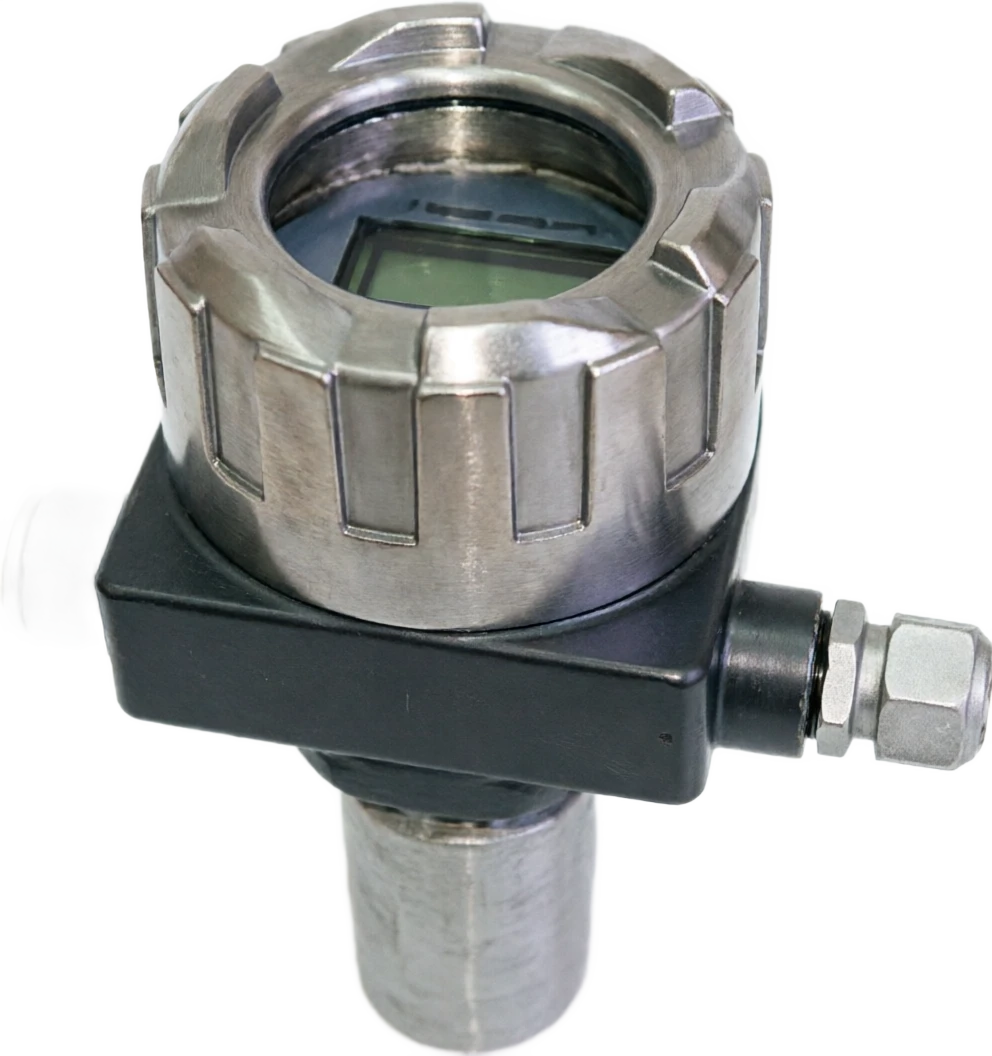
By acoustic probe, electronic module, human interface, shell, installation of Frank 5

Most of the composition, structured as follows (top-down)

Shell / Wire cavity

Material / Form: Aluminium alloy / stainless steel / plastics Primary function: Protection Level IP65 ~ IP68, Loading all internal components

Show Modules

Material / Form: LCD / OLD English menus Main function: Show liquid position, temperature, current, alarm

Main circuit board (CPU)

Material / Form: MMU + DSP Main function: Generating incentive, echo detection, temperature compensation, false echo inhibition, 4~20 MA output

Temperature sensors

Material / Form: PT1000 / Digital temperature supplementation Primary function: real time measurement of ambient temperature, compensatory acoustic speedc

Porcelain chips.

Material / Form: PZT-5 / PZT-8 Primary function: complete electrical acoustic conversion (core sensitive component)

Match Layer

Material / Form: epoxy resin / tungsten powder composites. Primary function: Acoustic resistance matching, more efficient launch

Sound lens / Focus

Material / Form: PE / PTFE / Silicon Rubber Primary function: Focused beams, increased direction

Spectrum shell.

Material / Form: PVDF / PP / PTFE / stainless steel

Process Connection / Frank

Material / Form: screw G2 / Frank DN50+ / Carpentry Main function: Connect to top or side tube of the tank

Cable entrance / Grand Head

Material / Form: M20 × 1.5 / ½"NPT Main function: Power + Signal cable introduction, IP68 seal

Probe type

Component: Frequency Material / Form: beam angles. Primary function: Quantum scale Typical application

HF short-range survey

Component: 100 ~ 200 kHz material / form: 3 ° ~6 ° main function: ≤ 6 m small water tank, process tank, reaction sheet

Medium frequency general survey

Component: 40 ~ 80 kHz material / form: 6 ° ~10 ° main function: ≤ 15 m pool, water treatment, city, fire tank

Low frequency remote detection

Component: 20 ~ 40 kHz material / form: 10 ° ~15 ° main function: ≤ 30 m deep well, deep pool, large stand-by tank

Cleaning up.

Component: 40 kHz material / form: 8 ° Primary function: ≤ 15 m sewage tank, solid particles, easy to tie media

Partite probe

Component: 40 ~ 80 kHz material / form: 6 ° ~10 ° Primary function: ≤ 15 m high temperature, strong vibration, long range signal transmission

Shell Level

Component: Protection level Materials / Form: Material Primary function: Applicable environment

Generic

Component: IP65 material / form: Aluminium alloy spray main function: indoor, mechanical, simple outdoor

Enhanced

Component: IP67 material / form: aluminium alloy cast / stainless steel

Dive.

Component: IP68 Materials / Form: PVDF / stainless steel 316L Primary function: Dive installation, wells, long-term inundation

Preservative type

Component: IP67 material / form: PVDF complete / PTFE liner main function: acid alkaline, embedding above the corrosive medium

Health

Component: IP69K material / form: stainless steel 316L mirror polishing main functions: food, beverages, pharmaceuticals, biofermentation

04

TECHNICAL GUIDE

Analysis of strengths and weaknesses

4.1 Main advantages

4.1 Main advantages

Non-contact measurements

Note: No contact with the medium, no corrosion, dirt, congestion, health concerns

Install Easy

Note: Top open-pore screw/Frand installation, without damage to tanks, debug 5 ~ 15 min

Price economy

Note: At equal scales, the price is approximately 1/3 ~1/5 for radar bitings.

Wide application

Note: Water, sewage, oil, acid alkaline, plasma can be measured (except for strong foam/steam)

Displayable

Description: Integrated LCD, direct reading of liquids on site, except for the live dashboard

No active widget

Note: Non-activated mechanical parts, MTBF usually > 10 years

Air height/LiPhone Double-Specific

Note: The fluid level can be exported at the same time as the remaining space to facilitate high-level alerts

Temperature compensation

Note: Internalized PT1000 autocompensation for acoustic changes within -40 ~ +80 ℃

Multi-Panel Output

Description: Support 4~20 maA + HART / Modbus / Profibus PA / FF

#

Advantages: shortcomings

The strong foams are causing loss.

Note: Loading of conductor tubes (PP/stainless steel) or running of probes from side to side

Mass steam / fog causes decay

Note: Increase launch power or switch to radar position count

High dust / particle loss

Note: Air-blowing devices added or converted to radar position count

Blind zone restrictions

Note: The level of liquids approaching the top of the tank enters the blind zone (approximately 0.25 ~ 0.5 m) and needs to be increased to the height of the installation

Temperature compensation limits

Note: Non-linear changes in acoustic speed at low/high temperatures, with compensation for extended temperature

Medium precision

Note: ±0.25% ~±0.5% FS, less than Magnetic Zooming / Radar, not applicable to trade measurement

I'm not gonna let you get away with it.

Note: Use of false echo learning (FES) to avoid mixing oars/heating tube interference

Not for a vacuum tank.

Note: Soundwaves need medium to communicate, not working in a vacuum

05

APPLICATIONS

Application area

Applicable to Quantities (≤15)

m) The measurement of liquids at constant temperature pressure and relatively clean environment, with the following typical application scenarios:

5.1 Applications not recommended

Not recommended 1

Large foam + highly mixed pressure tanks (e.g. beer fermentation tanks, sugared pots) with severe loss of wave, should be replaced by radar position metrics or conductive radars.

Not recommended 2

High vapour / high dust (e.g. steam boilers, coal powdered bunkers) with severe acoustic decay, and should be replaced by radar biting.

Not recommended 3

Vacuum / negative pressure tanks, which cannot be transmitted in a vacuum, should be replaced by differential / radar / magnetic stretching.

Not recommended 4

Trade measures (equipment ± 0.5% FS is not sufficient to meet trade settlements) should be replaced by magnetic scalding ± 0.5 mm or mass flow metrics.

Municipal water supply

Typical applications: water reservoirs, secondary water tanks IP68 Waterproof.

Water treatment

Typical applications: sewage, filtration, filtering, cleaning water ponds

Fire

Typical applications: fire-fighting water tanks, high-level water tanks, spray tanks IP68 / Battery power is suitable for power outages

Chemical storage tanks

Typical applications: acid-alkali tanks, process tanks, intermediate tanks Recommended rationale: PVDF/PTFE probes resistant to corrosion

Food and drink

Typical application: Juice, milk, syrup, recommended rationale: Sanitary 316 L + IP69K Application CIP

Pharmaceutical / Biofermentation

Typical applications: culture-based tanks, buffer tanks

Paper / Print

Typical applications: Whitewater, Blackwater, Escalation. Recommended rationale: Clean detection of contamination.

Agricultural irrigation

Typical applications: reservoirs, channel fluids. Reason for recommendation: solar + 4G wireless program matures.

River level

Typical applications: riverways, reservoirs, tides. IP68 Dive + Mine-protective

Power plant / metallurgical

Typical applications: chemical water tanks, circulatory pools, saline-water tanks

06

TECHNICAL SPECIFICATIONS

Technical Parameter Table

The following table summarizes typical technical parameters for the industrial ultrasound liquids scale, covering most of the plants (e.g. Siemens SITRANS Probe).

General specifications of LU, VEGA VEGA 60, E+H FMU 30/40/90, Trans River ULG100, etc.)

Technical Parameter Table # / Parameter ItemCross-reference
#Parameter ItemTypical specification
1Measuring span0.25 ~ 30 m (by header frequency)
2Dead zone0.15 ~ 0.5 m (the smaller the probe, the better)
3Measurement accuracy± 0.25% FS (high accuracy); ± 0.5% FS (standard)
4Resolution1 mm / 0.1%FS
5Working frequency20 ~ 200 kHz (HF short, low frequency long distance)
6Beam angle3 ~ 15 ~ (higher angles and smaller frequency)
7Working temperature40 ~ +80 °C (probate), 20 ~ + 70 °C (electronic)
8Process pressure≤ 0.3 MPa (normal pressure); pressure resistant ≤ 1.0 MPa
9Media RequirementsThe liquid surface is calm, there is no foam, there is no steam, there is no dust explosion.
10Temperature compensationInline PT1000, automatic compensation -40 + 80 °C
11Output signal4~20 ma+HART (two-line/ four-line)
12Communication protocolsHART 7 / Modbus RTU / Profibus PA / FF
13Electricity voltageDouble-lined 12~30 VDC; Four-line 24 VDC / 220 VAC
14Work≤ 1.5 W (two-line system); ≤ 5 W (four-line tape display)
15DisplayLDC Chinese menu + Barchart + 4 bits
16Ingress protectionIP65 / IP67 / IP68 (Dive)
17Explosion protection markingEx ia IIC T6 (Ben)/Ex d IIB T4 (separation)
18Process connectionG2 / G1 (b) A single-sniff; DN50 / DN80 Frank, Carpenter. 2 "/ 3 "
19Probe materialPVDF (resisting of corrosion)/PTFE (strength of acid)/ stainless steel 316L (sanitation)
20Body materialAluminium alloy / stainless steel 316L / plastic (IP65 economic)
21Cable entrance.M20 × 1.5 / 1⁄2 "NPT, with PG Grand Head
22Response time1 ~30 s (modifiable, default 4 s)
23False echo suppressionFES Learning function, record maximum 20 interference points
24Disorder diagnosisLoss alarm, empty tank set, false echo tracking, temperature abnormal.
25AuthenticationCE / CCC / Blast/ SIL 2 / Measurement Device Type Approval
07

SELECTION GUIDE

Select Table

The selection should be in the form of "Quantification Process", "Specific Detection", "Media Compatibility", "Explosion Control", "Specific and Control".

"Communication Protocol" five steps down, five subdivided spectrometers.

7.1. Type by scale

Selecting table . Code / ScaleCross-reference
CodeRangeFrequencyDead zoneTypical applications
UL-A≤ 6 m100~200 kHz0.15 mSmall water tanks, process tanks, response packages
UL-B≤ 10 m60~80 kHz0.20 mMedium water pools, reconciliation pools
UL-C≤ 15 m40~50 kHz0.30 mLarge reservoirs, water treatment, fire tanks
UL-D≤ 30 m20~30 kHz0.50 mDeep wells, deep water pools, large stand-up cans
UL-E≤ 6 m (cleaning from)40 kHz0.30 mSewage tanks, grain-bearing, easy-to-contain media
sceneRecommended scaleProbe materialProtectionCommunications
Cleaning pool.UL-B/CPVDFIP684~20 mA / HART
SewageUL-E (cleaning from)PP / PVDFIP684~20 mA / HART
Fire water tankUL-B/CPVDFIP684~20 MA+ dry point
Acid storage tanksUL-A/BPTFE / HaxIP67HART + FF
Food cansUL-Astainless steel 316LIP69KHART / Modbus
Process CansUL-A/BPVDFIP65HART / Profibus
River levelUL-D+solarPVDFIP684G / NB-IoT / LoRa
Deep wellUL-DPVDFIP68Battery power + Wireless
Reactivate (≤ 200 ℃)UL-A splitstainless steel + high temperature cableIP65HART / 4~20 mA
Media TypeMedia ExampleProbe materialAttention
M1 Water purificationWater, water, water, desalinized waterPVDF / 316LNormal.
M2 SewageHousehold sewage, industrial wastewaterPP / Clean-upIt's either clean or air-blowing.
M3 AlkylHCl / Naoh / SaltwaterPVDF / PTFE / HaePVDF Algebra Durable, PTFE Strong Algebra
M4 OilCrude oil / diesel / lubricants316L / PTFEWe need to be careful with the steam effect.
Select Table . Media Type / Example of MediaCross-reference
Media TypeMedia ExampleProbe materialAttention
M5 PlasmaPulp / mud / minePP / Clean-upCleaning or cathetering tubes
M6 FoodMilk / Juice / Flut316L Health levelIP69K + Mirror polishing
M7 with granulesMixer / SandwaterPP + CleanupThe air is necessary for the air-blowing.
CodeExplosion protection typeIngress protectionTypical applications
EX-NNo blast-proof (normal)IP65Airroom, outdoors, non-hazardous areas
EX-DEx d IIB T4IP67Chemical storage tanks (explosive gas environment)
EX-IEx iIC T6IP67 / IP68Above the embers, flammable, explosive medium
WP-ANo blast + IP65IP65Installations indoors
WP-BNo blast + IP67IP67Outdoor, wet environment
WP-CNo blast + IP68IP68Dive installation, wells, long-term water inundation
WP-DNo blast + IP69KIP69KFood, pharmaceuticals, CIP flushing
CodeProcess connectionSpecificationsApply scene
CN-T1ThreadG2 / G1½Small, process, economic
CN-T2It's a fine screw.2"NPT / 1.5"NPTNorth American standards, process tanks
CN-F1Frank.DN50 / DN65 / DN80Medium tanks, tanks, pressure containers
CN-F2Frank.DN100 / DN125Large cans, easy to unload
CN-C1Health card2" / 3" Tri-clampFood, beverages, pharmaceuticals
CN-S1Installation of the supportType L / -way supportOutside, riverways, top of the pool.
08

SELECTION GUIDE

Selective guidance and trouble-checking

8.1 Nine-step selection process

Summary

The ultrasound liquids are the primary instrument for small and medium-sized ranges, constant temperature pressure, and non-contact, with significant advantages in terms of low price, fast installation and low maintenance. The selection should focus on four main elements of quantum range, blind zone, temperature compensation, media compatibility, and consider upgrading to radar or conductor radar programmes for special conditions such as strong foam, high vapour, vacuum, high precision, etc.

Selective guidance and troubleshooting . Step / TaskCross-reference
StepsTasksKey issues
1Clearly measure objectsLiquid / plasma / oil / acid / ? media density, viscosity, corrosiveness?
2Determine the scaleCanal height H? / Minimum fluid level? Blind zone?
3Assessment of the environmentMedia temperature, process pressure, steam / foam / dust?
4Select the scout.7.1. UL-A/B/C/D/E; Preference in media
5Select protection.IP65/IP67/IP68/IP69K by environment
6- Take the blast.Explosive gas / dust environment? Ex d / Ex ia
7Select Communications4~20 ma+HART (most commonly used)/ Modbus /Profibus / FF / 4G
8Select Connectionscrew / Frank / Carp/ stand, press 7.5 table
9Order.Check power voltage, display language (Chinese), authentication (CE/CCC/SIL)
#Attention
1Avoid the blind zone: maximum liquid level should be at the spot ≥ 0.3 m (i.e. blind area + safety sufficiency)
2Avoiding barriers: ladders, mixing, heating tubes in the tank should be removed from the periphery beam radius (general 0.3 ~ 0.5 m)
3Probe Vertically Down: Vertical Dividing Zoom ±2 ° Otherwise the echo will weaken
4Temperature compensation line length: Temperature sensor to detect ≤ 1 m, otherwise compensation is not available
5Cable shield: use of double winch, single end of shielding to avoid parallel lines of power cables
6Power stability: voltage fluctuations ≤ 5%, pressurers or barriers, if necessary
7Cannertop takeover: take over height ≤ 0.3 m, I.D. Zippo, probe diameter, otherwise decaying beams
8False echo learning: once in the empty cans of first installation, once in the second when the barrier is added
9Mine/water: outside installation should be equipped with a mine-proof fence + water-protected wire box
10Preserve the blind zone: no maximum liquid level of the tank ceiling should enter the blind zone, otherwise the output range is full
Fault phenomenaPossible causeMeasures to address
Output 22 MA (overrange)Lost wave / fluid level into blindLower the height of the probe / Reempt the cans for learning
Output 4 MA (Ure Low)Rebroadcast weak / detector failureChecking power, cleaning the probes, relearning.
Selective guidance and trouble-shooting • Fault phenomena / Possible causesCross-reference
Fault phenomenaPossible causeMeasures to address
Output jumps unstableFake echo interference.Adjust thresholds, relearning, boosting wave tubes
Large deviation and temperature variabilityTemperature compensation for failureCheck PT1000, check inside.
The fluid is still flat and flat.Liquefied foam/ steamRe-use radar, increase wave tubes or lower the height of the probe
Show spaces/ nonePower/ panel failureCheck 24 VDC power, replace display module
The measure is higher than the actualFalse echo recognition errorReempting the cans of learning FES, adjusting the gain
The measured values are lower than actualSignal decay / PossibilitiesCleaning the probes, increasing the launch power.
Communication Failed (HART)/ Blocking mismatchBackway block 250 once ± 20%, check polarity