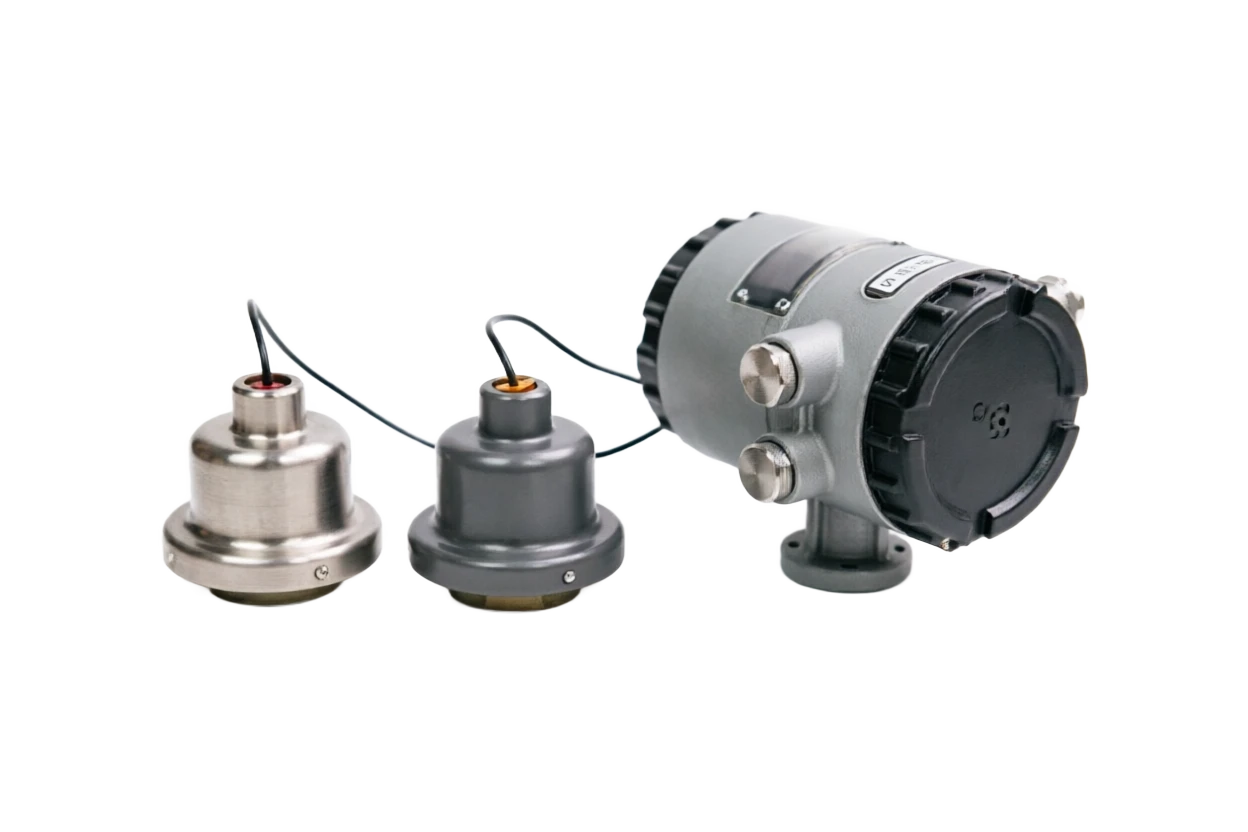
PRODUCT TECHNOLOGY

Externally-pluggized fluids

Operating principle

External liquid bitmeters.

(b) Ultrasound (voltage ceramics PZT) sends ultrasound vertical waves at a certain frequency (usually 200 kHz~1 MHz) to the jar wall, which is transmitted through the jar wall into the liquid inside the tank and returns to the probe after reflection by the gaseous interface; Distance from echo time t to sound speed c to reach the liquid surface D = c.t / 2 :D = c · t / 2 (c) Sound speed in medium, water ≈1480 m/s) c = ⁇ (K / old) (sonic c depending on liquid elasticity K and density old) radar probe (K / old) 80 GHz / 120 GHz mm wave) sends a microwave pulse at the wall of the tank, which can penetrate the non-metal jar wall (plastic, glass steel, glass), and reflect on the metal jar wall, so the radar is overloaded.

  1. 01

    1 . ..proximation .. high-pressure pulse triggers voltage ceramics, generating ultrasounds.

  2. 02

    2 Through the canal wall .. acoustics through the coupling agent (silicate/ butter)

  3. 03

    3 Intra-wall transmission . Sound waves spread in the cans (sonic ⁇ 5900 m/s in steel)

  4. 04

    4 Wall-Line Interface Transmitting . Sound waves enter liquid media through inner walls

Externally-plugin selected support

Provide survey missions, media and installation conditions and obtain product configuration advice.

Contact us
External liquid bitings Technical note

TECHNOLOGY & APPLICATION

Understand the principles, the exact selection.

From measurement principles to field applications, the technical features and selection elements of the external LMP are understood.

01

TECHNICAL GUIDE

Overview

(External-mounted Lever Meter) is a completely non-contact tank grade meter. Its sensors (ultrasound or radar antenna) are installed on the outer wall of the tank, which transmits energy through the wall by ultrasound or electromagnetic waves, and is at the height of the liquid position in the tank by a backwave time difference. The tank is unopened and unexposed throughout the measurement process.

Because of its unique advantages of being unopened and unreached, it is an irreplaceable option in the following scenario: a strong corrosive tank (cans, i.e. a barrier to isolation), a -sanitary tank (food/pharmaceutical/bioCIP), a -flammable explosive tank (without wall seals) and a -permary refit tank (unopenable storage tank).

02

MEASUREMENT PRINCIPLE

Motion of work (ultrasound/ radar breach)

2.1 Hypersonic external-posted liquid-position method

(b) Ultrasound (voltage ceramics PZT) sends ultrasound vertical waves at a certain frequency (usually 200 kHz~1 MHz) to the jar wall, which is transmitted through the jar wall into the liquid inside the tank and returns to the probe after reflection by the gaseous interface; Distance from echo time t to sound speed c to reach liquid D

= c.t / 2: D = c t / 2 (c for medium medium acoustic speed, hydrophoto 1480 m/s)

L = H - D (H for installation height = distance from the bottom of the can)

c = ⁇ (K / old) (sonic c depending on liquid elasticity K and density)

2.2 Radar external drop-down liquid-positioning principles

Radar probes (80 GHz / 120 GHz mm wave) send microwave pulses into the jar wall, which can penetrate non-metal canned walls (plastics, glass steel, glass), and reflect on the jar wall, so the radar externals are only applied to non-metallic jars. The formula corresponds to the normal radar: D = c.t/2 (L = H - D).

2.3 Signal transmission path (8 steps, ultrasound)

/External-mountedLevelMeter page 3 Technical Summary Technical Document — Handbook on Selection

2.4 Quarry mass conformity requirements

/External-mountedLevelMeter, p. 4, Technical Summary Technical Document — Handbook of Options

The working principles (ultrasound/ radar breach) . Serial number / linkCross-reference
Serial numberLinkCritical handling
1Detectives.High-pressure pulses stimulate voltage ceramics, generating ultrasound waves.
2Through the canister wall.Sound waves enter metal walls by coupling agents (silicate/ butter)
3Indoor transmissionSound waves spread in the cans (sonic ⁇ 5900 m/s in steel)
4Wall-Line Interface TransmutationSound waves enter liquid media through the inner walls.
5Gaseous interface reflectionRevert to liquid, the reflex strength is determined by the acoustic resistance of the interface
6RebroadcastReverting liquid tectonic condensant, receiving.
7Timespace RecognitionDistinguishing wall-side echoes from liquid resonance (first + two)
8Liquid Level Output⁇ D = c.t/ 2 ⁇ L
The working principles (ultrasound/ radar breach) . Cannerys / FitnessCross-reference
CannerysFitnessRemarks
Carbon steel / stainless steelHypersound: GoodStandard industrial applications, external preferences
AluminiumHypersound: GoodThe channel is good, but the oxidation layer needs to be observed.
Plastic / PE / PPUltrasound + Radar: AllIt's for radar.
Glass Steel (FRP)Ultrasound + Radar: AllTwilight wave is good.
Glass.Radar: GoodFood / Pharmaceuticals Transparent Cans
Scratch.Hypersound: good (testing required)The porcelain layer may affect the wave.
Nematode / ShadeWe need to assess first.The lining may be snorting, but it needs to be field tested.
03

PRODUCT STRUCTURE

Product structure

3.1 List of main components (10 major components)

/External-mountedLevelMeter, p. 5 Technical Summary Technical Document / Selective Manual Extra-Package Portometer/External-MountedLevelMate, p. 6 Technical Summary Technical Document / Options Manual

Shell / End cap

Main function: IP66 / IP67 protection to accommodate circuits Usual materials: ABS / Aluminium alloy / 316 L

Show Modules

Main function: LCD displays measurements, wave shapes, commonly used materials: glass + PC

Signal processing MMU/DSP

Main function: Rebroadcast recognition, temperature compensation

Ultrasound Launch / Receive Circuit

Main function: High pressure pulse incentive + Low noise magnification Common mass: voltage ceramics PZT

Probes (voltage ceramics)

Main function: Electro-Acoustic / Acoustic-Electro-Transformation Usage Usage: PZT-5A / Composite voltage

Collapse interface

Main function: Filling ultrasound coupling (silose resin/ butter)

Fixed devices

Main function: Magnetic inhaling / Stickling / carding / bolts Common material: Strong magnet + epoxy

Communication interface

Main function: 4~20 ma + HART / Modbus / Wireless Usage: Connector End

Power interface

Main function: DC 24V / Battery / Solar Materials Common: Wirebox + Solar Board

Shell seal

Main function: Waterproofness and Dust

Fixed Mode

Name of component: Application of tank Main function: Speed of installation Usage material: Characteristics

Strong Magnetic Sorbing

Component name: Iron tank wall. Primary function: Extreme (second class) Usual material: non-marked, mobile, suitable for temporary monitoring

epoxy glue.

Component name: Any material tank, primary function: 24 hours to fix, commonly used materials: permanently fixed, signal coupling

Cutting.

Component name: Cylinder tank Main function: Faster Usual material: Dismantling, signal coupling

Snatch fixed.

Component name: Main function: need to open a hole Common material: the most solid but the most destructive of the cans

Track card button

Component name: with a plate cane, main function: fast, commonly used materials: repositionable

Classification dimensions

Name of component: Type of primary function: Typical parameter Usual material:

By reason

Component name: External ultrasound main function: 200 kHz~ 1 MHz / Precision ±0.5% FS Usage:

By reason

Component name: External radar, main function: 80/120 GHz / precision ±1~5 mm commonly used materials:

By electricity

Component name: Wireless 24V Primary function: stable, suitable for stationary monitoring Usage:

By electricity

Component name: Battery power supply, main function: NB-Iot / LoRA remote commonly used materials:

By Communications

Component name: LoRa / NB-IOT Wireless Main function: Wire-free, remote centralized monitoring Usage:

By Communications

Component name: HART / Modbus Wireable Main function: Access to DCS commonly used materials:

Press the tank

Component name: Metal tank special purpose, main function: external ultrasound, commonly used materials:

Press the tank

Type: plastic / glass steel tank Typical parameter: external ultrasound + external radar

04

TECHNICAL GUIDE

Analysis of strengths and weaknesses

4.1 Main advantages

/External-mountedLevelMeter, p. 7, Technical summary technical document — optional manual

4.1 Main advantages

Cans are unopened.

Note: To avoid the risk of leaks through wall seals

Total non-exposure medium

Note: Not affected by medium corrosion, clay, adhesive

Health level matches.

Note: Fit food / pharmaceutical / bioreactive

Fire safety.

Note: The instrument is outside the tank and there is no electrical interface in the tank

Install Easy

Note: Magnetic suction spectrometer installation, no need to stop production

Suitable for service

Note: Fire opening without a cut-off, online loading

Disabled for reuse

Note: Magnetic insulation / card scavengers can be reused

Maintenance simplicity

Note: Clean shell is sufficient and no need to enter the tank

Wireless Options

Note: NB-Iot / LoRA / 4G remote monitoring

Disadvantages and use restrictions

Precision below insert instrument

Response: Precision ±0.5% ~±1% FS, slightly worse than input

Sensitivity to the jar wall mass.

Response: Non-metal Canter Radar / Metal Canning Ultrasound

Measurement of the impact of the wall thickness of the canister

Response: Field marking, wall thickness ≤ 30 mm

Cannery Walls / Paint Impact

Response measures: clearance of exposed paints, assurance of alignment

There's a liner in the can that could be blocked.

Response: field test for permeability

Cans are lost when they're badly rusted.

Response: Handle contact face, smooth

The metal canister radar is not able to penetrate the wall.

Response: Change to an oversound

Gaseous two-phase / Strong flow influences the echo

Response: Change to a conductor radar or a differential pressure formula

05

APPLICATIONS

Application area

/External-mountedLevelMeter, p. 8 Technical summary technical document — optional manual

Food / Beverage

Typical applications: milk, juice, syrup, beer cans

Pharmaceutical/ Biological

Typical applications: fermentation tanks, CIP tanks, culturers

Corrosion chemicals

Typical applications: hydrochloric acid, sulphuric acid, Wang Water Can, recommended solution: external ultrasound

Flammable and explosive

Typical applications: oil, light hydrocarbons, dangerous tank referral: external ultrasound (separation)

In-service tank rehabilitation

Typical application: unmoveable storage tanks

Plastic / PE storage tanks

Typical applications: water treatment tanks, alkali plastic tanks

Glass steel canisters

Typical application: Chemical glass steel storage tanks

Glass bottle / glass reaction

Typical applications: laboratories, reagent tanks

Gas / Gas station

Typical application: site LPG / fuel tank recommended option: external ultrasound (explosive)

Water / Water

Typical applications: closed water tanks, fire-fighting pools

06

TECHNICAL SPECIFICATIONS

Technical Parameter Table

/External-mountedLevelMeter, p. 9 Technical summary technical document — optional manual

Technical Parameter Table · Parameter Category / Parameter NameCross-reference
Parameter CategoryParameter NameTypical specification
Measuring PerformanceMeasurement principleUltrasound penetrating wall (mainstream)/ Radar penetrating wall (non-metal tank)
Measuring PerformanceApplication of tank materialsSteel, stainless steel, aluminium, plastics, glass steel, glass
Measuring PerformanceMeasurement range0.15 ~3 m (standard) / 0.3 ~ 10 m (specific)
Measuring PerformanceMeasurement accuracy±0.5% FS (ultrasound)/ ±1 ~ 5 mm (radar)
Measuring PerformanceRepeatability±2 mm
Measuring PerformanceResponse time2~5 s
Measuring PerformanceCannery wall thickness≤ 30 mm (Stone) / ≤ 50 mm (plastics)
Process conditionsProcess medium temperature40 ~ +120 °C (standard)/ +250 °C (high temperature)
Process conditionsAmbient temperature40 ~ +70 ℃
Process conditionsMedia PressureNot affected by medium pressure (non-contact)
Electrical specificationsElectricity voltage24 V DC ± 10% / 3.6 V lithium batteries / solar energy
Electrical specificationsOutput signal4~20 mA + HART / RS485 Modbus / NB-IoT / LoRa / 4G
Electrical specificationsWorkWireless ≤ 0.8 W/ Wireless ≤ 1 mW (stand by)
Electrical specificationsBattery lifetime5-10 years (wireless)
StructureProbe materialPZT-5A voltage Ceramic + ABS / Aluminium Alloy shell
StructureShell protectionIP66 / IP67
Fireproof.Explosion protection markingEx d ib IIC T6 Ga / Ex ia IIC T6 Ga
Fireproof.Bomb protection certificationNEPSI / ATEX / IECEx
AuthenticationCommunication protocolsHART 7 / Modbus / LoRa / NB-IoT / 4G
AuthenticationHealth certificationEHEDG / 3-A (food/pharmaceutical level)
EnvironmentEnvironmental humidity0~95% RH
07

SELECTION GUIDE

Select Table

7.1 Type by measurement principle

/External-mountedLevelMeter, p. 10, Technical Summary Technical Document — Handbook of Options

7.4 Type by mode of communication

/External-mountedLevelMeter page 11 Technical summary technical document — optional manual

Selecting Table . Code / Instrument TypeCross-reference
CodeInstrument typeApplies tanksTypical precisionPrice slot
EX-UExtra ultrasoundMetal cans are the main±0.5%FSMedium
EX-RExternal radarPlastic / Glass / Glass Steel Can±1 mmMedium High
EX-MExternal ultrasound + magneticIron tank (second stage installation)±0.5%FSMedium
EX-WWireless NB-IoLoAny can/ remote centralized monitoring±0.5%FSMedium High
EX-SHealth level (EHEDG)Food / Pharmaceuticals±1%FSHigh
TanksRecommended programmeKey requirements
Carbon steel / stainless steelExtra ultrasound≤ 30 mm thickness of cans
AluminiumExtra ultrasoundRemove the oxidation film.
Plastic / PE / PPExternal radar (80 GHz)Transcript is good, it's very precise.
Glass Steel (FRP)Externals Ultrasound / RadarField test coupling.
Glass.External radarIt's a perfect glass-breaker.
Scratch.Extrasound (test required)The porcelain layer may affect
Scrolls/ ScolletsWe need to test it on site.The lining could be snorting.
CodeApplicationsRecommended instrumentKey parametersRemarks
SC-01Food sanitation cansExternal radarEHEDG AuthenticationOpen-open, clean, clean.
SC-02Pharmaceutical fermentation cansExternal radarCIP CompatibilityGMP requirements met
SC-03hydrochloric acid / sulphuric acid canistersExternal sound316L + PTFEPreferably on a corruption-resistant occasion
SC-04LPG Gas CanExternal ultrasound (explosive)Ex d disinterruptionNo leaks through the walls.
SC-05In-service tank rehabilitationMagnetic Extrasonic24V DCFire-free, cut-off.
SC-06PE Water storage tankExternal radar80 GHz Permolite plasticsPrecision ±1 mm
SC-07Glass ReactionExternal radarThrough the glass.It's common in laboratories.
SC-08Buried LPG CanExternal soundBattery + 4GRemote Wireless Transfer
SC-09Water fire pondsExtrasonic (cells)LoRa / NB-IoTFree-wire
SC-10Petrol / diesel tankExternal ultrasound (explosive)Ex d disinterruptionIt's safe.
Selective Table · Communication Method / Applies sceneCross-reference
CommunicationApply sceneCharacteristicsWork
4~20 mA + HARTFixed access DCS / PLCSteady, undisturbed.Wireless power supply
RS485 ModbusMulti-group surveillanceHangable 32Wireless power supply
LoRaLong distance low power1 ~ 5 km, open areaBattery 5-10 years
NB-IoTOperator Network Wide AreaFree from building base stationsBattery 5-10 years
4G / 5GCloud platform centralized surveillanceReal time sex.External power supply
Wi-Fi/ BluetoothIn situ debuggingPortable debugging toolShort Distance
08

SELECTION GUIDE

Selective guidance and trouble-checking

8.1 9 Step Process

/External-mountedLevelMeter, p.12, Technical Summary Technical Document . Selected Manual external to the L.D./External-mountedLevelMate, p.13

Selective guidance and troubleshooting . Step / ContentCross-reference
StepsContentsCritical judgement
1Clear tankMetal / plastic / glass / glass steel
2Clear the wall thickness of the can.≤ 30 mm Steel / ≤ 50 mm Plastic
3Determine the scalePlugging a probe to the bottom of a can = a scale
4Determine media and temperatureCorrosion, Zoom, select 316L + PTFE
5Determine precision requirementsProcess ± 0.5% FS / Trade ± 0.1% FS
6Determination of the mode of communicationWireless HART/ Wireless NB-Iot/ LoRA
7Establishment of power supply24V cable / battery / solar
8Identify blast/protectionEx d / Ex ia + IP66/67
9Assessing installation conditionsExtra-cannel space, wall status
Serial numberAttentionReason
1Clear the jar wall paint / rust / dustGuarantee soundwaves/ radar coupling
2Spectrum and canister wall coating ultrasound couplingsReduced acoustic resistance to mismatch losses
3Avoid canisters to strengthen the band/ weldsPrevent sound dispersive interference.
4Metal Cans Preferred ExtrasonicRadar waves are not able to penetrate metal.
5Plastic tank preferred external radarIt's better to get plastic.
6Spectrum Top ≥ 50 mmAvoid top interference.
7Stay away from the powerful electromagnetic interference source.Guarantee signal quality
8Magnetic adsorption needs to be checked for solidness.- I'm not gonna let it go.
9Open-air shieldingUV-resistant, rain-resistant snow
10Observe echo curves when debuggingConfirm the wave and the surface wave clear.
Fault phenomenaPossible causeMeasures to address
Show no liquid positionNot close enough to detect / co-ordinateRecoup, tighten.
Measured jumpCannery Walls / Paint ImpactCleaning of cans of walls, re-installation
Low measuredCandle wall thickness error / sound speed deviationRemark canton wall parameters
Selective guidance and trouble-shooting • Fault phenomena / Possible causesCross-reference
Fault phenomenaPossible causeMeasures to address
High measuredUnderlying interference error identification.Set Bottom Block
Show no signalCollator failed / Dispersion damagedAdd a coding agent / replace the probe
Electricity constant 4 MAThe instrument's down.Check HART fail code
Electricity constant 20 maThe instrument's fail-safe.Check the scale, the echo signal.
Wireless communication is out.Battery battery is non-electrified / operator's signal weakReplacement of batteries / fitting up antennas