PRODUCT TECHNOLOGY

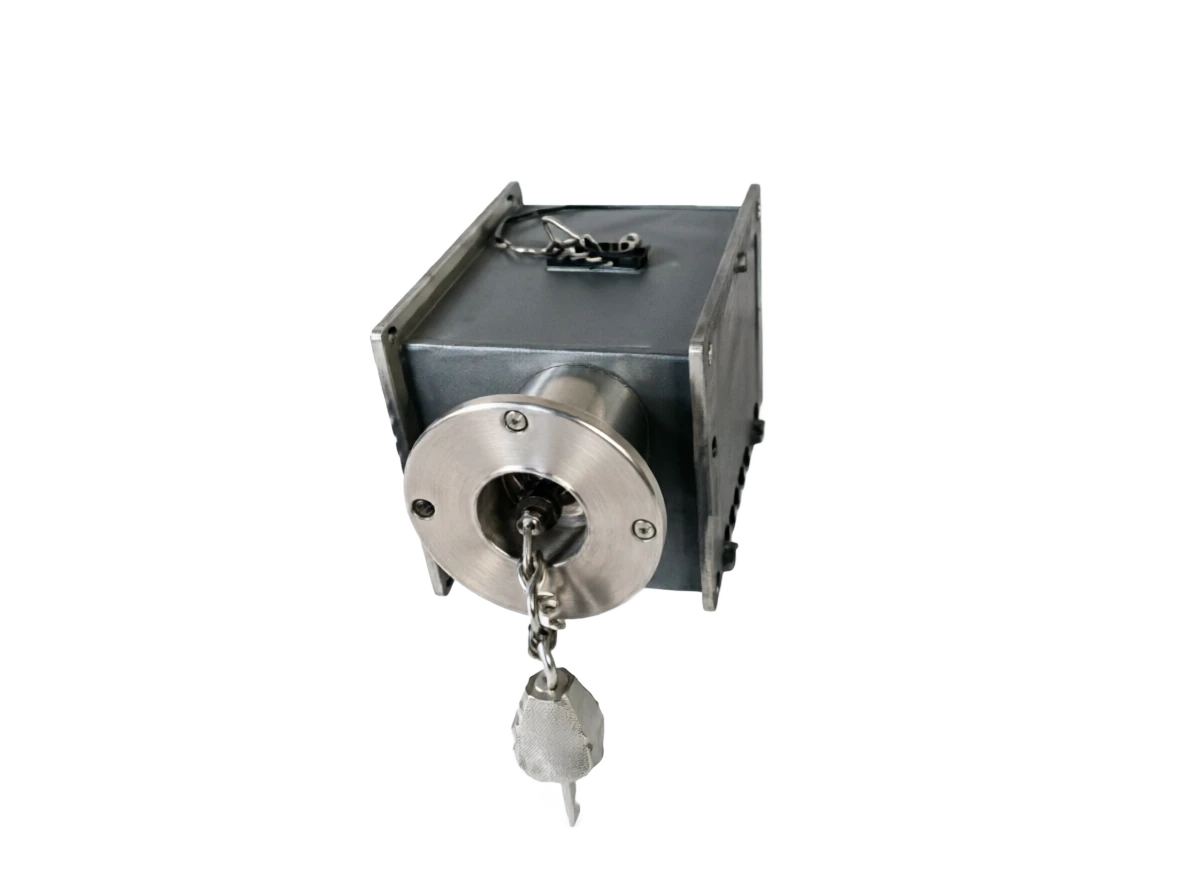
Hammer Bitmeter

Operating principle

The hammering betometer.

The core is the "measured drum" installed at the top of the warehouse. The drums are internalized with servers, speed-reducing machines, rollers and optical coders. After the instrument is electrocuted (automatic or timed), the MPU controls the server is turning, the wheeling wheel slowly releases the cable/steal, and the hammer (also known as the probe) at the end of the cable relies on self-regulating equilibria. When the hammer is transferred to the material surface, the cable is suddenly less stretched, and the electrical current is reduced or the tension sensor signal is altered. The instrument, by detecting current or tension signals, judged that the heavy hammer had touched the material, immediately stopped decentralizing and started reverse recovery. The PV encoder is installed on a wheeled arc, sending a pulse signal at every angle (responding to the cable's decentralization distance) and MMU cumulative pulses x unit pulses are aligned

  1. 01

    • Aerial airborne current ⁇ 0.1A; after load surge to 0.5 ~1A • Simple structure, low cost • Vulnerability to grid fluctuations, low sensitivity

  2. 02

    The tension sensor method, the heavy hammer toucher, the tension, the sensor output, the sensitivity, the responsiveness, the need for extra tension sensors.

  3. 03

    Encoder algorithms • Photocodifier records the length of the cable's decentralised length • high accuracy, anti-disruption • only range detection, no recognition of the "touch" state

  4. 04

    · Consolidated determination · current + tension + encoder combined judgement = highest reliability = structural complexity and high cost

Remixing toolplugging support

Provide survey missions, media and installation conditions and obtain product configuration advice.

Contact us
Heavy hammering feed bitmeters . Technical note

TECHNOLOGY & APPLICATION

Understand the principles, the exact selection.

From measurement principles to field applications, the technical characteristics and selection elements of the hammered positionometer are understood.

01

TECHNICAL GUIDE

Overview

(Plumb-Bob / Weight-Type Lever Meter), also known as the mechanical, cable, steel belt hammers, is a continuous position gauge of the altitude of the material by means of electric-driven hammers falling inside the container and rising after exposure to the material. It calculates the surface distance of the material from the installation of the Frank by measuring the decentralized length of the cable/belt, thus obtaining the real-time feed position of the material in the warehouse.

It dates back to the 60 era and is one of the main programmes for the measurement of early large industrial silos. It is not sensitive to the properties of the medium (dust, steam, temperature, density, electrical constants, etc.) and is particularly suitable for the location measurement of solid materials such as cement powder, coal powder, mine powder, food, plastic particles, etc., which is widely used in the cement, electricity, metallurgical, chemical, food industries, etc.

Main features

Developmental progress

The hammered feed bitmeter originated in the 60 of the last century, initially in mechanical steel belt structures, and in the 80 years, the introduction of electronic encoder + CMU control was gradually introduced to measure a significant increase in accuracy and stability; 90 introduced smart control algorithms and bus communications in the late years; It has evolved into a high-precision, long-lived, intelligent, networkable industrial position gauge.

Plumb-

General description · Serial number / Main featuresCross-reference
Serial numberMain featuresBrief description
1Not affected by the material.Not affected by dust, steam, temperature, density, medium constant, almost all solid materials applicable
2Large range of measurementsSingle stations can reach 0-50 m, maximum 80 m, suitable for large silo measurements
3Higher precisionTypical precision ±1 ~ 5 cm, relative error ±0.5% FS
4Numbers Show IntuitiveLD / LED directs percentage of material, residual capacity, etc.
5Install EasyThe top opening is installed, with a small impact on the container structure.
6Multiple Output ModesRelay / 4-20mA / Hart / Modbus / Profibus-PA optional
7Maintenance easeModular design, cable / hammer replacement on site
8Price is moderate.The measurements above 30 m have cost advantages over radar, ultrasound positional.
02

MEASUREMENT PRINCIPLE

Operating principle

2.1 Mechanical decentralization rationale

The core is the "measured drum" installed at the top of the warehouse. The drums are internalized with servers, speed-reducing machines, rollers and optical coders. After the instrument is electrocuted (automatic or timed), the MPU controls the server is turning, the wheeling wheel slowly releases the cable/steal, and the hammer (also known as the probe) at the end of the cable relies on self-regulating equilibria. When the hammer is transferred to the material surface, the cable is suddenly less stretched, and the electrical current is reduced or the tension sensor signal is altered. The instrument, by detecting current or tension signals, judged that the heavy hammer had touched the material, immediately stopped decentralizing and started reverse recovery.

2.2 Range and calculation principles

The PV encoder is installed on a scrollboard axis, and, with the release of the cable, sends a pulse signal at every angle (the corresponding distance of the cable's decentralization distance), the MMU cumulative pulses x the distance corresponding to the unit pulse, and receives the total decentralization length of the cable L.

Height H from Lower

H = H_total - L + ⁇ where H_total is the distance from the installation of Frank to the base (user-set); L is the length of the cable; and the fine-adjusted amount of post-heavy hammer tentacles (manufacturing default 50 ~ 100 mm).

After measuring altitude H, the instrument can be obtained by the HX warehouse interdiction area = material volume, multiplied by density mass, thus achieving the material content "residual capacity" display, which facilitates the management of production movements.

2.3 Method of detection

2.4 Workflow mapping

Plumb-Plumb-

The working principles, the test methods, the principles.Cross-reference
Test MethodRationaleAdvantagesDisadvantages
The current mutation⁇ 0.1A; after loading, the currents increase to 0.5~1ASimple structure, low costVulnerability to grid fluctuations, low sensitivity
The tension sensor methodThe pressure is reduced after the hammer's touch, the tension is transmitted, the sensor output is reduced.High sensitivity, quick response.Additional tension sensors required
Encoder CountThe PV encoder records the length of the cable decentralised.Precision, resistance to interference.Only range can be measured, no touchage status recognised
Comprehensive determination methodElectricity + tension + encoder synthesisMaximum reliabilityComplex structure and higher cost
Motion of work . Step / ActionCross-reference
StepsActionsAnnotations
1Measuring triggersTime / Manual / Remote Trigger Measurement Command
2Power decentralizationThe server is turning, the cable / the steel belt is slowing down the hammer
3tension / current monitoringMonitor tension / current signals in real time
4Touchage determination/ Fluids of the current
5The power stops / reversesStop decentralising, twirling and reverse the hammer immediately.
Motion of work . Step / ActionCross-reference
StepsActionsAnnotations
6Encoder CountCumulative pulses, ⁇ , cable decentralised length L
7Location CountH = H_total - L + δ
8Output / Display4-20mA / Hart / LCD display location / residual capacity
03

PRODUCT STRUCTURE

Product structure

3.1 Complete structure

Composed of the surface (shell, electrocular cavity, display module, electrical interface), measuring drums (electric + speed-reducing machine + scroll + encoder + tension detection), cable/codifier, hammer (probation), process connection (Franc/screw), control circuit board, etc. The outer casings are usually found in aluminium alloy or engineering plastics with a protection level of up to IP65 ~ IP66.

3.2 Hammer type (probate)

Plumb-

3.3 An overview of the output mode

Plumb-

Shell

Main function: Protect internal components Typical material: clasped aluminium / engineering plastic / stainless steel optional

Electronic cavity

Main function: Installation of main panels, power, display module Typical material: PCB + seal

LCD/ LED display

Main function: Show location, residual capacity, alert information Typical material: LCD LCD / LED count

Key / Operation

Main function: Field parameter setting Typical material: Silicon key / Magnetic bar operation

Electrical connection

Main function: Power / Output connection Typical mass: M20 / 1/2 "NPT/ Waterproof interface

Process connection

Main function: Connect to top of the warehouse Typical material: Frank DN100 / DN150 / G3 etc.

Measurement drums

Main function: Mechanical motion core Typical material: Aluminium alloy / stainless steel

Servers

Main function: Drive the wheeling typical mass: 24V straight current / 220V transient

Speed-reducing machine

Main function: Reduce speed and increase the twister

Tire Disk

Main function: Cables / Belts Typical mass: aluminium alloy / stainless steel

Photocoding

Main function: Recording the decentralised length of the cable

The tension detector.

Main function: Detection of the change in the pressure of the heavy hammer tentacle

Steel cable / belt

Main function: Connecting hammers to roller discs Typical mass: 316 SS/ zinc-plating steel belt / stainless steel belt

Hammer (probate)

Main function: Test component for exposure to material Typical material: 316 SS / Cast iron / PTFE overlay

Seal / Guide

Main function: Preventing dust from coming out of the water

Hammer Type

Structure module: Structural characteristics Main function: Typical application Typical material:

Standard cylinder

Structure module: Cylinder weight hammer, weighing 0.5~2 kg, main function: powder, routine measurement of particulate matter

Reinforce Cylinder

Structure modules: 2~5 kg, with increased exposure area, main functions: heavy material, block solids Typical materials:

Cones / Rewind

Structure modules: The bottom is cone-shaped, which allows for the insertion of material, the main function: particulate material, irregular solids, typical materials:

Reload Smash

Structure module: thickening internal, shell wrapper, main function: impacting conditions such as ores, coal blocks, etc.

Blocked / mixed

Structure module: Hammer + Smuggle blades. Main function: powder, coil, bridge silos

Light / Long pole

Structure modules: long pole structure, lower impact on materials, main functions: light powder, grain, flour

Corrosion resistant

Structural characteristics: Haq alloy / PTFE covered Typical application: Corrosive Chemical Warming

Output Type

Structural characteristics: number of channels Typical applications: typical load / communications Application scene

Relay DPDT

Structural characteristics: 1-2 Group Conversion Contacts Typical application: 250VAC / 5A or 30VDC / 5A object / Lower alert, pump valve connection

Double-line 4-20mA

Structural feature: 1 channel Typical application: 24VDC roundabout power supply, maximum load 600 continuous position measurements, remote surveillance

Hart Protocol

Structural feature: 1 channel Typical application: superimpose on 4-20mA long-range parameter setting / diagnostic

Modbus RTU

Structural feature: 1 Channel Typical application: RS485 Interface PLC / DCS comm chain

Profibus-PA

Structural feature: 1 channel Typical application: PA field bus chain with DCS communication

Field bus FF

Structural feature: 1 channel Typical application: Foundation Fieldbus process control field bus

04

TECHNICAL GUIDE

Analysis of strengths and weaknesses

4.2 Main shortcomings

Plumb-

4.1 Main advantages

Not affected by the material.

Note: Not affected by the properties of the mediums, such as dust, steam, temperature, density, and meso-bulk constant, almost all solids are applicable

Large range of measurements

Note: Single stations can reach 0-50 m, maximum 80 m, especially for large warehouses above 10 m

Higher precision

Note: Typical precision ±1 ~ 5 cm, relative error ±0.5% FS, better than ultrasound berth count

Numbers Show Intuitive

Note: LCD / LED shows the percentage of material position, remaining capacity, weight, etc., directly, to facilitate production movement

Install Easy

Note: French openings are installed at the top, with low impact on container structure and low retrofit costs

Price is moderate.

Note: The measurement above 30 m has significant cost advantages compared to radar position count

Different modes of output

Description: Relay / 4-20mA / Hart / Modbus / Profibus-PA multiple outputs, integrated with PLC / DCS

Maintenance ease

Note: Modularized design, steel cables / hammer / encoder can be replaced on site

Disadvantages and use restrictions

Long measurement period

Note: A single measurement takes between tens of seconds and minutes, does not allow continuous measurements in real time and is not suitable for fast-changing material levels

Mechanical wear

Note: Ethers, speed-reducing machines, cables / steel belts are worn for long periods and require regular maintenance

It's a lot of stuff.

Note: The hammer may fall into powder / particulate matter, leading to measurement deviations, and requires re-emergence design to avoid

Not for very light material

Note: Very low density material (e.g., dust, smoke) is not subject to significant post-clinic changes that are difficult to identify

The dust scene needs sealing.

Note: Fugitive risk, need to strengthen sealing / dust collection measures

Higher maintenance costs

Note: Need to periodically replace vulnerable items such as cables / hammer / encoder, with longer-term maintenance costs higher than non-contact instruments

Not for Flammable Exploding Dust

Note: Mechanical actions can generate static and friction sparks, which are prohibited for use in certain dust-proof blast scenarios

Need to reserve top installation space

Note: Retain space for roller drums at top of the warehouse and re-emergence of areas with barrier-free areas

05

APPLICATIONS

Application area

It is widely used in cement, electricity, chemicals because of its non-media-specific properties, its large range of measurements and its high accuracy.

The following table shows the common application areas:

Typical application cases

(1) Cement plant clinker silo level: install a plumb-bob level meter at the top of a 30 m clinker silo for periodic measurements. The instrument sends a 4–20 mA signal to the DCS for production scheduling and inventory management.

(2) Control of Coal Stations in the former coal storage plant

Installation of a hammer-type table at the top of the original coal warehouse at the plant, continuous monitoring of coal positions, connection to the coal-providing and coal-transmitting systems, and automatic coal supply.

(3) Control of Particle Silos at PVC Chemical Plant

Installation of a hammer-like feed position at the top of the PVC granular silo, time measurement of the position and the connection of the valve to avoid the silo being empty or spilling.

(4) Food bank wheat warehouse position measurements

Installation of a hammered beam at the top of the standing grain warehouse, timing of the grain position, and output of Modbus signals to the food storage management system.

(5) Coal Warming Station Monitoring at Steel Plant

Installation of a stabbing-resistant hammer-type positionometer at the top of the coke warehouse, time measurement of the material position and control of the discharge system.

Plumb-

Cement / Building Materials

Application scenes: cement storage, raw materials, clinker, coal, powdered powder, typical media: cement, raw materials, clinker, coal powder

Electricity / Energy

Application scenario: original coal, coal powder, ash bank, gravel, coal bunker, typical medium: original coal, coal powder, dust, lime coal

Chemical / petrochemical

Application scene: granular silos, catalyst silos, plastics, granules, typical medium: PVC particles, PE particles, catalysts, urea particles

Metal / Steel

Applied scenes: ore, mine, coal, coal, typical media: iron ore, iron ore, coke, limestone

Food / Feed

Apply scenario: grain, wheat, flour, fodder, typical mediums: wheat, corn, soybeans, flour, tweed

Plastic / Rubber

Application scenario: plastic granule, rubber granule

Building materials / concrete

Application scenario: Sandstone, Cement, Addedware

Environmental / Water Treatment

Application scenes: sludge, dusty ash, lime silos

Paper / Pulp

Application scenario: material, chemical storage, typical media: calcium carbonate, slid powder, starch particles

Food / Pharmaceuticals

Apply scenario: material, sugar powder, milk powder, typical medium: sugar powder, milk powder, starch, additive

06

TECHNICAL SPECIFICATIONS

Technical Parameter Table

6.1 General parameters for the whole machine

Plumb-

6.2 Accuracy and reliability parameters

6.3 Application of electrical parameters for media

Plumb-

Table of technical parameters · Parameters / Technical indicatorsCross-reference
ParametersTechnical indicatorsRemarks
Measurement principlePower Drive Hammer Decline + tension / current mutation + Encoder Distance—
Measure ObjectPowder / Particle / Block solid material—
Measurement range0~15m / 0~30m / 0~50m / 0~80mPress cable / length of belt
Measurement accuracy±1~5 cm, relative error ±0.5% FS—
Measurement cycleSets 1min~24h, fastest 10s/sConfigure on demand
We're going down.About 0.1 ~ 0.5 m/s, truncable—
Hammer weight0.5~5 kg, selected by medium density—
Steel cable / belt316 SS cable / zinc-plating steel beltPress Media
Process connectionFrank DN100 / DN150 / DN200; screw G2 / G3By container
Power supply24 VDC ±10% / 220 VAC ±20%By Model
Work≤ 30 W (in electric manoeuvres)Standby ≤ 3 W
Output MethodRelay / 4-20mA / Hart / Modbus / Profibus-PAOptional by Model
Relay capacity250 VAC / 5A,30 VDC / 5ADisable load
Process medium temperature40 ~ + 150 °C (by model)Customized high temperature
Ambient temperature40 ~ +70 ℃—
Operating pressureConstant pressure / ±0.05 MPa—
Ingress protectionIP65 / IP66By Model
Explosion protection markingEx d IIB T4 / Ex tD T4 (demolitions)By Model
Housing materialArgument/ Engineering Plastic / 316L SS optional—
Plumb weight material316L SS/ Cast/ PTFE covered/ Hapsy AlloyPress Media
Display typeLCD LCD / LED Digital tube / Chinese display—
Electrical connectionM20 / 1/2 "NPT/Waterproof cable locks—
MountingTop Frank Install / Thread Install—
Weight5~25 kg (by model)—
Technical parameter table · Parameter / IndicatorCross-reference
ParametersIndicatorsTest Conditions
Absolute precision±1~5 cmTemperature pressure
Repeatability±0.5 cm10 consecutive measurements
Measurement cycle10s~24hOn-site settings
We're going down.0.1~0.5 m/s truncableAs required on site
Insulation resistance≥ 100 MΩ500 V mega-eats
Pressure resistance2500 VAC / 1 minPower-to-ground stress.
MTBF≥ 50000 hoursAverage no-facilities time
EMC CompatibilityGB/T 17626Industrial-level electromagnetic compatibility
Vibration resistance5 g / 10~500 HzGB/T 2423
Media TypeTypical stack densityTypical particle sizeSensitivity advice
Cement powder1.0~1.6 g/cm³< 0.1 mmStandard is sensitive.
Coal powder.0.5~0.9 g/cm³< 0.1 mmStandard is sensitive.
Flour / grain flour0.5~0.8 g/cm³< 0.3 mmStandard is sensitive.
Plastic particles0.5~0.7 g/cm³2~5 mmStandard is sensitive.
Urine particles0.7~0.8 g/cm³1~3 mmStandard is sensitive.
limestone powder0.9~1.4 g/cm³< 0.1 mmStandard is sensitive.
Sandstone.1.4~1.8 g/cm³0.5~5 mmScalp
Iron ore1.8~2.5 g/cm³5~50 mmScalp
Charcoal0.5~1.0 g/cm³20~80 mmScalp
07

SELECTION GUIDE

Select Table

7.1 Naming rules

Selected examples

PL-S-I-1500-W1-T1-L-N-6 indicates hammer type, standard type, 4-20mA output, measured range 15m, hammer 1kg, temperature 80°C, 316L material, normal type, IP66 protection.

7.2 Summary of commonly used models

Plumb-

Selective Table . Code Section / Code ExampleCross-reference
Code segmentExample:What's code for?
PL-PLPlumb-Bob Lev series code
- TypeS/HS Standard / H Reload
- OutputR/I/H/MR Relay / I 4-20mA / H Hart / M Modbus
- Measurement range1500Four digits, in 0.1m = 15.0m
- Heave.W1/W3W1 0.5~1kg / W3 2~5kg
- TemperatureT1/T2T1 80℃ / T2 150℃
- MaterialsL/H/TL 316L / H Haps Alloy / T titanium
- Bomb protection.N/DN / D barlast / dustproof blast
- Protection5/65 IP65 / 6 IP66
Selective Table . Model / RangeCross-reference
ModelRangeOutputTemperatureHammerApplications
PL-S-I-15000~15m4-20mA80℃1kgCement depots, coal powder storage
PL-S-H-30000~30mHart80℃1kgLarge silos, silos
PL-S-R-15000~15mRelays80℃1kgTop-down, bottom-up, alarm control.
PL-S-M-50000~50mModbus80℃1kgSuper-high silo, DCS communications
PL-H-I-30000~30m4-20mA150℃3kgSteel coke warehouse, aggravated
PL-H-H-50000~50mHart150℃5kgOre warehouse, super-large
PL-S-I-1500-IP660~15m4-20mA80℃1kgDust scenes, seals up.
PL-S-D-15000~15mRelays80℃1kgThe dust-proof blast scene.
08

SELECTION GUIDE

Selection Guide

8.1 Basic steps for selection

8.2 Model job recommendations

8.3 Selective care

(1) The range of measurements should be left in surplus

The normal range of measurements = actual temperature of the silo + 1~2 m surplus to avoid failure of touchdown measurements.

(2) The strong dust environment shall be selected for a seal-enhanced (IP66) and the dust collection mechanism shall be added below the drums.

Plumb-(3) Very Low Density Media (e.g., dust, smoke) has a low change in the touch-on tension, and it is recommended that the first communication test be done with the manufacturer and that the radar be used instead of the digitized.

(4) The blast-proofing scene must confirm the blast-proofing certificate number and grade provided by the manufacturer, and the power supply / output parameters are strictly wired in accordance with blast-proof specifications.

(5) The top of the warehouse needs space for the installation of a roller drum and for the re-emergence of the area to be accessible (internal reinforcement, beams, etc.).

(6) The measurement cycle should be adjusted for the speed of variability of the medium

Change fast short-cycle; change slow long-cycle, avoiding unnecessary wear and tear.

(7) Periodic inspection of the wear and tear of the cable/belt, and replacement as necessary; it is recommended that periodic verification be conducted every 6-12 months.

(8) Cables and power supply sub-chutes should be installed to avoid co-opting with power cables; it is recommended that 24 VDC be used to isolate the power supply.

(9) The site should be equipped with a chain/shelter to avoid an accidental crash of a hammer causing a safety incident.

(10) For scalables and bridge silos, it is recommended that the problem of bridge construction (e.g., the addition of arch breakers) be resolved first, otherwise the measurements will be highly biased.

8.4 Summary

One of the most widely applied instruments in the field of large material warehouse position measurement, which, by virtue of its characteristics, is free from the influence of media, its wide range and precision, adapts to the majority of solid material measurements in the cement, electricity, chemical, metallurgical and food industries. The selection of the type needs to be combined with factors such as the density of the medium, the particle size, the height of the material, the measurement precision, and the form of output, with care to avoid the use of the hammering for very low density, stand-off bridge material and to reserve sufficient installation and maintenance space to ensure long-term stability of operation.

Selective guidance · Steps / ConcernsCross-reference
StepsElements of concernCommon Options
1Media TypePowder / Particle / Block Solid / Sticky / Strong Corrosion
2Medium densityLight < 0.5 g/ cm³ ) / Medium / Heavy > 1.5 g/ cm³ )
3Medium particle sizePowder (< 0.1mm)/ Powder / Powder / Powder / Block
4Warden height< 15m / 15~30m / 30~50m / > 50m
5Measurement accuracy±1 cm / ±3 cm / ±5 cm
6Measurement cycle1min / 5min / 30min / 1h
7Output FormRelay / 4-20mA / Hart / Modbus
8Explosive protection requirementsNormal / Disconnect / Dust Prevent Exploding
9Ingress protectionIP65 / IP66
10Hammer formStandard cylinder / Heavy / Cone / Smash
Typical Work StatusRecommended ModelRationale
Cement storage measurementsPL-S-I-1500Cement storage height 10 ~ 15 m, 4-20mA apogee
Coal powder warehouse position measurementPL-S-I-1500 / PL-S-H-3000Coal powder is light. Standard is good.
Pre-coal warehouse position measurementPL-H-I-3000Coal, massive.
PVC granular warehousePL-S-I-1500Particle material, 4-20mA, televised
Charcoal warehouse position measurementsPL-H-H-5000Coal block, low density, hammer-type.
Iron ore powder storage position measurementsPL-H-I-3000Iron ore powder is high, and the hammer is strong.
Large grain warehousePL-S-M-5000Food warehouse height 50m, Modbus comm to food system
The dust-proof blast scene.PL-S-D-1500Dust protection against blast, GB12476
Flour warehouse measurementsPL-S-I-1500-IP66Dust, seal up, IP66, protection.
Urea granule warehouser position controlPL-S-R-1500Call the police at the top and bottom limits.