PRODUCT TECHNOLOGY

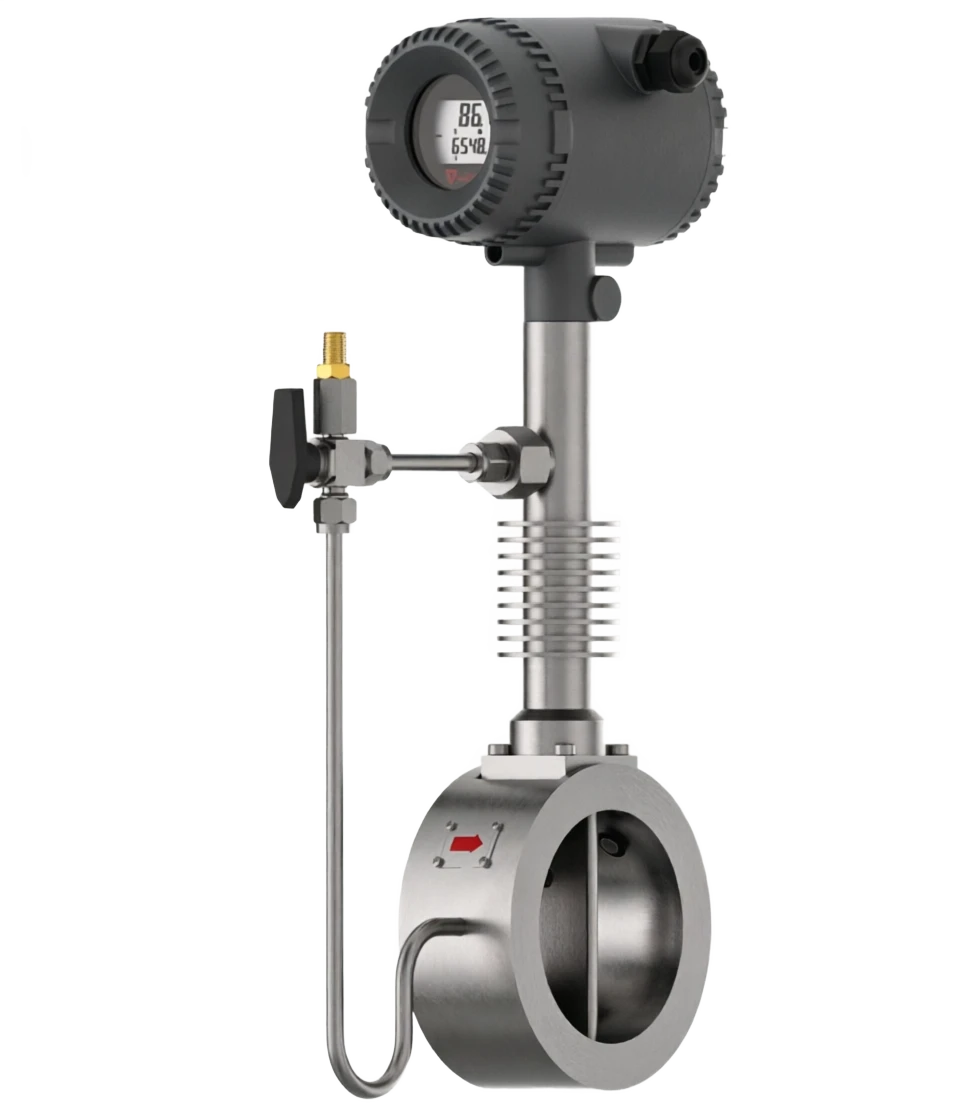
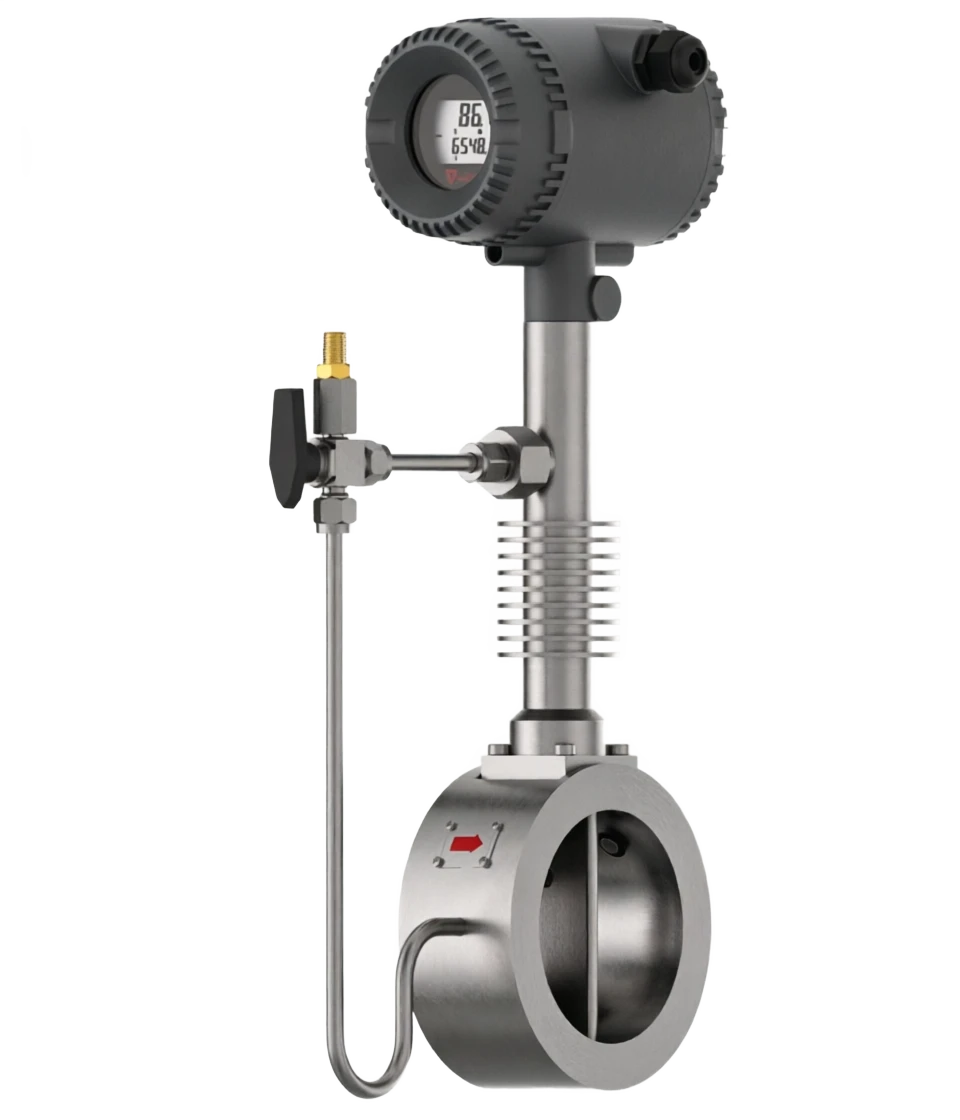
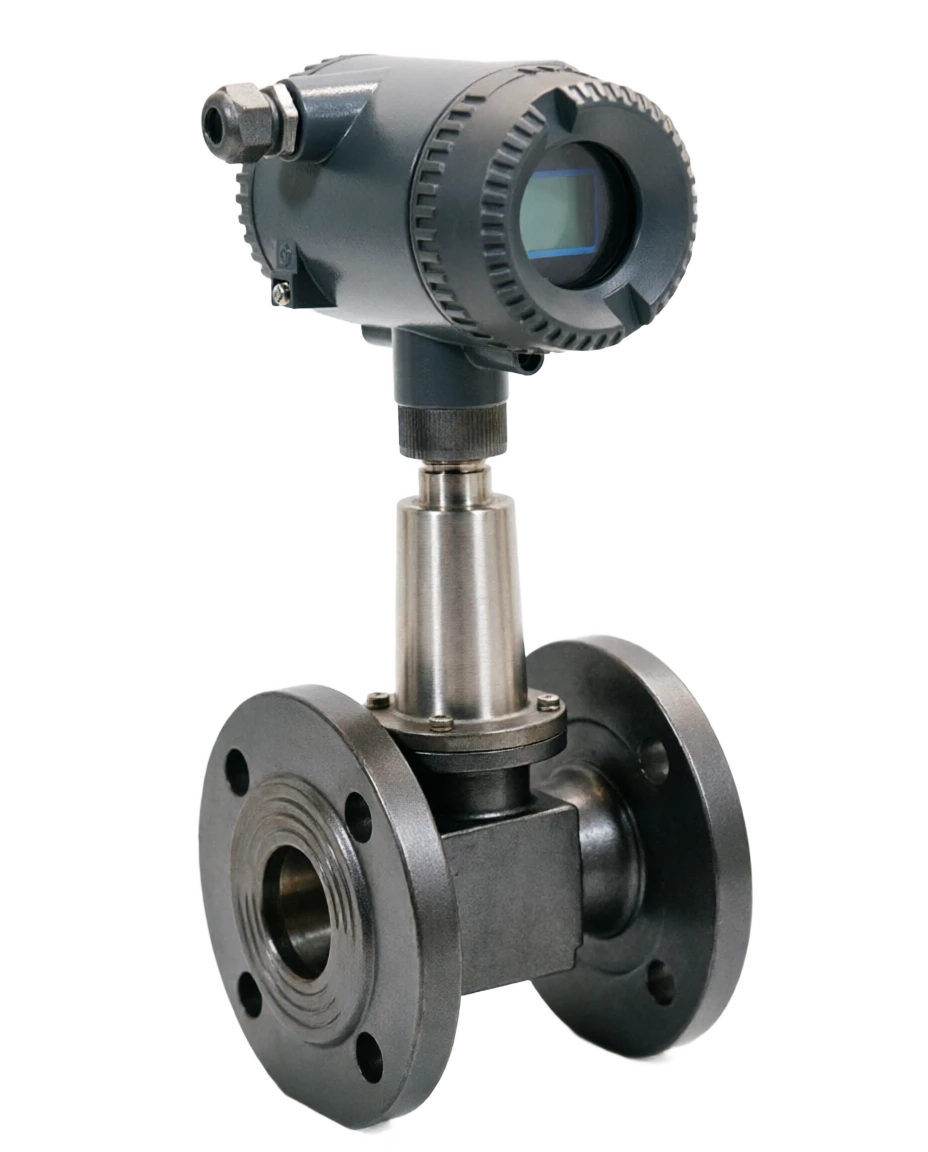
Vortex flowmeter

Operating principle

Turbo-Turk-Truck-Clow Count.

The core mechanism is "Fluid column around which Carmen Turbo Street is generated, with the vortex defusing frequency proportional to the flow speed" and the back end is calculated as volume or mass flow through the vortex detector and the temperature compensation channel. The following are presented in six angles. When fluids circulate around non-flowing columns (e.g., cylinders, rectangles, triangles), they form a vortex that alternately falls on both sides of the column, with a regular "turb street" followed by a systematic study by Theodore von Carmen, an American aerodynamicist of Hungarian origin, and are therefore known as "Carmon Turb Street". vortex deflation frequency f and flow speed v content relationship pattern: f = St x v/ d, where d is column-to-face width, St is Strouhal

  1. 01

    17~0.20. So keep the K coefficient (pulse equivalent) high linear within the stabilization of the Renault number, which forms the physical basis for the vortex flow accuracy.

  2. 02

    14~0.16; II, column width d, relationship with pipe inner D d / m shall meet 0.15~0.3, too small vortex signals weak and too large

Turbo Street flow menu support

Provide survey missions, media and installation conditions and obtain product configuration advice.

Contact us
Turbo Street Flow Count

TECHNOLOGY & APPLICATION

Understand the principles, the exact selection.

From measurement principles to field applications, the technical features and selection features of the turbo-flow meter are understood.

01

TECHNICAL GUIDE

Overview

It is a speed flowometer based on the "Flow-to-Flow-Ray" ratio of Carmen Turbo Street, which is calculated by means of a rotational vortex frequency that is alternately defunct when the fluids are detected to be bypassing the non-flow-lined column. It is located in the flow meter family in the "Carmen Turbo Street" with the Aoxin (69), gas turbine (68), hole plate (discretionary pressure), mass flow meters (Corioli), ultrasound parallels of six main flow meters, which, with the three main characteristics of "no active items + width + wide application medium" captures the median market share of vapour measures, industrial gases, liquid measurements. Its core advantage is that there are no moving parts in the table, which is therefore highly reliable, low maintenance, and adapted to the dirty and corrosive medium; Its core constraint is Vibration Sensitive - the vortex is a weak fluid force that is highly susceptible to mechanical vibrations, and steam pipe circuit vibrations are the most common source of malfunctions on the ground. Typical application areas: steam trade measurement (saturation and overheated vapour, industry ' s first largest application), industrial gases (compressed air, nitrogen gas, gas, flue gas), liquids (cycle water, light oil, chemical liquids)

. This paper summarizes the working principles, product structure, strengths and weaknesses, areas of application, technical parameters, selection tables and selection guides.

02

MEASUREMENT PRINCIPLE

Operating principle

The core mechanism is "Flower column around which Carmen Turbo Street is generated, with the vortex dropping in a positive proportion of the speed of flow" and the back end is calculated as volume or mass flow through the vortex detector and the temperature compensation channel. The following is a six-dimensional sequence.

2.1 Carmen Turbo Street Foundation: Strawhar Numbers St.

When fluids circulate around non-flowing columns (e.g., cylinders, rectangles, triangles), they form a vortex that alternately falls on both sides of the column, with a regular "turb street" followed by a systematic study by Theodore von Carmen, an American aerodynamicist of Hungarian origin, and are therefore known as "Carmon Turb Street". F vortex deflation frequency f v content relationship: f = St x v/ d, where d is column-to-column width, St is Strouhal Number, almost constant within a given Renault number (typically)

  1. 01

    17~0.20. So keep the K coefficient (pulse equivalent) high linear within the stabilization of the Renault number, which forms the physical basis for the vortex flow accuracy.

This constant is the source of the better-than-pressive flow meters of the vortex, which relies on the K coefficient for the aoxen and the perforation plates, while the vortex depends on the St constant.

2.2 Geometric design of vortex generators

The geometry of the vortex generator is the precise lifeline of Turt Street.

First, the column shape affects St Stability - rectangular column St is the most stable (0.17 ~0.18), cylinder St is slightly higher (0.20 ~0.21), triangle column / ladder column is different from fluid separation by pressure loss, St

  1. 01

    14~0.16; II, column width d, relationship with pipe inner D d / m shall meet 0.15~0.3, too small vortex signals weak and too large

(a) Pressure high; Three, the column shall be kept open on both sides of the column, symmetrically and without a condensation, ensuring parity in the vortex on both sides; Four, the column thickness ratio (onward) ensures that the vortex is stable from the downstream and does not form a secondary vortex interference from the downstream. Modern vortex is mostly a "dread column" or "dual-column" structure, balancing signal strength with budget erosion.

2.3 Spirulse detection principles: voltage, reaction, capacitation, ultrasound

The vortex drops with a pressure pulse from both sides of the column, and the column itself is subject to a shift-to-variate lifting, which is detected in five ways: first, voltage - the electrocrystals embedded in the column, the pressure telecommunications code generated by the upward change, most commonly used and highly sensitive; Second, retrofit - the retrofitting of the mutation in the column, which produces the signal of the retroactivity; Third, electric-capable - the placement of a conceiving sensor in a lower column or in a test body position, which is suitable for gas due to changes in the condensity of the fluid; Fourth, thermal sensitivity - the temperature pulse detection frequency from the vortex, suitable for clean gases; Its five, ultrasound - the sound wave/ ultrasound change detection by the vortex, anti-dirty, non-contact media, is a new generation of direction. Main industrial vortex traffic is dominated by voltage, owing to strong signals, high resistance to interference and wide temperature ranges.

2.4 Flow formulae and K coefficient

The frequency of Turbo Street - traffic should be followed.

Q = f / K, of which Q is the volume flow of work, f the frequency of loss of vortex, and K the flow factor (in: pulse/ m³ or Hz/ m³). The physical nature of the K coefficient is the combination of St and column geometry: K = 1 / (Stxd x A), where A is the pipeline area. Modern vortex flow meters usually rate K coefficients with "standard scale matching" or "mass time method" before leaving the plant, with precision up to 1.0 ~ 1.5. For gas or vapour media, the density of the work condition varies with the pressure temperature and therefore must be compensated with the temperature: the pressure/temperature transporter is connected by the surface and is calculated by the state equation in the carrier or DCS; Vapour trade measures must be accompanied by a trade computer (based on a IAPWS-IF97 or ASME water vapour table).

2.5 Application of the Renault number

The "St constant" feature of Turbo Street is only established when the current is fully developed, when the Renault number is below the threshold (typical Re) <10⁴ ~2×10⁴ ) the vortex drops irregularly, St. drift, K coefficient deviates from the nominal value; When the number of Renaults is above the upper limit (Re) > 10 The following is a list of the most important features of the project: The number of renords given by the manufacturer is typically: Re = 2×10⁴ ~7×10. Practical engineering: First, low Renault numbers (high sticky liquids such as heavy oil, syrup) are not applicable to Turbo Street; Second, the lower range of the range is subject to the Renault number, which is rapidly decreasing below a certain current speed gauge accuracy; Third, the manufacturer usually gives "minimum detectable flow speed" as a project floor indicator. For high-composite liquids, the "low Renault number specialty" type of vortex flow is to be selected or replaced by a volume/Corioli mass flow measure.

2.6 Vibration sensitivity and resistance design

The most common source of malfunctions in the field is the sensitivity of the mechanical vibrations.

Vapour tube roads are often accompanied by strong mechanical vibrations (from steam pressure reduction, hammers, compressors, pipe heat expansion), which are not associated with current speed, but the detector is unable to distinguish "vortex signals vs mechanical vibration signals", which cause a severe reading jump or complete distortion. (a) The anti-vibration design has four pathways: first, the surface of the table is accompanied by a buffer or deviation support; Second, the surface is designed to be "bi-generous + differential detection" (two-column signal differential offset commo vibration); Third, the algorithmic level of "vibration filter" (digital signal processing to recognize vibrating on vortex vs. Four, selected by the manufacturer's "Vibration Resistor" product line (e.g., the Trans-Wide DY Vibration Resilient). When the steam pipe circuit street is selected, vibration is the primary constraint, not the precision, of design.

03

PRODUCT STRUCTURE

Product structure

The five components consisting of the surface component, the vortex component, the vortex detection component, the converter component, and the accompanying temperature compensation module are essentially velocity flow measurement systems for "no active agent fluid disturbance + micro-sign detection + intelligent transformation". This section is structured as "one component + two instrument + process attachment" on a three-layer structure.

3.1 3-layer structure overview

3.2 Four main genres of vortex occurrence

One Widget

Widget: Form function: Fluid channel + Installation interface Key points: Frank / hold / pair of three; material 304SS / 316SS / dual-skin steel; caliber DN15 ~ DN300

One Widget

Component: Turbo occurrence function: Generating stable Carmen Turb Street Key points: ladder column / rectangular column / cylinder; St. stability determines accuracy; column width d matches pipe path

One Widget

Component: Turbodetectors Function: Detection of vortex drop signals Key points: voltage / response / capacitation / heat sensitivity / ultrasound; voltage is mainstream; temperature-resistant -40 ~ +400℃

Secondary instrument

Component: Converter function: signal magnification integer + smart algorithm Key elements: One / Parte; 4~20mA + HART; pulse output; menu grouping

Secondary instrument

Component: Pressure / Temperature Transmitters function: Temperature Compensation Signal Source Key points: Pressure accuracy 0.1%; Pt100 Thermal Resistance; Vapour Pressed IAPWS-IF97

Secondary instrument

Component: Flow Accumulation / DCS Card Function: Frequency + Temperature ⁇ Flow Ealysing Key Elements: Time + Cumulative; Vapour Trade by IAPWS-IF97; Gas by AGA-8

Process Annex

Front direct tube / resonance support, flow management + vibration isolation, 15D~25D / post-table 5D; steam pipe deviation support; front-table filter (dirty pollution medium)

Process Annex

Refrigerated condensers (for steam) Separating high temperature vapour + balancing liquid column Vapour tube markers; different from condensed tanks with differential transmitters

Process Annex

Separators / Interceptors Separators Separators Obsistently Obsistently Observed Observes Pulse Corrosive Media Separators; Vapour / Pulse Site Detachors

Shape

ST Number Characteristics Typical Application

Rectangular column

0.17 ~0.18 St Most stable; medium signal intensity; medium pressure medium industrial gas mainstream programme

Cylinder

0.20~0.21 St stability; high signal intensity; slightly higher pressure damage; early vortex mainstream vapour measurement

Ladder column

0.14 ~0.16 St is low but stable; signal strength; pressure impairment is low; modern mainstream vapour / gas general

Triangular

0.14 ~0.18 St is affected by a high angle; pressure is lost; plant is underused; special occasions

Double / Multi-column

Combining St differential detection against vibration; downstream flow stabilization; high end commonly used Vibration-resistant vortex mainstream

04

TECHNICAL GUIDE

Advantages and disadvantages

The advantages of this make it broadly covered in the field of vapour measurement, industrial gas, and general measurement of liquids, but its vibration sensitivity and sensitivity to dirty pollution also constrain its application to some high vibration/high-dirty pollution scenes.

4.1 Advantages: inactive + Quantification + Media Adaptation

No active messages

Specific advantages: Inert mechanical parts in the table Typical indicator / Engineering value: high reliability; long-term operating stability; low maintenance; life of more than 10 years

Scale Range

Specific advantages: 10:1~20:1 Quantities Ratio Typical Indicator / Engineering Value: Cover steam traffic and small flow peaks; multiple meters are not required and linked

Media Adaptation

Specific advantages: Gas, liquid, steam phase commons Typical indicators / Engineering value: one table detectable multimedia (different); multi-shop generics; reduction of spare parts type

Pressure is on.

Specific advantages: 1/3~1/2, far below the perforation plate Typical indicator / Engineering value: acceptable long-duration steam; energy efficiency for long-range tube grids

Output is flexible

Specific advantages: Pulse + 4 ~ 20mA + HART Trimony Typical Indicator / Project Value: Old DCS Pulse Count; New DCS 4 ~ 20mA + HART; Trade Computer Access

Precision

Specific Advantages: 1.0 ~ 1.5 Class Typical Indicator / Project Value: Trade Measurement Level; Less Than Turbo (0.5 Level); but only 60% ~80% price

Install friendly

Specific advantages: holding / Frank multiple interfaces; small size; light weight typical indicator / engineering value: retrofit friendly; DN300+ non-lifting equipment

Disadvantages and use restrictions

Vibration sensitivity.

Specific deficiencies: direct damage readings by mechanical vibration; especially steam pipe roads; engineering response: additional and defibration support; additional buffers; selection of antivibration forms; avoidance of pump / compressor exit

Scrub sensitivity.

Specific deficiencies: Obsolete surface of the column altered by viscosity; Decoration detection element tested Engineering response: 100-face filters; regular maintenance; ultrasound anti-fouling design

4.2 Disadvantages: Vibration sensitivity + Smuggle sensitivity + Low flow insemination

Low-flow speed is insinuated.

St-Landscape Unstable; K coefficient drifting calibration by Renault Lower Quantities; Low Flow / Aoxaba

High sticky liquids

Renodes deviate from the full-development zone of the current; vortex disengages, irregularity, high-composite liquids switching to the Corioli mass flow meter.

A strong pulse source.

Compressor / export to repump not permitted; buffer tank front; avoid pulse sources

Small caliber

DN15 Processing and precision limits DN15 Retrovolt turbines / Turbo Street mini-specialized machines; ultra-small caliber float flow meters

Trade-level precision

Less than the turbine 0.5 class; the steam trade settlement is disputed Measurement accuracy requires 0.5 to change turbines; process monitoring 1.0 ~ 1.5 turbo street is sufficient

05

APPLICATIONS

Application area

The application diagrams are organized around the three main lines of "Voam + Industrial Gas + General Liquids", and are presented below in five sectors, each with a typical scene and selection of the main features.

5.1 Industry Maps: Five Typical Scenarios

5.2 Horizontal comparison with other family flow meters

The principle of the Carmen Turbo Street differential (more than a half) pulse (leave wheel)

Typical industry of very low, very low, low and very low-dirty, low-pretty high- and low-prevalence (lined) high-level DN15 ~ DN300DN15 ~ DN600DN15 ~ DN3000DN10 ~ DN300

Precision.

Level 1.0 ~ 1.5 10

1~20:1

0.5 ~ 1.5 Level 10

1~25:1

0.5 ~ 1.5 Level 10

1~40:1

0.3 ~ 0.5 class 10

1~100:1

0.2 ~ 0.5 class 10

1~50:1

Media requirements Vibration sensitivity

Gas/liquid/vapour high

Low gas/liquid/vapour

Clean gas.

Low electrical fluids

Liquids, slurry, gas, low

Vapour trade measurement

Typical work condition of medium: saturated vapour / overheated steam DN50 ~ DN300 (b) Elements of the selection: The temperature compensation must be provided; Trade computers are based on IAPWS-IF97; (b) Deviation support; 1.0 Level (b) Choices with other family flow meters: preferred; The Avespa is selected at a large calibre; Turbo, wheel is high-precision, but not steam.

Industrial Gas Master

Typical medium condition: compressed air / nitrogen DN50 ~ DN250 Selected elements: DN50~DN200 mainstream; (a) Accuracy 1.0 ~ 1.5; (b) The temperature compensation; HART Protocol (b) Choices with other family flow meters: preferred; Turbos are selected at small calibres; Ox, Ba'al is in the main pipe.

Fung/ Emission

Typical work profile of media: low dust-containing fume DN100~DN300 Selectorial elements: anti-dirty type; ultrasound option; temperature compensation; trade-offs with other family flow meters: first (quantity range + anti-dirty); A oxin is selected in DN500+

Cirque Water / Cool Water

Typical work profile of the medium: Water PN80~DN300 Select element: impurity-containing filtering; accuracy 1.5; cost-sensitive trade-offs with other family flow meters: preferred; electromagnetic flowmeters in conductivity fluids

Chemical liquid measurement

Typical medium condition: light oil / acid alkali solution DN50~DN200 Selective elements: selection of materials by medium of corrosive material; 316SS / Double-Size / PTFE inner lining; Separator Configuration (b) Choices with other family flow meters: preferred; Mass flow count selected at high precision ratio

Comparative

Typical work in media: Turbo Street. Selector: Aoxen and other family flow meters. Gas turbines, electromagnetic mass (Corioli)

Rationale

Type: differential pressure (over a few points) and other family flow meters: pulse (leave wheel) Faraday electromagnetic induction

Precision

Typical work profile of the medium: 1.0 ~ 1.5 Type of selection: 0.5 ~ 1.5 The trade-off with other family flow meters: 0.5 ~ 1.5 Level 0.3 ~ 0.5 Level 0.2 ~ 0.5 Level

Turndown ratio

Typical work profile of the medium: 10 : 1 ~ 20 : 1 Elements of a selection: 10 : 1 ~ 25 : 1 The trade-off with other family flow meters: 10 : 1 ~ 40 : 1 10 : 1 ~ 100 : 1 10 : 1 ~ 50 : 1

Pressure

Typical work profile of the medium: medium (poreboards 1/3 ~1/2) Selectorial elements: very low trade-offs with other family flow meters: low, very low, high

Media Requirements

Typical work in media: Gas / Liquid / Vapour Elements: Gas / Liquid / Vapours and other family flow meters

Vibration sensitivity.

Model work profile of the medium: high selection point: low trade-off with other family flow meters: medium, low

Scrub sensitivity.

Typical work profile of the medium: high selection point: middle trade-off with other family flow meters: high, low (liner protection) low

Typical caliber

Typical work profile of media: DN15~DN300 Selector: DN100~DN3000+ trade-offs with other family flow indices: DN15~DN600 –DN15 ~DN3000 ~DN10~DN300

Typical industries

Typical work profile of the medium: steam / industrial gas / general liquids

06

TECHNICAL SPECIFICATIONS

Technical Parameter Table

Technical parameters table in four blocks

6.1 Generic specifications, 6.2 precision and range parameters, 6.3 meso-feasibility and materials, 6.4 output and blast protection. The calibre range is the primary parameter (direct box application scenario), medium temperature and pressure determine material, output and blast protection determine availability on site.

6.1 Generic Specifications

6.2 Precision and process parameters

6.3 Media applicability and materials

6.4 Output and blast prevention

  1. 01

    The selected table type is "caliber, medium, accuracy, temperature pressure, output, blast protection,

Paired with a “seven-stage progression

The caliber is determined by the flow range; the medium determines the temperature pressure and the material; the accuracy level is determined by the measurement nature (trade vs monitoring);

Temperature pressure determines the material and the high temperature selection type; output is matched by the field system; blast protection and protection is determined by the installation site; and accompanying attachments (deflection, filtering, condensers, separators) are determined by the medium and condition.

7.1 Table of nine-part selection

7.2 Typical selection examples

  1. 01

    Selection Guide

The selection is based on "Method Quantum Accounting Accuracy Matches ⁇ Anti-Insistence and Depression ⁇ Output Complement Project Accounting" six-step propulsion, with the core discipline that vibration assessment must precede all (severe steam pipe paths), Quantification calibration (common current speed 5-25 m/s box) and media suitability determines the mass and temperature type, and engineering packages (inventory, filter, condensation tank, separators) must be clearly accounted for before procurement.

8.1 Six-step selection

8.2 List of selected types of pits

8.3 Four-part acceptances

Summary

Turbo-story flow meters are medium price master meters covered by the three main lines of the flow meter family, "Voam + Industrial Gas + General Liquids", which, with the three advantages of "no active components + Quantification + Medium Adaptation to Wideness", account for a wide share of vapour measurement, industrial gas masters, and generic liquid measurements. Its core mechanism is "Camen Turb Street Flow + Straulal Number St constant + K coefficient calculation", and the key constraint is the simultaneous position of the three combinations of "Voice Assessment + Renault Lower + Dirty Control". The logic of trade-off with other family members: Vow street (wide range + price), high-calibre DN300+ steam (energy saving + resistance), industrial gas master block (general + median), high-facility Corioli mass flow count, 0.5-degree high-precision turbine. Four disciplines then emphasize that vibration assessment must precede everything (especially steam pipe roads); The range must be Renault, Re. ≥2 × 10 ⁴; The steam trade must be compensated with temperature + trade computer; The dirty medium must be 100-foot filter + regularly cleaned. Selective logic: First medium and vibration (vapour first but only required to resist), second Quantification (at the lower limit of the usual current rate of 5~25 m/s + Renault), third reading accuracy (trade vs monitoring decision level and compensation), fourth reading of vibration impairment (deviation support + anti-vibration table + buffer), fifth reading of output packages (pulse + 4~20mA + HART), sixth reading of engineering packages (direct tube segment + deviation + filter + condensation). The 70th series has been completed, and the flow meter family continues to be completed along the lines of electromagnetic, mass, ultrasound, V cones, wedges, etc.

Technical Table of Parameters · Parameter Item / General SpecificationsCross-reference
Parameter ItemGeneral SpecificationsAnnotations
Nominal pipe sizeDN15 / 25 / 40 / 50 / 65 / 80 / 100 / 150 / 200 / 250 / 300Cover steam and general industrial fluid mainstream
Nominal pressure1.6 / 2.5 / 4.0 / 6.3 / 10 / 16 / 25 / 40 MPaVapour pressure 10 MPa mainstream; special needs 25 MPa optional
Suitable mediaGases (vapour, air, nitrogen, gas, flue gas); liquids (cycle water, light oil, chemicals)x generic; dirty sludge filtered
Process medium temperature40°C ~ + 250°C (conventional); +250°C ~ + 400°C (high temperature vapour type)High temperature corresponds to thermal vapour measurements; ultra-low temperature is used for LNG gasification
Ambient temperature40°C ~ +70°C (General)The blast zone is limited by the appropriate level.
MountingFrank/ Grab/ Match/ Sniffholding most frequently; DN50+ multi-plugin
Install orientationHorizontal / Vertical (to open-ended)Vertical conduits need to select the corresponding direction; surfaces have an arrow flow
Parameter ItemGeneral SpecificationsAnnotations
Accuracy class1.0 Level (general trade); 1.5 Level (process monitoring)Mainstream manufacturer 1.0 level; trade settlement plus trade computer
Turndown ratio10:1 (general); 20:1 (extension)Vapour 20:1 Main; Liquid 10:1
Application of the Renault numberRe = 2×10⁴~7×10Spectacular fully developed; low Renault K drifting
Repeatability≤ 0.2% (typical); ≤ 0.1% (high end)Repeated indicators are at the core of precision stability
Pressure loss1/3~1/2 for the perforation plateOne scale lower than perforation; higher than a oxen
Flow factor KPlant identification (typical) 1 ~ 3 Hz/m³)Differentiate by caliber and medium; prohibition of on-site geometry
Response time0.1~1 secondsSlower than the turbine; faster than the oxen.
Start flow50% ~80% below the approximate rangeLow flow potential K drift
Parameter ItemGeneral SpecificationsAnnotations
Table material304SS / 316SS / Hapsy Alloy / Double-SkinCorrosive gases with dual-phase steel; conventionally with 316SS
The vortex is having a mass.316SS / Hapsy Alloy / Double-Skin / PTFE coatingSame as the surface; PTFE coatings are used for strong corrosive
Detecting the material of the componentvoltage ceramics / stainless steel shellsTemperature resistance 250°C; special voltage material for high temperature
Sealing gasketSoft graphite/ metal entanglement / PTFEHigh temperature metal entanglement; corrosive mediums PTFE
Process medium temperature40℃ ~ +400℃Spacing: Cold / Constant / Medium / High
Media PressureConstant pressure ~25 MPaVapour pressure 10 MPa mainstream; special 25 MPa
Technical parameter table · Material authentication / NACE MR0175 (acid environment)Cross-reference
Material authenticationNACE MR0175 (acid environment)The HS must be ready for the event.
Health certification3A / EHEDG (food medicine)Food and medicine for pure steam / craft water
Parameter ItemGeneral SpecificationsAnnotations
Pulse out5V TTL / 24V Pull / OC CCD DriveThe frequency is now comparable to the volume flow of work; the old DCS is collected by high-speed counting.
4~20mA outputCorresponds to instant flow (with HART protocol supersing)smart model matching;conventional options
HART ProtocolHART 6 / HART 7 Two-way CommunicationOrganisation / Diagnosis / Remote calibration; Thermic Transmitters are accessible via the HART gateway
Modbus ProtocolRS-485 Modbus RTU / TCPFlow Computer / RRU access
Field busFoundation Fieldbus / Profibus PAPIC preferences
LCD DisplaySwift traffic + cumulative flow + state + medium typesmart field readable; menu grouping
Explosion protection markingEx d IIB T4 / Ex d IIC T4 / Ex ia IIC T4By hazard zone on site and medium group
Ingress protectionIP65 (General); IP67 / IP68 (Outdoor)Outdoor and immersion upgrades
Technical Parameter Table . Bits / SelectionCross-reference
bitsSelectionBasis of judgement
1. Common diameterDN15 / 25 / 40 / 50 / 65 / 80 / 100 / 150 / 200 / 250 / 300Select by Flow Range + Common Flow Speed 5~25 m/s
2. Publicly called pressure1.6 / 2.5 / 4.0 / 6.3 / 10 / 16 / 25 / 40 MPaDesign pressure by pipe + safety factor
3. MediaVapour / air / nitrogen / gas / flue gas / circulation water / light oil / chemicalsThe medium determines temperature pressure and material
4. Media temperature40°C ~ + 250°C (conventional); +250°C ~ + 400°C (high temperature)High temperature steam is the heat steam.
5. Precision level1.0 / 1.5 / 2.5Trade settlement level 1.0; process monitoring level 1.0 ~1.5
6. Materials304SS / 316SS/ Double-Skin/ Hapsy Alloy / PTFE coatingBy medium corrosiveness + temperature + pressure
7. Output modePulse / 4~20mA / HART / Modbus / FF / ProfibusBy the receiving end system; old DCS pulse, new DCS 4~20mA + HART
8. Explosive-proof levelEx d IIB T4 / Ex d IIC T4 / Ex ia IIC T4Decision by hazard field and media group
9. Consisting annexesVibration support / buffer / filter / condenser / separator / blockerVapour pipe deviation; dirty sludge filter; steam condensed tank
Technical Parameter . scene / conditionCross-reference
sceneWorkSelect Configuration
Head Steam Manager, Power PlantOverheated vapour DN200, 540°C, 10 MPa, trade classNN200 / PN16 / 1.0 / 316SS High Temperature / Ex d IIC T4 / IP67 / Pulse + 4~20mA + HART / Trade Computer Press IAPWS-IF97 / Deviation Support + Buffer
Chemical saturated steam bronchiesSaturated steam DN 100, 184°C, 0.8 MPaNN100 / PN2.5 / 1.0 Level / 316SS / Ex d IIB T4 / IP65 / Pulse + HART / Temperature Compensation (External) / Dresilient / Deviation + Filter + Condensation tank
Compressed air masterCompressed air DN150, 0.7 MPa, oily and wateryNN150 / PN1.6 / 1.5 Class / 316SS / IP65 / Pulse + 4~20mA / Pre-foil with frozen dry + buffer tank blocker
Chemical plant circulatory water managerCirculation DN250, impurity, process monitoringDN250 / PN1.6 / 1.5 level / 316 SS / IP65 / Pulse + 4 ~ 20mA / with 100-Fig filter Y + devibration support
Chemical acid alkali liquid measurement20% Sodium hydroxide DN80, 60°C, constant pressurePN80 / PN1.6 / 1.0 Level / 316SS + PTFE internal liner / IP65 / HART / film-coated separator (combustion) + deviolation support
Technical parameter table · Step / DeterminantsCross-reference
StepsThe content of the judgementDecision-making rules
1. Media and vibrationType of medium, temperature, pressure, vibration?Vapour first vortex street but must be resistant; axoba/ ultrasound in a violent vibration; high-coriot liquid to Colloli
2. Metric accountingMax, minimal, usual, flow speed?Select the calibre by the usual current speed 5 ~ 25 m/s frame; The maximum / minimum flow covered by the range; Re ≥ 2×10⁴ is the lower limit
3. Precision matchingTrade measurement or process monitoring?Trade settlement: 1.0 + temperature compensation + trade computer; process monitoring: 1.0 ~ 1.5 + built-in compensation available
4. Resisting oscillationThe origin and strength of the vibration?Add defibration support + buffer; select an antivibration table (two-column differential); avoid pump / compressor exit
5. Output packagesWhat do the systems receive?Old DCS: Pulse + Speed Count; new DCS: 4~20mA + HART; trade computer: Pulse + Temperature Signal Synchronization
6. Project support accountingDirect sections, filters, temperature, attachments, can you match?15D~25D / 5D behind table; steam with condensers + deviation; dirty with 100-face filters; pressure / temperature transmitter accuracy above system requirements
PipepointTypical error zoneThe right way.
Vapour tube vibration not assessedDirectly installed after pressure-relief valve or hammer positionAdd defibration support + buffer; avoid pump / compressor exit; select an antivibration table
The range is too low.Common current speed < 5 m/s, low Renault number of lower rangeCalving at Renault; changing a small DN if necessary; very low current speed to turbine
Slurpable medium not filteredObsolete column changes St. properties, K driftingFront of the table 100 OC Y-type filters; regular cleaning; ultrasound anti-smuggling alternative
Temperature signal not answered.The steam is not compensated for by temperature, only by the volume of work.Temperature transmitters must be fitted before the steam trade; steam is calculated by IAPWS-IF97
Technical parameter table · Large calibre / Common flow speed below 3 m/s, low Renault number of lower rangeCross-reference
Large caliberCommon current speed below 3 m/s, low Renault in the lower rangeSelect by common current speed 5~25 m/s; consider lowering or joining a set when DN is large
Small caliberOver-pressure and increased running energy consumptionZoom in on one DN; pressurized accounting ultra-modified / ultrasound
Trade untraded machineVapour trade data are not accepted.Trade settlement required trade computers; calculated by IAPWS-IF97/ AGA-8
There's not enough direct sections.There's a bend valve in the 10D.Old plant retrofit and ductor; pre-table 20D for design
LinkThe point of acceptance.
1. Factories acceptanceK coefficient calibration certificate check; temperature compensation matching check; material documentation check; blast control certificate check
2. Installation of acceptances15D~25D straight-dippendency measurements; strong emitter support installation; cable shield and blastproof Glen seal; calibration of condensation tank horizontals
3. Receiving and inspection of shipmentsZero-flow floor stability; live measurements of vibration resistance; simultaneous access to temperature signals; trade unit area reserves aligned with design
4. Periodic reviewK coefficient review (each 1 to 2 years); column cleaning (by condition); inspection element inspection; management of trade certification validity